
Cover photo: Scott Graham / Unsplash.
Normalize the outcome and baseline
Compare AI SEO proposals by the work they will deliver, who will implement it and what evidence will demonstrate completion. Normalize the business goal before comparing activity counts or fees. A proposal to diagnose technical barriers is different from one that fixes them. A promise to monitor brand mentions is different from a plan to verify accurate recommendations and qualified enquiries. Until those differences are visible, the lowest price or longest deliverable list tells you little about fit.
Write a common buyer brief that every provider must answer. Define the offer, eligible customer, actual market, priority pages and meaningful business action. Describe known constraints, such as limited developer availability or missing conversion data. Include the uncertainty: you may not yet know whether the main obstacle is access, weak evidence, inaccurate business information or an unsuitable measurement panel. A good proposal explains how it will resolve that uncertainty before committing the whole budget to one tactic.
Use a concrete starting question. A hypothetical equipment supplier might want appropriate buyers to understand its maintenance capability when comparing providers. That is more useful than “improve AI visibility.” The brief should specify which services and locations are real, what information buyers need and what happens after an enquiry. Nothing in this example describes an audited vendor or measured client outcome. Its purpose is to make an abstract proposal comparable with an actual business decision.
Require the baseline to distinguish named mentions, linked citations, suitable recommendations and subsequent business actions. Ask which products or interfaces are measured and what conditions are recorded. A proposal that begins with a handful of flattering screenshots has not established a representative baseline. Screenshots can support specific observations; their selection and context determine what they mean. Request the underlying method rather than rejecting or accepting a case study solely because its headline looks impressive.
Finally, state the acceptance criteria for the engagement itself. The provider can commit to specified research, verified implementation, documented corrections and reporting. External platforms decide whether a page appears in a particular answer. A useful contract keeps those responsibilities understandable and ties payments or milestones to work that can be checked, while making the desired business outcome clear.
Compare implementation scope line by line
Translate each proposal into the same scope rows. Typical rows include technical eligibility, important service pages, business facts, supporting evidence, internal discovery, measurement and delivery verification. For every row, ask whether the provider investigates, recommends, implements or verifies. Those verbs are not interchangeable. A detailed audit can be valuable when you have a capable delivery team; it can also leave the project stalled when nobody has the capacity to turn recommendations into working changes.
Imagine two fictional proposals. Proposal A includes a diagnosis and recommendation document, with implementation assigned to the client. Proposal B includes a bounded implementation and post-change checks. Neither is automatically better. A team with a strong technical department may prefer specialist diagnosis, while an understaffed business may need execution. Compare the full dependency chain and the client's actual capacity rather than treating omitted delivery work as if it were free.
Content scope needs similar precision. “Ten optimized pages” could mean revising existing service descriptions, commissioning original evidence, producing supporting guides or creating near-duplicate keyword pages. Ask which reader decisions each page will answer, what existing URL owns that intent and what factual inputs are required. A page count is a production quantity, not proof of usefulness. The proposal should preserve successful pages and explain why each new destination deserves to exist.
For Google, the current generative AI optimization guidance does not require special AI schema or llms.txt for inclusion in its features. Use that documented limit when evaluating claims about mandatory proprietary markup. A provider may offer a useful structured information project, but it should explain the real consumer and benefit. A branded name for ordinary work does not make the work worthless; it does make the underlying deliverable worth inspecting.
Put exclusions beside the deliverable rather than at the back of the comparison. If the service excludes developer fixes, author interviews, source verification, CMS entry or image production, identify who will supply them. If a page cannot be published without those inputs, its delivery date depends on them. The normalized table below makes that hidden dependency visible before it becomes a dispute.
| Scope row | Question to resolve | Acceptable evidence |
|---|---|---|
| Technical findings | Who implements and checks the fix? | Affected URLs and delivered-response verification |
| Content and facts | Who validates offer boundaries and supporting claims? | Approved facts, sources and published content |
| AI observations | What prompts, conditions and denominators apply? | Recorded method and reproducible answer evidence |
| Reporting and enquiries | Which business actions are reconciled? | Event definitions, qualification rules and limitations |
| Exit and ownership | What usable records and assets remain? | Documented export and ownership terms |
Inspect the evidence and measurement design
Inspect the proposed evidence as carefully as the production plan. Ask the provider to show an anonymized example of how a consequential claim is checked, how an inaccurate brand description is classified and how a technical fix is verified after release. You need enough detail to understand the method, not confidential client records. A provider should be able to explain a process without inventing a customer story or asking you to accept a screenshot as universal proof.
For AI reporting, require a documented prompt panel and eligibility rules. Which buyer tasks, services and markets are represented? Are neutral discovery prompts separated from questions that already name the brand? How are errors, refusals and ambiguous recommendations handled? Are the same conditions repeated over time? These questions distinguish a usable observation process from a dashboard whose score changes whenever the operator changes the sample.
Read the case-study claim narrowly. A measured increase in mentions within one panel is not evidence of a corresponding increase in qualified leads. A citation gain may be relevant, but it does not establish that the cited page caused the gain or that every major product behaves the same way. Ask what changed, what was observed, how comparable the periods were and what other changes occurred. Clear limitations strengthen the usefulness of evidence because they identify the decisions it can actually support.
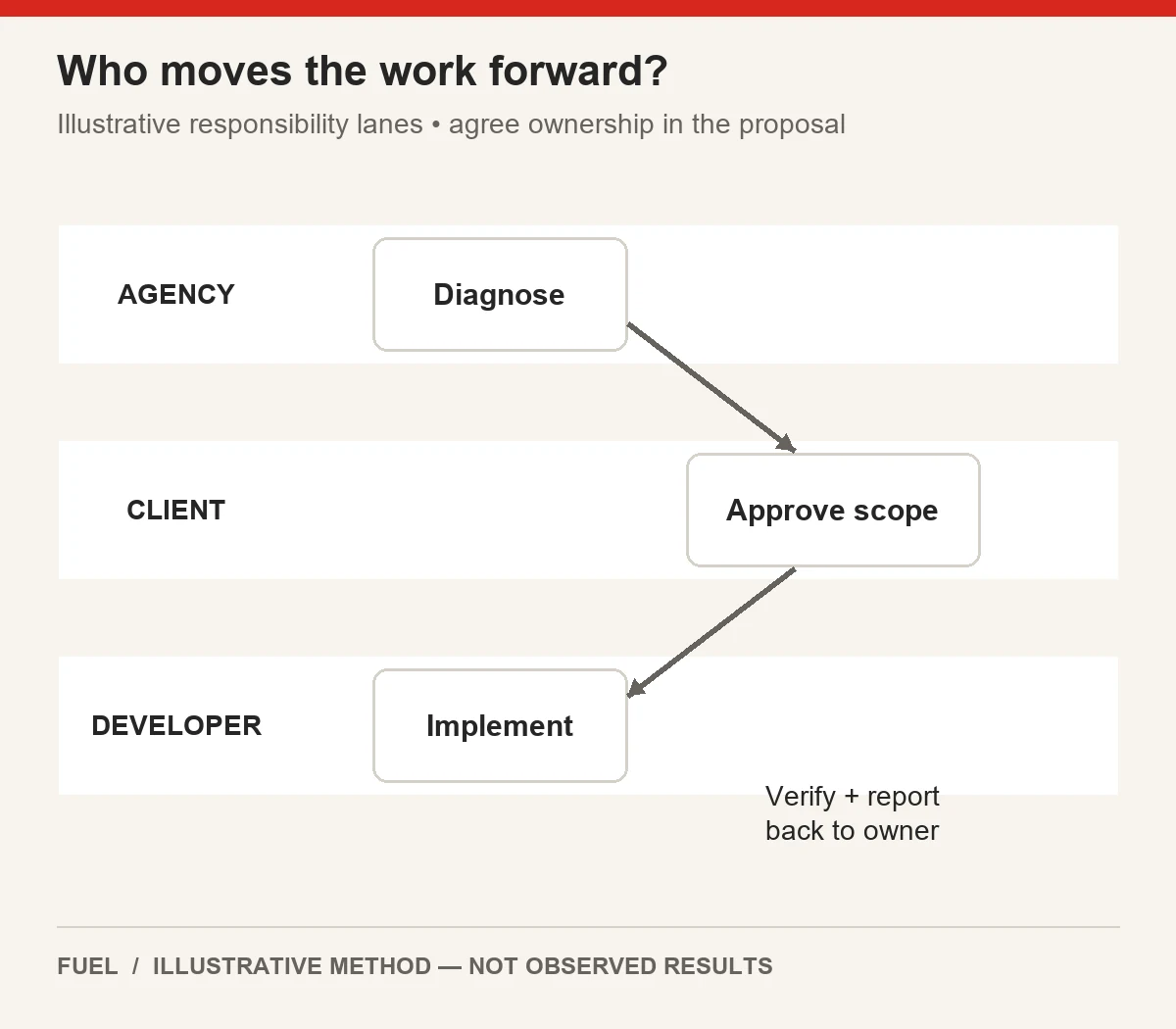
The responsibility diagram shows a common agency-client-developer chain. The agency may diagnose, the client may approve scope and the developer may implement. Verification needs its own named owner. Without that last handoff, the report can mark a task complete because someone merged a change even though the delivered production page still has the old setting. Require observation of the actual result wherever the scope claims implementation.
Be cautious about universal coverage promises. A provider should name the products, interfaces and markets it can observe, and explain which identifiers or settings may be unavailable. No proposal should convert a limited sample into a claim to know every user's AI answers. A practical provider can still deliver valuable work by maintaining a defensible sample, identifying consequential errors and improving the underlying assets with a clear audit trail.
Assign technical and editorial ownership
Assign one accountable owner to each deliverable while recording the people needed to complete it. Technical eligibility may involve the agency, your developer and the person controlling the hosting or security layer. Accurate service descriptions may require an internal subject-matter owner. Publishing may belong to a CMS editor. If those responsibilities are absent from the proposal, ask for a delivery map before deciding that the schedule is realistic.
Use an acceptance record containing the task, affected pages, required input, responsible owner, observable completion condition and evidence location. For a canonical correction, the evidence might include the delivered head markup and the affected URL list. For a revised service description, it should include verified offer facts and the actual published page. A recommendation document has different acceptance evidence from a deployed fix. Keep both legitimate forms of work explicit.
Business facts need an internal source of truth. A provider should not infer a new location, credential or service capability merely because a query looks commercially attractive. Identify who confirms the facts, how contradictory descriptions are resolved and what happens when information changes. This protects more than search visibility: it reduces the risk that a prospect receives an accurate-looking recommendation for an offer the company cannot fulfill.
Analytics access also needs a practical owner. Who defines the important action, tests the event and reconciles unsuitable or duplicate enquiries? Google's key-event and conversion terminology provides one reporting distinction, but your business still has to decide what qualifies as a useful enquiry. A proposal should say whether it configures measurement, checks an existing setup or merely consumes the available reports. Those scopes require different skills and time.
Plan for review delays without treating them as unlimited excuses. Agree which inputs must exist before a milestone begins and how unresolved questions are escalated. A weekly status can show completed work, blocked dependencies and the next decision without turning every meeting into a long presentation. The purpose of ownership is to keep the work moving and make the final result reviewable, not to create paperwork around an undefined engagement.
Understand commercial terms and exclusions
Read the commercial terms alongside the implementation map. Compare the actual included work, expected client effort, external costs and conditions for additional scope. Two identical retainers can buy very different delivery capacity. Conversely, a larger quoted amount may include work you do not need because your internal team already provides it. Without a common scope, a price comparison can reward the proposal that leaves the most important responsibilities unpriced.
Clarify what you retain at the end of the engagement: content, creative assets, source records, measurement definitions, access to relevant accounts and usable implementation documentation. Ask how information is exported if a proprietary dashboard is no longer available. The reporting interface may be convenient, but a business should be able to understand its own definitions and historical observations without relying on a sales call to interpret them.
Examine content and evidence rights. If the provider interviews staff, licenses media or uses third-party research, the agreement should describe the permitted use and any ongoing restrictions. Do not assume a polished sample proves that every asset is reusable indefinitely. Similarly, ask whether facts, prices and availability are rechecked when pages are refreshed. A page that was accurate at launch can become misleading when the business changes.
Set a bounded repair process. If a published page has an incorrect fact, broken action or implementation mismatch, who investigates and corrects it? What evidence shows the repair worked? Distinguish a defect in the agreed deliverable from a new request prompted by a change in strategy. That boundary helps both parties protect useful completed work while addressing actual failures promptly.
For ongoing measurement, confirm observation frequency, covered products and report retention. More frequent collection is not automatically better if it crowds out implementation or produces noisy comparisons the team cannot use. Match the reporting effort to the decisions you expect to make. A business fixing an inaccurate high-value service description may need a different cadence from one running a carefully bounded research panel across several markets.
Score fit using your constraints
Use a simple scorecard after you have normalized scope and checked minimum conditions. Choose criteria that reflect the actual bottleneck: implementation ability, evidence quality, appropriate measurement, relevant expertise and working fit with your team. Explain the weights as planning judgments. A weighted score can organize a discussion, but it does not transform incomplete information into an objective prediction of revenue.
Apply minimum requirements before averaging. If your main service page is technically inaccessible and a proposal excludes implementation, the proposal may fail your immediate need even if its presentations and reporting are strong. If a provider cannot explain how it verifies factual claims, a high score on output volume should not compensate. Some conditions are gates because their absence prevents the engagement from doing its job.
Then test whether the ranking depends on fragile assumptions. In a hypothetical comparison, one provider may look strongest only because you assumed your developer could complete extensive changes at no extra cost. Revisit the score with realistic internal effort. Another provider may be attractive only if an unverified case-study claim is treated as certain. Lower that confidence and inspect whether the choice changes. This sensitivity exercise exposes the decision you actually need to resolve.
Request clarification on the few uncertain items that could change the outcome. Ask for a sample acceptance record, a specific ownership amendment or a narrower initial scope rather than commissioning another entire pitch. A bounded first phase can be sensible when the limiting problem is still unknown, provided the outputs will be useful and the next decision is clear. Avoid a pilot that merely postpones the same unresolved measurement question.
If Fuel is among the options, compare the AI SEO package scope using the same table and evidence standards as every other proposal. Bring the business objective, known technical constraints and verified service facts. The useful conversation concerns what will be diagnosed, implemented and checked, with explicit limits on external outcomes. A provider comparison should make your choice more accountable rather than give any brand an exception from the criteria.
Questions that reveal an untestable promise
Several questions expose an untestable promise quickly. What exactly changes on the site or in the measurement process? Who has authority and capacity to make that change? Which artifact or observed behavior proves it is complete? What does the provider do when the expected answer does not appear? A proposal that cannot answer those questions may describe a desired outcome without specifying a workable service.
Ask what “guaranteed visibility” means operationally. If it means a fixed number of reports or observations, the promise may concern a controllable deliverable. If it means a particular external platform will recommend the business for all relevant requests, the provider needs to explain how it could control that decision. Do not let the same phrase alternate between those meanings during the sale and the performance review.
Inclusion settings are another useful specificity check. Google's generative AI control concerns its covered Search features and can involve inherited property settings. A credible proposal identifies the setting it will inspect rather than promising to turn on AI visibility across every provider. Your organization should understand the effect before changing any inclusion or training preference. The engagement must respect the actual authorized decision.
Choose the proposal that gives you the clearest path from your constraint to a useful, verifiable result. Keep the assumptions, exclusions and acceptance criteria with the decision record. That foundation makes it easier to evaluate the engagement later: you can compare completed work with agreed scope, examine observed outcomes honestly and decide what to improve without arguing over what the original promises meant.