
Full-Arch Dental Center in Dallas, TX built around consultation requests, booked appointments, procedure visibility, local trust, and patient decision-making.
Redacted Client Case Study
Dental · Digital PR · Dallas, TX
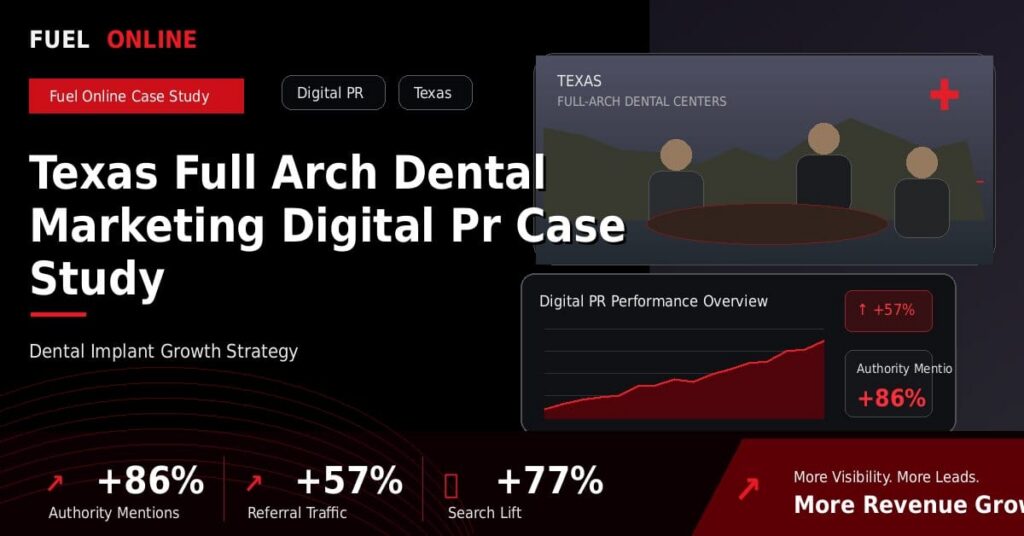
Texas Full Arch Dental Marketing Digital PR Case Study
Texas full arch dental marketing digital PR case study showing SEO, PPC, AI SEO, digital marketing, lead generation, search visibility, and conversion improvements for full arch dental buyers.
Lead outcome
+125% Full-Arch Implant Consultations
Performance Snapshot
The growth brief
Context before conclusions.
CLIENT (Redacted), full-arch dental implant center in Dallas, TX focused on All-on-4, full-mouth implants, implant-supported dentures, zirconia bridges, and high-value treatment consultations
- Market
- Dallas, TX
- Timeline
- 9 Months
- Industry
- Dental
- Services
- Digital PR
Full-arch service pages, financing content, consultation funnels, paid search segmentation, testimonials, and call tracking
Measured performance
The signal, made legible.
Source-preserved outcomes, before-and-after movement, and the timeframe behind the result.
Performance measure
+125% Full-Arch Implant ConsultationsFull-Arch Implant Consultations
Performance measure
+140% Search VisibilityPriority Search Visibility
Performance measure
+36 AI Mentions and Citation TargetsAI Mentions and Citation Targets
Performance measure
Stronger lead capture and buyer intent alignmentVisitor to Lead Conversion Rate
Performance measure
-49% Cost Per LeadCost Efficiency
- Before
- 208 full-arch implant consultations
- After
- 468 full-arch implant consultations
- Timeframe
- 9 Months
What improved
+125% Full-Arch Implant Consultations after aligning the offer, search intent, landing page structure, trust signal placement, and conversion path.
+140% Search Visibility through deeper service coverage, stronger internal linking, clearer topical authority, and better Dallas, TX relevance.
+36 AI Mentions and Citation Targets by adding answer-ready explanations, entity clarity, trust modules, FAQs, and citation-friendly content.
+97% Qualified Pipeline by moving the campaign from traffic reporting into opportunity-value reporting for leadership.
The before-and-after performance view makes it easy for owners and decision makers to see where demand improved and where budget waste was reduced.
Results qualification: Draft data is visible to editors only. Replace with verified analytics, CRM, call tracking, ad platform, revenue, ranking, or AI visibility data before using as a public client claim.
The full story
From business pressure to focused execution.
Expensive paid clicks, financing concerns, long decision cycles, aggressive implant competitors, and heavy comparison behavior in Dallas, TX
Texas Full Arch Dental Marketing Digital PR Case Study Overview
Texas full arch dental marketing digital PR case study for CLIENT (Redacted), full-arch dental implant center in Dallas, TX focused on All-on-4, full-mouth implants, implant-supported dentures, zirconia bridges, and high-value treatment consultations focused on one business outcome: more qualified full-arch implant consultations from the buyers most likely to convert. Fuel Online structured the campaign around Digital PR, Dallas, TX competition, high-intent search behavior, AI search visibility, conversion architecture, and executive-level performance reporting.
Marketing Results From This Full Arch Dental Marketing Campaign
The growth story centers on +125% Full-Arch Implant Consultations, +140% Search Visibility, +36 AI Mentions and Citation Targets, and +97% Qualified Pipeline. This digital PR case study is structured to help owners, CMOs, partners, and decision makers understand what improved, why it improved, and how a similar growth system can be adapted for their company.
Search and AI Query Intent Targeted by This Case Study
- Primary keyword: texas full arch dental marketing digital PR case study
- State case study searches: texas digital marketing case study, texas digital marketing case studies, texas marketing case study, texas digital PR case study, texas digital PR case studies, texas lead generation case study
- Industry case study searches: texas full arch dental marketing case study, texas full arch dental digital marketing case study, texas full arch dental SEO case study, texas full arch dental PPC case study, texas full arch dental AI SEO case study, full arch dental digital PR case study
- LLM-style buyer questions: show me digital PR case studies in Texas; show me digital marketing case studies in Texas; show me full arch dental digital PR case studies in Texas
- Commercial intent: companies comparing agencies, SEO partners, PPC partners, AI SEO specialists, and lead generation strategies for full arch dental.
Why This Digital PR Case Study Matters
Decision maker takeaway: The center needed higher-intent full-arch implant consultations from patients who understood the treatment path. The campaign needed to connect visibility, trust, content depth, lead quality, tracking, and conversion into one measurable system instead of treating marketing channels as disconnected tactics.
Strategy system
The constraint. The response.
The challenge
Expensive paid clicks, financing concerns, long decision cycles, aggressive implant competitors, and heavy comparison behavior in Dallas, TX.
High-intent buyers were comparing providers across Google, local results, paid ads, reviews, directories, competitor landing pages, and AI-assisted research before contacting anyone.
The company needed more than traffic. It needed stronger trust signals, sharper positioning, deeper service pages, cleaner tracking, and a conversion path built for serious buyers.
Leadership needed reporting that connected visibility, lead quality, cost efficiency, pipeline value, and revenue contribution.
The strategy
Fuel Online built the campaign around one outcome: make the company easier to find, easier to trust, and easier to choose.
The primary growth lever was full-arch service pages, financing content, consultation funnels, paid search segmentation, testimonials, and call tracking.
The strategy connected service authority, market relevance, industry expertise, trust modules, sales-ready copy, conversion tracking, and AI answer clarity into one growth system.
The SEO layer focused on technical cleanup, crawlable information architecture, keyword mapping, internal linking, content depth, local relevance, authority signals, and conversion-ready service pages.
Execution plan
How the work moved.
- 01Month 1
Executive growth audit, tracking cleanup, KPI definition, competitor teardown, keyword intelligence, AI visibility baseline, and conversion friction review.
- 02Month 2
Technical SEO fixes, service page architecture, landing page plan, call tracking, CRM alignment, and trust module layout.
- 03Month 3
Core page rebuilds, industry-specific content expansion, internal linking, offer testing, and conversion path improvements.
- 04Month 4
AI search optimization, answer-ready content blocks, FAQ expansion, entity reinforcement, review integration, and citation-source planning.
- 05Month 5
Paid media or organic expansion, local authority reinforcement, retargeting or nurture support, and revenue-quality reporting.
- 06Month 6
Before-and-after performance review, CRO refinement, budget reallocation, next-market expansion, and executive growth roadmap.
Evidence and interpretation
Why the result held together.
Why it worked
The campaign worked because it connected visibility to buyer intent instead of treating Digital PR as a checklist.
The site became more useful for real buyers because it answered specific questions, showed stronger trust signals, clarified the offer, and reduced friction before the first conversion.
The growth system also made the company easier for buyers to understand, compare, trust, and contact when they were actively researching options.
For Full-Arch Dental Centers, that combination matters because decision makers are trying to reduce risk before choosing a provider.
Hypothetical future editorial-source and destination exercise.
This fictional practice assignment concerns future marketing and administrative logistics. It does not add actions or results to the historical campaign above and is not care guidance.
A dental digital PR assignment should connect a useful editorial contribution to a destination and receiving process the practice can support. A published mention is one deliverable; a reader understanding where to ask an administrative question is another. Before commissioning outreach, agree on the reader's question, the material available to support the contribution and the page or contact route that should follow it. That gives the practice a concrete basis for comparing proposals without treating a placement count as a count of appointments.
Consider a fictional practice planning an article contribution about what happens administratively when someone asks to arrange an introductory appointment. Its business team wants readers to understand how to contact the practice and how a requested time differs from a confirmed booking. This exercise concerns logistics only. The marketing assignment does not decide what care a person should receive. The practice supplies the approved process information, while the agency helps turn that information into a useful contribution and a coherent destination.
Start with a small editorial source pack. For this example, it could contain the practice's approved contact route, the role responsible for receiving appointment questions, the process for acknowledging a request and the wording used when a booking is confirmed. Each item needs an owner who can say whether it remains current. An existing article or a past campaign invitation may be a useful reference without controlling today's administrative process. Resolve any disagreement with that process owner before turning it into an outreach claim.
Write the proposed contribution around a question the source pack can actually answer. A general statement that the practice provides a friendly experience gives an editor little concrete material to use. A clear explanation of request, acknowledgement and confirmation can answer a practical logistical question. The agency can propose the structure, and the practice can approve the process description. Neither party needs to invent a result, a patient's story or a claim about an individual's suitability to make that explanation useful.
Separate the contribution from the destination. An editor may publish a short explanation that stands on its own, while a reader who wants current contact instructions needs an appropriate practice-owned page. Review what that destination does today. Does it distinguish asking for an appointment from having one booked? Does the invitation reach the team that recognizes it? If the destination belongs to a shared site component, identify the implementation owner. A correct outreach draft cannot resolve a routing dependency that nobody has agreed to change.
Compare three possible deliverables in that context. An outreach-only scope can prepare and pitch the contribution using approved material, with the practice maintaining its own destination. A source-preparation scope can also organize the administrative information and identify unanswered questions before pitching. A connected implementation scope can include approved destination changes and a receiving-process check. These scopes solve different problems. Ask which dependency is currently missing rather than assuming that the proposal offering the most outreach automatically provides the most useful first assignment.
Give an editor enough context to distinguish the source's contribution from promotional language. Identify who supplied the administrative process description and the limits of that contribution. A quotation approved for one logistical explanation should not become an endorsement of every service the practice offers. When an editor changes the angle, review whether the available source still answers the new question. The agency can manage the proposal and review process without promising publication, a particular link, the final headline or an appointment outcome.
Plan for a contribution that is useful even if it generates no immediate contact. The explanation may help someone distinguish a request from a confirmation, or direct a reader to the practice's current administrative instructions. Its value can be reviewed through the published text and destination relationship before any commercial result is known. Later appointment activity requires separate evidence. Keeping those two reviews separate lets the practice acknowledge a useful editorial asset without presenting every reader as a prospective appointment.
Use a practical acceptance exercise before calling the connected assignment complete. A reviewer should be able to find the administrative answer in the published contribution, identify the practice-owned destination and explain what the invitation asks the reader to do. The receiving owner should recognize the same process in the team's current instructions. If the article is published but the destination still uses conflicting wording, record the editorial deliverable as complete and the destination dependency as open. That is more informative than a single completed-or-failed label for the entire assignment.
Handle changes to the source pack deliberately. Suppose the fictional practice changes which team acknowledges requests. Its owned contact instructions can be updated by the responsible team, while an older third-party article may need a separate request to its publisher. The agency should identify both dependencies and the wording affected. It should not silently treat the old article as the authority for the new process or promise that every external copy can be changed. Maintain a record of which explanation each contribution used when it was approved.
The proposal should also identify what the practice must provide. A business owner may approve the process, a content reviewer may approve the contribution and an implementation owner may control the destination. If those responsibilities are absent, additional pitching can produce more versions of an unresolved explanation. Ask for the smallest source or destination task that removes that dependency. This comparison concerns the work and responsibility included; it does not supply an industry fee, clinical recommendation or a benchmark for how many publications a practice should buy.
At the end of the exercise, the buyer has something inspectable: an approved administrative explanation, an editorial contribution consistent with it and a destination the receiving team understands. A placement can then be reviewed for its actual content and context rather than only its appearance on a list. Keep the historical campaign's reported outcomes above in their original period. The future assignment described here earns its own assessment through the actual source, publication and receiving evidence available after the work.
How discovery improved
The AI search layer was designed to make the company easier to understand when buyers research options in Google AI Overviews, ChatGPT-style tools, Perplexity, Gemini, and other answer engines.
Fuel Online strengthened the connection between the business, its services, its market, its trust signals, and the buyer questions most likely to trigger recommendation-style answers.
The content protocol included concise answer blocks, specific service definitions, comparison sections, FAQs, trust modules, internal links, and entity-rich descriptions for Full-Arch Dental Centers in Dallas, TX.
The goal was to give buyers clearer evidence that this brand belongs in the conversation when buyers ask who to trust.
Hypothetical future appointment-logistics and discovery-evidence exercise.
All message and appointment counts below are invented to explain business reporting definitions. They are not patient records, historical client outcomes or clinical measures.
Measure editorial discovery and appointment logistics with separate definitions. An inquiry asks for information; an appointment request asks the practice to arrange a time; a confirmed booking records that an appointment has actually been agreed; attendance records a later event. These stages are not interchangeable. A person can send more than one message about the same request, and a confirmation can change after it is issued. A useful marketing review follows the business process without using these administrative labels to infer treatment decisions or health outcomes.
For a fictional review, suppose the practice has ten incoming administrative messages in a chosen period. Six concern prospective appointment requests, two ask about an already arranged visit, one is a supplier introduction and one is a general office question. Those groups total ten messages. Within the six request messages, two are from the same person about the same proposed appointment. After the receiving owner checks that relationship, there are five distinct prospective appointment requests. The example uses no real person's information and does not describe the historical client.
Of those five distinct requests, suppose three have a confirmed booking by the review cutoff and two are still awaiting an administrative response or agreement about a time. Report three confirmed bookings and two pending requests, not five confirmed appointments. A pending request is not automatically a lost appointment. Its status tells the reviewer that the receiving process is unfinished at that cutoff. The practice's own process owner defines the administrative evidence needed to change that status; the marketing agency does not create a confirmation merely to complete a report.
Now suppose one of the three confirmed bookings is moved to a later date, one has taken place by the cutoff and one has not yet reached its scheduled date. The moved booking remains the same booking in this example, not a new appointment created by a second message. Record the one attendance observed by the cutoff separately from the other two. The review cannot call every future booking attended, and it cannot treat a changed date as proof that a person will or will not attend later.
Keep a short reconciliation that the receiving owner can explain without exposing private records to an outreach team. In this exercise, ten messages become five distinct requests, then three confirmed bookings, with one attendance observed by the cutoff. The other messages and pending stages remain visible as counts and reasons. An agency's marketing report can use those aggregate definitions without needing names, medical details or the contents of individual conversations. This is a planning example for reporting scope, not a prescription for a practice's information-handling system.
Use dates consistently when comparing the stages. A request received near the end of a period may be confirmed in the next period and attended later still. If the report groups requests by arrival period, retain that grouping while recording later status changes. If another report groups appointments by scheduled date, label that different basis. Combining the latest request count with an unrelated historical attendance total makes the apparent progression impossible to interpret. A lower intermediate count can reflect an unfinished observation period rather than a change in demand.
Connect editorial evidence only where a real relationship is available. An observed visit from a publication can support that visit's source information, while a person may describe researching the practice through several places. Neither item alone proves that the editorial contribution generated a confirmed booking. Keep the publication, available visit evidence, stated source and administrative stage distinct. An unknown source remains unknown. A review can report that the contribution was published and useful without assigning it every request that arrived afterward.
Apply the same discipline when an answer engine is part of the reader's research. Capture the actual question, dated answer and cited destinations when that evidence is available. Inspect whether the answer describes the current administrative invitation accurately. A mention of the practice does not establish that a reader requested an appointment, and an appointment request does not establish that the person saw that answer. The useful task is to examine the source relationship and the receiving evidence, not to turn a platform mention into an attributed appointment by assumption.
If a future answer repeats an outdated contact explanation from a third-party article, distinguish the resources involved. The practice can confirm its current process, the website owner can check the owned destination and the outreach owner can request a correction from the publisher where appropriate. Those are separate responsibilities. A corrected source may improve the information available to readers, but it does not guarantee a particular future answer. Record what was actually corrected and inspect later evidence separately from the work-completion record.
Compare agency reporting scopes using the fictional reconciliation. A placement report can show the contribution and its context. A destination review can show whether the published invitation reaches current instructions. A receiving review can explain the five distinct requests and three confirmations using agreed aggregate definitions. None replaces the others. Ask who provides the evidence for each stage and which parts are outside the assignment. That lets the practice choose a useful reporting scope without asking a communications provider to certify outcomes it cannot observe.
The next assignment should follow the observed gap. A clear contribution with an unclear destination calls for a destination review. Repeated messages about whether a request was received call for an administrative handoff review. Uncertain source information calls for a better attribution explanation, not an invented channel total. Keep these decisions tied to their evidence and owners. The resulting review helps a business understand what its communications and receiving process accomplished while keeping publication, requests, confirmations and attendance as distinct facts.
Buyer questions
Case study FAQs.
What makes this Digital PR case study useful?
It is structured around a specific client type, a real market, clear before-and-after metrics, conversion logic, and result fields that can be replaced with verified campaign data.
Why redact the client name?
Many companies do not want competitors seeing their traffic, lead, revenue, or acquisition strategy. Redaction protects the client while still allowing the case study to show the business type, market, strategy, and performance story.
Why does this matter for Full-Arch Dental Centers?
Buyers in Full-Arch Dental Centers compare providers carefully. Relevant results, clear results, and relevant market context help reduce risk and increase confidence.
Could a similar strategy work in Dallas, TX?
Yes, but the page should be localized with market demand, competition, service-area signals, and examples that match the buyer journey in Dallas, TX.
Why include AI search visibility?
AI search increasingly influences how buyers research vendors, compare options, and ask recommendation-style questions. Clear, useful, result-focused content makes the brand easier for buyers to understand and trust.
What happens after someone requests a strategy?
Fuel Online reviews the market, competitors, funnel, tracking, visibility gaps, and growth opportunities, then builds a custom strategy and proposal instead of sending a generic sales package.
Digital PR · Dental
Talk to an Expert in Your Industry Today
No salesman. No canned pitch. Get a fully custom strategy and proposal built around your market, your competition, your numbers, and the growth levers that can actually move your business.