
Commercial Construction Company in Texas built around quote requests, project inquiries, buyer education, cost comparison traffic, and vendor selection.
Redacted Client Case Study
Manufacturing · PPC · Texas
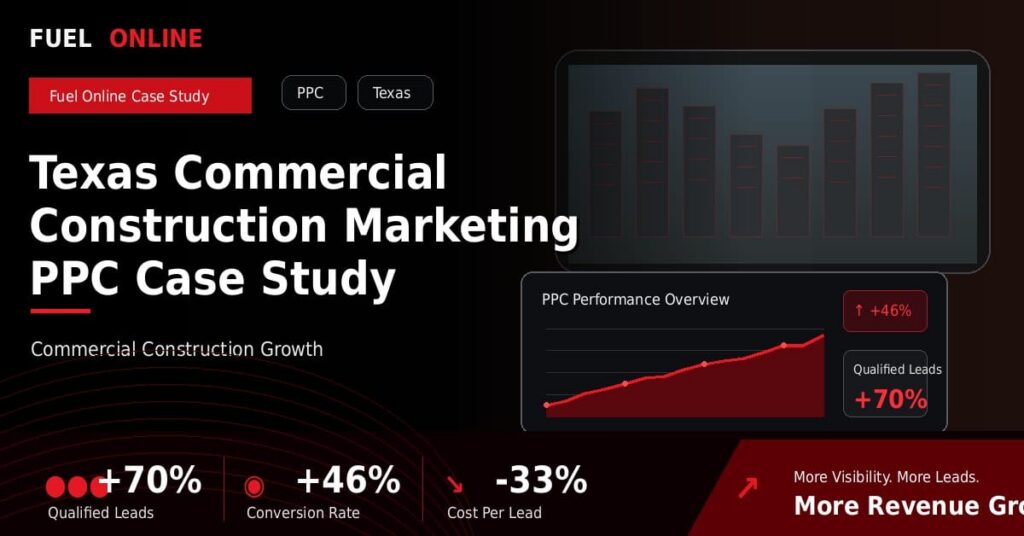
Texas Commercial Construction PPC Case Study
Texas commercial construction PPC case study showing SEO, PPC, AI SEO, digital marketing, lead generation, search visibility, and conversion improvements for commercial construction buyers.
Lead outcome
+193% Project Inquiries
Performance Snapshot
The growth brief
Context before conclusions.
CLIENT (Redacted), commercial construction company in Texas focused on design-build projects, tenant improvements, commercial buildouts, industrial construction, and bid opportunities
- Market
- Texas
- Timeline
- 6 Months
- Industry
- Manufacturing
- Services
- PPC
Project-type pages, portfolio strength, local SEO, proposal CTAs, and executive-level reporting
Measured performance
The signal, made legible.
Reported outcomes, before-and-after performance, and the campaign timeframe.
Performance measure
+193% Project InquiriesProject Inquiries
Performance measure
-46% Cost Per LeadPriority Search Visibility
Performance measure
+56 AI Mentions and Citation TargetsAI Mentions and Citation Targets
Performance measure
Stronger lead capture and buyer intent alignmentVisitor to Lead Conversion Rate
Performance measure
-46% Cost Per LeadCost Efficiency
- Before
- 47 project inquiries
- After
- 138 project inquiries
- Timeframe
- 6 Months
What improved
+193% Project Inquiries after aligning the offer, search intent, landing page structure, trust signal placement, and conversion path.
-46% Cost Per Lead through deeper service coverage, stronger internal linking, clearer topical authority, and better Texas relevance.
+56 AI Mentions and Citation Targets by adding answer-ready explanations, entity clarity, trust modules, FAQs, and citation-friendly content.
4.6x Pipeline Efficiency by moving the campaign from traffic reporting into opportunity-value reporting for leadership.
The before-and-after performance view makes it easy for owners and decision makers to see where demand improved and where budget waste was reduced.
Results qualification: Draft data is visible to editors only. Replace with verified analytics, CRM, call tracking, ad platform, revenue, ranking, or AI visibility data before using as a public client claim.
The full story
From business pressure to focused execution.
Referral-heavy sales, thin service pages, local competitors, and long project decision cycles in Texas
Texas Commercial Construction PPC Case Study Overview
Texas commercial construction PPC case study for CLIENT (Redacted), commercial construction company in Texas focused on design-build projects, tenant improvements, commercial buildouts, industrial construction, and bid opportunities focused on one business outcome: more qualified project inquiries from the buyers most likely to convert. Fuel Online structured the campaign around PPC, Texas competition, high-intent search behavior, AI search visibility, conversion architecture, and executive-level performance reporting.
Marketing Results From This Commercial Construction Marketing Campaign
The growth story centers on +193% Project Inquiries, -46% Cost Per Lead, +56 AI Mentions and Citation Targets, and 4.6x Pipeline Efficiency. This PPC case study is structured to help owners, CMOs, partners, and decision makers understand what improved, why it improved, and how a similar growth system can be adapted for their company.
Why This PPC Case Study Matters
Decision maker takeaway: The company needed digital credibility that supported larger project conversations. The campaign needed to connect visibility, trust, content depth, lead quality, tracking, and conversion into one measurable system instead of treating marketing channels as disconnected tactics.
Strategy system
The constraint. The response.
The challenge
Referral-heavy sales, thin service pages, local competitors, and long project decision cycles in Texas.
High-intent buyers were comparing providers across Google, local results, paid ads, reviews, directories, competitor landing pages, and AI-assisted research before contacting anyone.
The company needed more than traffic. It needed stronger trust signals, sharper positioning, deeper service pages, cleaner tracking, and a conversion path built for serious buyers.
Leadership needed reporting that connected visibility, lead quality, cost efficiency, pipeline value, and revenue contribution.
The strategy
Fuel Online built the campaign around one outcome: make the company easier to find, easier to trust, and easier to choose.
The primary growth lever was project-type pages, portfolio strength, local seo, proposal ctas, and executive-level reporting.
The strategy connected service authority, market relevance, industry expertise, trust modules, sales-ready copy, conversion tracking, and AI answer clarity into one growth system.
The PPC layer focused on intent segmentation, negative keyword discipline, landing page match, ad message testing, conversion tracking, call quality, and budget movement toward the campaigns producing the best opportunity value.
Execution plan
How the work moved.
- 01Month 1
Executive growth audit, tracking cleanup, KPI definition, competitor teardown, keyword intelligence, AI visibility baseline, and conversion friction review.
- 02Month 2
Technical SEO fixes, service page architecture, landing page plan, call tracking, CRM alignment, and trust module layout.
- 03Month 3
Core page rebuilds, industry-specific content expansion, internal linking, offer testing, and conversion path improvements.
- 04Month 4
AI search optimization, answer-ready content blocks, FAQ expansion, entity reinforcement, review integration, and citation-source planning.
- 05Month 5
Paid media or organic expansion, local authority reinforcement, retargeting or nurture support, and revenue-quality reporting.
- 06Month 6
Before-and-after performance review, CRO refinement, budget reallocation, next-market expansion, and executive growth roadmap.
Evidence and interpretation
Why the result held together.
Why it worked
The campaign worked because it connected visibility to buyer intent instead of treating PPC as a checklist.
The site became more useful for real buyers because it answered specific questions, showed stronger trust signals, clarified the offer, and reduced friction before the first conversion.
The growth system also made the company easier for buyers to understand, compare, trust, and contact when they were actively researching options.
For Commercial Construction, that combination matters because decision makers are trying to reduce risk before choosing a provider.
Hypothetical future paid-search project-inquiry exercise.
This fictional future assignment is separate from the historical campaign and its reported outcomes. It illustrates commercial marketing and receiving decisions, not additional work performed for the client above.
For a commercial construction paid-search assignment, agree on the project inquiry the business wants before buying more traffic. A completed contact form might concern a potential project, a job application, a subcontractor introduction or a vendor offer. These are different conversations even when they reach the same inbox. The campaign brief should connect the buyer's requested project type, the company's approved service area and the receiving team's next step. A higher contact count alone cannot show that those three things agree.
Consider a fictional construction business planning a campaign for tenant-improvement inquiries in an area it already serves. Its commercial owner has selected that offer for the exercise; this does not imply that every construction company offers it. The team also receives messages from people looking for work and firms offering materials or subcontracting services. The assignment is to make the project invitation clear while keeping those other business conversations identifiable. It is not a plan to label every unfamiliar sender as spam or discard legitimate nonbuyer correspondence.
Begin with an accepted-project definition the receiving team can apply. In this example, a potential customer is asking about a project type the company offers in its supported area, and the team has enough information to begin a relevant conversation. Acceptance does not mean that the project has been won, that a proposal has been issued or that its financial value is known. Record unresolved requests separately when the requested work or location still needs clarification. An agency should not quietly change this definition to improve a monthly report.
Compare three possible campaign destinations. A broad company page may explain the firm but leave the visitor to locate the relevant offer. A project-specific destination can connect the advertised service with examples and an appropriate inquiry route. A general contact page may be useful when the business deliberately wants several kinds of conversation, provided the receiving process distinguishes them. Choose the destination by tracing the intended request through it, rather than assuming that any page containing a contact form is equally ready for paid traffic.
For the fictional tenant-improvement assignment, give the landing-page reviewer a specific test: identify the offered work, identify the stated service area and explain what happens after an inquiry. Relevant existing project material can help a buyer understand the company's work without becoming a promise that every future project will resemble it. The commercial owner approves the offer and coverage wording. The agency maps that approved invitation to the campaign message. Neither a campaign launch nor an old project address establishes a new service commitment.
Then test the receiving route using an internally agreed example, without submitting fabricated public leads. The receiving owner should know where a project request arrives and how the requested service and location remain attached to it. If the message loses that context, the initial repair may concern the destination or internal handoff rather than additional advertising. A proposal should identify who can change that component. Copy approval is insufficient when the component responsible for routing still belongs to another team and remains unchanged.
Treat employment, subcontractor and vendor messages as separate intent groups during review. A request for a job should not count as a prospective construction project. A subcontractor introduction may be useful to another department without qualifying as a buyer inquiry. A materials offer likewise has its own purpose. The company can maintain appropriate routes for these conversations while assessing whether the paid campaign invited the wrong audience. This distinction supports useful routing; it does not authorize deleting correspondence or blocking access to public information.
Use actual query and receiving evidence together before proposing exclusions. A phrase that seems employment-related in isolation might have a different meaning in a longer request. Conversely, repeated job-seeking queries paired with employment messages can support a focused campaign review. The agency should show the evidence and proposed scope of a change, and the commercial owner should check that a genuine buyer use is not being removed. This exercise specifies the decision process, not a universal negative-keyword list or a claim about a particular advertising interface.
Define a release boundary that can be inspected. The first assignment might include one approved offer, its campaign-to-page message match, the receiving route and a classification worksheet. Expansion to another project type should be conditional on having its own accurate offer and a team prepared to receive those requests. A broader geographic label is not evidence that the company can accept work throughout it. Resolve coverage with the business owner instead of using the campaign's technical reach as the commercial coverage definition.
Ask competing agencies to price the same responsibility boundary. One proposal may manage traffic while leaving the destination and receiving review to the client. Another may include those components and a named implementation owner. Identify what each proposal requires from the commercial team and who maintains the classification rules after launch. This comparison is about included work and dependencies, not a standard agency fee or construction budget benchmark. Additional media spend should remain distinguishable from the work required to make the inquiry journey ready.
Make the proposal comparison concrete with two fictional scopes. Scope A includes campaign management and a monthly contact total, with the client responsible for destination changes and receiving review. Scope B includes the same traffic work plus an agreed project invitation, implementation coordination and a reconciled inquiry review. Neither scope is automatically superior. If the client already owns and maintains those functions, Scope A may cover the needed gap. If nobody is responsible for them, its apparent simplicity leaves a dependency unresolved. Ask each provider to identify the deliverable the client can inspect and the input needed to finish it, rather than comparing identical labels with different responsibilities.
When the first review finds a problem, name the constraint precisely. The destination may describe the wrong project, the area may be unclear, the receiving process may lose context or the contact totals may combine unrelated purposes. Each finding calls for a different next assignment. Keep a record of the approved change and inspect the affected journey afterward. That gives the buyer a concrete way to judge completed work without treating traffic, form activity or an agency's own acceptance statement as proof of commercial success.
How discovery improved
The AI search layer was designed to make the company easier to understand when buyers research options in Google AI Overviews, ChatGPT-style tools, Perplexity, Gemini, and other answer engines.
Fuel Online strengthened the connection between the business, its services, its market, its trust signals, and the buyer questions most likely to trigger recommendation-style answers.
The content protocol included concise answer blocks, specific service definitions, comparison sections, FAQs, trust modules, internal links, and entity-rich descriptions for Commercial Construction in Texas.
The goal was to give buyers clearer evidence that this brand belongs in the conversation when buyers ask who to trust.
Hypothetical future cost-denominator and discovery-evidence exercise.
The contacts, media cost and calculations below are invented solely to demonstrate a review method. They are not client records, market benchmarks or additional historical campaign results.
Evaluate paid-search costs against a stated denominator, and examine AI-assisted discovery as separate evidence rather than a substitute for that denominator. A prospective customer can research providers through several sources before contacting a construction firm. An answer-engine mention, an ad click and a receiving record describe different events. Keep their dates, definitions and available source information distinct. The following arithmetic concerns a fictional future review; it does not extend the reported results of the historical campaign above.
Suppose the fictional business records twelve contact records during a review period associated with its campaign review. Six records concern prospective projects, three are employment requests, two are subcontractor introductions and one is a vendor offer. Those groups total twelve records. Of the six prospective-project records, two concern the same proposed project from the same organization. After checking that relationship, the receiving team has five distinct prospective-project conversations, not six new opportunities. The example makes no assumption about real conversion rates or typical construction demand.
Now suppose the receiving team accepts three of those five distinct conversations under the previously agreed project-type and service-area definition. One concerns an area the firm does not currently support, while one still lacks enough information to classify. The unresolved conversation stays unresolved; it is not automatically accepted or rejected. The out-of-area request can inform the coverage and message review without becoming evidence that the company should expand. Report the three accepted conversations alongside the two other dispositions so the denominator can be reconstructed.
Use a hypothetical media cost of $1,200 solely to illustrate the calculation. Dividing that amount by twelve raw contact records gives $100 per record. Dividing it by five distinct prospective-project conversations gives $240 per conversation. Dividing it by three accepted project conversations gives $400 per accepted conversation. All three calculations can be arithmetically correct while answering different questions. None establishes a market price, a recommended campaign budget, a profitable acquisition cost or a historical result for the client in this case study.
Specify the cost numerator as carefully as the denominator. These illustrative figures use media cost only. They exclude agency management, creative, destination changes, receiving work and any other business costs. A proposal using a broader cost total should identify what it includes before comparing its figure with a media-only measure. Accepted conversations also do not establish contract revenue or margin. If the business later evaluates those outcomes, the relevant commercial records and observation period must support the additional calculation.
Keep the two same-project records visible in the reconciliation even though they count as one project conversation. One could be an initial request and another a follow-up asking whether the message arrived. Treating both as separate buyer opportunities exaggerates the denominator; deleting one from the audit trail would make the review harder to explain. The receiving owner should state the matching rule and record uncertainty when two records cannot confidently be connected. The agency should not infer separate projects merely from different contact methods.
Record the relationship between campaign and inquiry evidence without inventing attribution. A paid click record might support a particular visit, while a customer might later describe researching the firm elsewhere. That does not prove that an answer engine generated the project or that the paid campaign had no role. Keep a customer's stated source, observed visit information and the receiving disposition as separate fields in the review. Missing evidence should remain missing rather than being filled with whichever channel makes a report look stronger.
For an AI-assisted research review, capture a concrete question and its answer with the date and cited destinations. Ask whether the answer describes the company's current offer and supported area accurately. An answer about careers, subcontracting or a different provider may be relevant to another task while failing to help the intended project buyer. A general mention of construction work does not establish a qualified recommendation. This is a proposed future inspection method, not evidence that any platform made an error about the historical client.
If a captured answer draws on an old project page, inspect what that page actually says before proposing a campaign change. Historical project context can remain useful without describing every current service or service area. The commercial owner approves current offer information; the agency identifies the resource involved and the scope it can change. A third-party source may require a different owner. Do not bundle an unsupported promise to control future AI answers into a paid-search management proposal.
Keep the review period consistent when presenting those costs. If twelve contacts arrived during the chosen period but only some have been reviewed, the accepted-conversation count is provisional. Say how many remain awaiting a receiving decision and when that review will be completed. Do not combine one month's spend with an accumulated conversation total from several months simply because both are available. Likewise, a later contract related to an earlier inquiry needs its own dated relationship; it should not silently become a contract generated by the latest campaign period. The reporting owner should preserve the original period and document any later classification change so the buyer can distinguish new demand from a completed review of older records.
At the review meeting, use the fictional twelve-record reconciliation to decide the next question, not to claim a winning channel. Employment-heavy contacts may justify inspecting message and query alignment. Repeated follow-ups may justify checking the receiving handoff. Unresolved project records may call for clearer intake context. A correct offer with few accepted conversations can require further evidence before a change in spend. Agree on the next limited investigation and its owner, then keep the same definitions when comparing the next period.
Buyer questions
Case study FAQs.
What makes this PPC case study useful?
This case study describes the client market, campaign approach, measurement period, and reported outcomes. Use those details to assess relevance to your own goals.
Why redact the client name?
Many companies do not want competitors seeing their traffic, lead, revenue, or acquisition strategy. Redaction protects the client while still allowing the case study to show the business type, market, strategy, and performance story.
Why does this matter for Commercial Construction?
Buyers in Commercial Construction compare providers carefully. Relevant results, clear results, and relevant market context help reduce risk and increase confidence.
Could a similar strategy work in Texas?
Yes, but the page should be localized with market demand, competition, service-area signals, and examples that match the buyer journey in Texas.
Why include AI search visibility?
AI search increasingly influences how buyers research vendors, compare options, and ask recommendation-style questions. Clear, useful, result-focused content makes the brand easier for buyers to understand and trust.
What happens after someone requests a strategy?
Fuel Online reviews the market, competitors, funnel, tracking, visibility gaps, and growth opportunities, then builds a custom strategy and proposal instead of sending a generic sales package.
PPC · Manufacturing
Talk to an Expert in Your Industry Today
No salesman. No canned pitch. Get a fully custom strategy and proposal built around your market, your competition, your numbers, and the growth levers that can actually move your business.