Call 1-888-475-2552

SEO by Platform / Shopify SEO / Shopify Plus SEO for Enterprise Commerce
SHOPIFY SEARCH + AI COMMERCE ENGINEERING
Shopify Plus SEO for Enterprise Commerce.
Built for qualified discovery and revenue.
Fuel Online is a specialist Shopify Plus SEO, answer engine optimization and AI commerce agency. Our veteran digital marketing engineers combine advanced diagnostics, commercial analysis, AI-assisted research and production-level implementation for Shopify and Shopify Plus stores. Shopify Plus SEO is an enterprise operating system for organic and AI-assisted product discovery. Fuel aligns catalog architecture, markets, B2B rules, theme or Hydrogen releases, product data and governance so a large store can improve without creating uncontrolled template risk.
Built for established Shopify and Shopify Plus teams that need Shopify Plus SEO connected to accountable implementation, qualified discovery and commercial outcomes.
FUEL DIGITAL MARKETING ENGINEERS
Shopify specialists, not a sales handoff.
Your project goes to strategists and engineers who understand the difference between a Shopify setting, Liquid output, an app injection, catalog data and a headless route. We focus on the exact Shopify Plus SEO decisions affecting your storefront, catalog and growth goals.
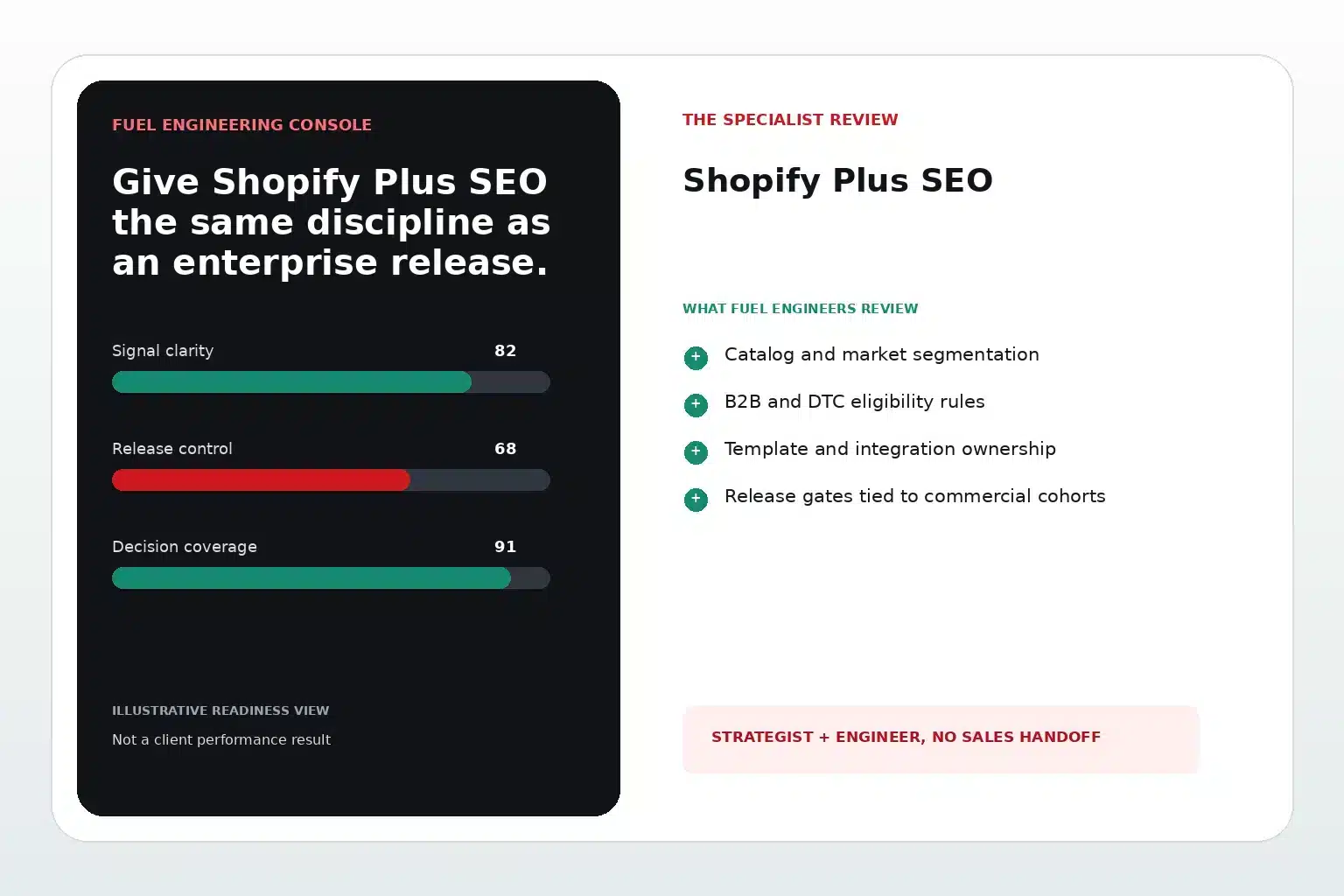
- Catalog and market segmentation
- B2B and DTC eligibility rules
- Template and integration ownership
- Release gates tied to commercial cohorts
Ratings checked September 2026. Review the independent profiles.
DIAGNOSE BEFORE YOU SCALE
Find the decision that actually changes the outcome.
If your store is underperforming in Shopify Plus SEO, the visible symptom may come from product data, Shopify configuration, theme output, an app or a release failure. These checks isolate the responsible layer before your team edits the catalog at scale or adds another dependency.
01
Regional stores drift
02
SEO work stalls in development
03
Large catalogs waste crawl paths
THE ENGAGEMENT, MADE CONCRETE
Six deliverables tied to implementation.
Your Shopify Plus SEO engagement should reflect catalog size, storefront architecture and implementation ownership. These work products show your team the evidence behind each recommendation, the required change and an explicit definition of done.
01
Enterprise opportunity model
Prioritize categories, markets and product groups by demand, margin and current visibility.
02
Governance map
Assign responsibility for theme, apps, feeds, content, analytics and release approval.
03
Template acceptance suite
Test collection, product, B2B, locale, variant and unavailable-product edge cases.
04
International architecture
Define market URLs, localization depth, hreflang and availability exceptions.
05
AI commerce readiness
Evaluate Shopify Catalog, agentic channels, entity clarity and product-data completeness.
06
Executive measurement
Connect delivery to nonbrand revenue, assisted discovery, technical health and release velocity.
DECISION MODEL
Conditions, decisions and production acceptance.
Illustrative scenario: A Shopify Plus brand operates US, UK and EU markets with shared product templates but different availability and delivery terms. The useful program starts with an equivalence map and market-specific exceptions. It does not copy one canonical or one offer policy across every locale merely because the theme is shared.
| Condition | Evidence needed | Engineering decision | Acceptance |
|---|---|---|---|
| Shared global template | One change can alter every storefront. | Use representative market and product fixtures before release. | All fixtures retain intended metadata, content and conversion behavior. |
| Catalog scale | Crawl totals can hide priority pages. | Segment URLs by template, demand and revenue. | High-value groups receive explicit discovery and quality monitoring. |
| B2B versus DTC | Offers and visibility differ. | Keep audience, price access and AI-channel eligibility explicit. | Restricted offers are not exposed as public DTC promises. |
| Multiple teams | Ownership ambiguity delays fixes. | Put owners and acceptance tests in every ticket. | A responsible team signs off on production output. |
FUEL FIELD NOTE
The page-specific judgment behind the checklist.
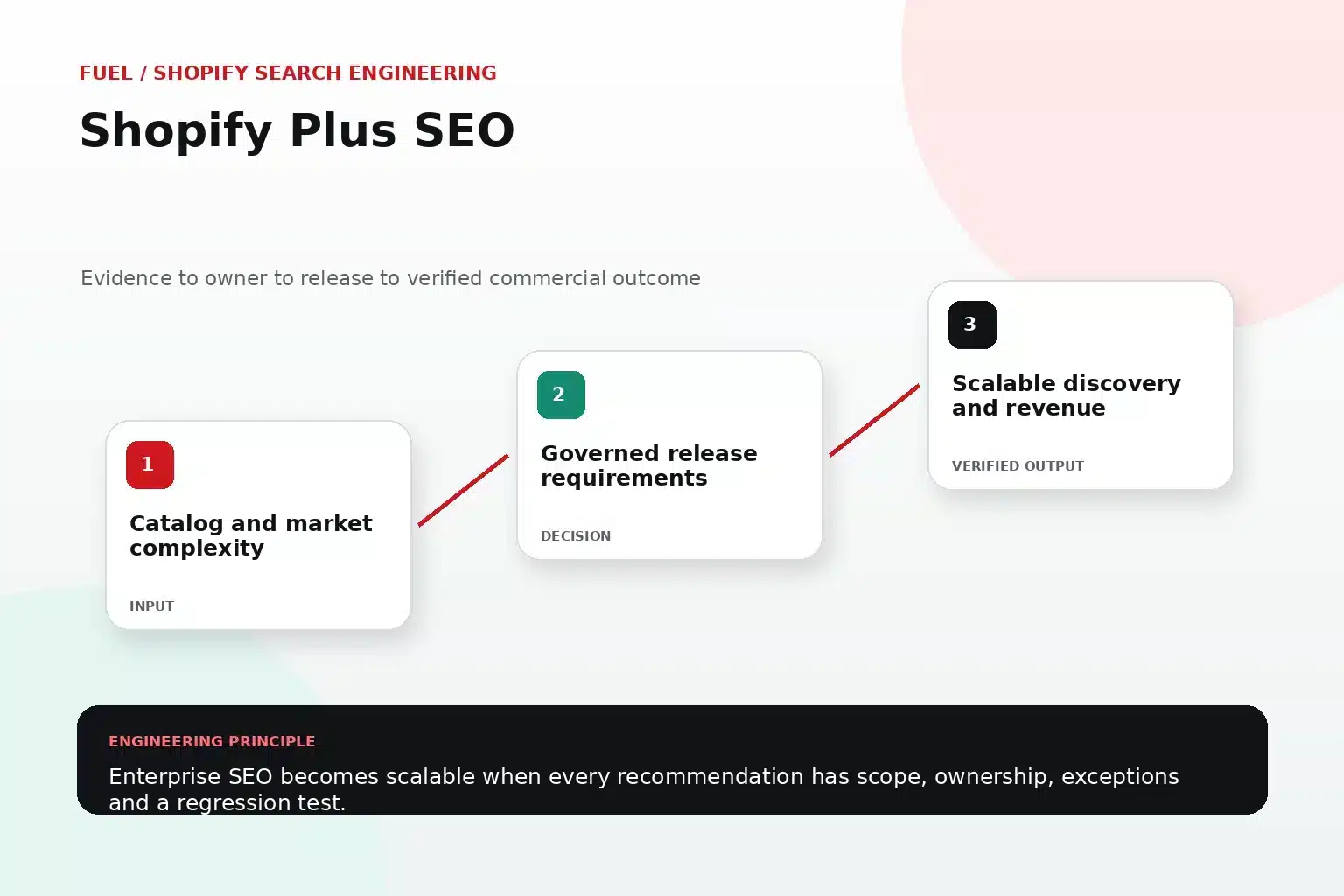
Fuel field note for Shopify Plus SEO: Enterprise SEO becomes scalable when every recommendation has scope, ownership, exceptions and a regression test. Fuel’s first review of your store spans Shopify Plus admin, theme or Hydrogen storefront, apps and integrations so one clean URL is never mistaken for the whole system. We compare what your store produces with its customer purpose and the team or system accountable for the change. This is where generic Shopify advice becomes a store-specific engineering decision.
What would change our recommendation? A different buyer task, materially different product state, market-specific output, headless route, app-generated markup or release constraint can produce a different answer. We retain those exceptions instead of forcing every Shopify URL into one rule.
PLATFORM OWNERSHIP
Put the change where Shopify produces the problem.
| Store layer | What it controls |
|---|---|
| Shopify Plus admin | Markets, B2B catalogs, products, collections, customer access and native channels. |
| Theme or Hydrogen team | Routes, templates, metadata, scripts and deployment behavior. |
| Apps and integrations | Reviews, subscriptions, feeds, search, personalization and schema ownership. |
| SEO and merchandising | Demand mapping, destination quality, links, lifecycle policy and acceptance. |
Your Shopify Plus SEO implementation plan should name the responsible layer, representative URLs, affected scope, exceptions, release dependency and expected output. This prevents a content decision from becoming an app uninstall and prevents a template defect from becoming thousands of manual catalog edits.
ORIGINAL FUEL DECISION MAP
Shopify Plus SEO: evidence to verified release.

Apply this sequence to a representative sample from your store. Your reporting should separate technical acceptance from commercial impact because Shopify output, search processing, demand and buyer behavior do not change on the same clock.
AI SEARCH + AGENTIC COMMERCE
How should Shopify Plus brands prepare for AI shopping?
Direct answer: Start with complete product data, stable identifiers, current price and availability, explicit policies and clear market eligibility. Then test Shopify Catalog mapping, public product pages and supported agentic channels separately. B2B-only products require particular care because Shopify states that agentic storefronts currently support DTC sales.
To measure how AI systems understand your store in relation to Shopify Plus SEO, Fuel uses a fixed panel of commercially relevant questions. We record the system, date, exact question, mentioned brands, cited URLs and answer accuracy. This shows what happened in that controlled panel while keeping AI observations separate from qualified referrals and revenue.
WHAT WE VERIFY
Public answers and channel data must agree.
- Product and collection facts are present in retrievable content
- Identifiers, variants, price and availability are coherent
- Policies and market eligibility are explicit
- Shopify Catalog and open-web behavior are evaluated separately
- AI observations, referrals and sales are not collapsed into one metric
ENGINEERING PROCESS
Four stages, each with a definition of done.
01
Segment the estate
Group markets, catalogs, templates and audiences before collecting issues.
Acceptance: Every sample URL belongs to a documented group.
02
Assign ownership
Map each important output to the team or system that controls it.
Acceptance: No critical field has competing unidentified owners.
03
Release by priority
Ship bounded changes to commercially important groups first.
Acceptance: Staging passes the enterprise acceptance fixtures.
04
Monitor by cohort
Measure the changed groups and markets separately.
Acceptance: Reporting distinguishes release effects, seasonality and other campaigns.
INFORMATION GAIN + MEASUREMENT
Record evidence another team can reproduce.
For a Shopify owner, useful Shopify Plus SEO evidence is not a longer copy of platform documentation. It connects an affected URL, the responsible Shopify layer, the commercial decision, the implemented change and the production result. Fuel retains that chain so a reader, developer or executive can see why the recommendation changed.
Fuel does not merge technical completion, Google processing, AI visibility and revenue into one Shopify Plus SEO success claim. A production output can be verified immediately, while indexing, ranking and AI answers follow different clocks. Revenue can also move because of promotions, inventory and paid campaigns. Reporting these clocks separately produces a more defensible decision.
Before recommending a sitewide Shopify Plus SEO change, Fuel records the sample logic: which templates, product states, collections, markets and edge cases were inspected, plus what was deliberately excluded. That prevents one clean URL from being generalized across a catalog it does not represent. The same sample is retained for post-release comparison.
| Evidence class | What to retain | How it is interpreted |
|---|---|---|
| Live technical fact | The current response, rendered output, link or entity relevant to Shopify Plus SEO. | Recheck the exact production URL after release. |
| Platform setting | The Shopify control that appears to influence Shopify Plus SEO, including plan, market or product-state context. | Confirm the setting changes the public output before scaling it. |
| Commercial decision | The buyer task, catalog group, market or revenue priority your Shopify Plus SEO work should support. | Keep this separate from a technical pass or fail. |
| AI observation | The AI system, exact question, date, cited page and answer accuracy when Shopify Plus SEO is tested. | This keeps your report from treating one chatbot response as market-wide visibility or commercial impact. |
| Business outcome | Landing-page revenue, assisted conversion, qualified inquiry or another agreed commercial measure. | Annotate promotions, inventory changes and concurrent releases. |
SHOPIFY SEARCH ENGINEERING LIBRARY
Continue with the relevant Shopify decision.
Primary technical references
Shopify and search controls change. These primary sources were reviewed for this Shopify Plus SEO page in September 2026. Fuel labels the platform documentation separately from our implementation judgment.
QUESTIONS SERIOUS BUYERS ASK
Answers without the platform theater.
Is Shopify Plus better for SEO than standard Shopify?
Plus expands enterprise capabilities and operating scale, but rankings still depend on useful destinations, implementation, authority and competition.
Can Fuel work inside an existing release process?
Yes. The engagement can produce tickets, validation evidence and release gates that fit the client’s development and governance workflow.
Does Shopify Plus solve international SEO automatically?
Markets provides important technical features, but teams still need useful localization, correct product availability and consistent market decisions.
Should every filtered catalog state be indexed?
No. Curate only combinations with distinct demand, inventory and maintainable value.
How is success reported?
Use delivery completion, technical acceptance, nonbrand visibility, landing-page revenue and qualified commercial outcomes by catalog cohort.
Qualified
organic traffic
Peel Appliance Repair, SEO and PPC engagement. Approximately two months. Client-reported on Clutch in February 2026. Baseline indexed to 100. This is not a forecast or a Shopify-specific result.
Read the client reviewPUT FUEL ENGINEERING TO WORK
Give Shopify Plus SEO the same discipline as an enterprise release.
SHOPIFY PLUS SEO / ENGINEERING + EXECUTION
Work directly with digital marketing engineers who specialize in this Shopify challenge. Bring us the store, the affected page groups and the outcome you need. We will discuss the evidence, constraints and work required to move forward.
- Catalog and market segmentation
- B2B and DTC eligibility rules
- Template and integration ownership
- Release gates tied to commercial cohorts
No sales team. Real strategists and engineers.
Share your URL, priorities and timing in the form below.
Prefer a conversation? 1-888-475-2552