Call 1-888-475-2552

SEO by Platform / Shopify SEO / Shopify SEO Migration and Replatforming Services
SHOPIFY SEARCH + AI COMMERCE ENGINEERING
Shopify SEO Migration and Replatforming Services.
Built for qualified discovery and revenue.
Fuel Online is a specialist Shopify SEO migration services, answer engine optimization and AI commerce agency. Our veteran digital marketing engineers combine advanced diagnostics, commercial analysis, AI-assisted research and production-level implementation for Shopify and Shopify Plus stores. A Shopify SEO migration must translate products, categories, editorial content, URLs, structured data and conversion tracking into Shopify’s architecture. Fuel builds the mapping and acceptance plan before target decisions become expensive to reverse.
Built for established Shopify and Shopify Plus teams that need Shopify SEO migration services tied to accountable implementation and qualified demand.
FUEL DIGITAL MARKETING ENGINEERS
Shopify specialists, not a sales handoff.
Fuel assigns Shopify SEO migration and replatforming work directly to strategists and engineers who understand Shopify configuration, Liquid and headless rendering, applications, product data, markets, and release QA.
- Source inventory
- Catalog transformation review
- Migration source of truth
- organic landing revenue and conversion compared with annotated baseline
Ratings checked September 2026. Review the independent profiles.
DIAGNOSE BEFORE YOU SCALE
Prove the Shopify SEO migration and replatforming condition before scaling a fix.
When businesses moving to Shopify or Shopify Plus from another ecommerce platform, domain, subdomain, catalog model, or headless architecture, one clean example can hide a catalog-wide exception. Fuel samples meaningful states and traces ownership so the store can transfer valuable URLs, content, product identity, internal authority, measurement, and customer journeys into a verifiable Shopify release.
01
Source inventory
Capture indexable URLs, canonical targets, organic entrances, backlinks, revenue, status codes, metadata, content, schema, and internal links before the source changes.
Decision: Confirm the affected cohort and controlling layer.
02
Catalog transformation review
Map products, variants, categories, filters, content types, customer accounts, markets, and legacy parameters into Shopify structures.
Decision: Separate the commercially valuable state from noise and exceptions.
03
Destination readiness test
Crawl staging or preview routes, render templates, validate redirects, compare parity, and exercise critical search and buying journeys.
Decision: Define the live output that will prove the correction works.
THE ENGAGEMENT, MADE CONCRETE
Six controls for accountable Shopify SEO migration and replatforming.
Fuel converts findings into bounded decisions that can survive a theme release, application update, catalog change, or new market. The result is executable by the people who own the storefront.
01
Migration source of truth
A versioned URL inventory with source value, destination decision, owner, status, redirect, and validation result.
02
Redirect specification
One-hop mappings for retained, consolidated, replaced, retired, parameterized, and media URLs.
03
Content and metadata parity report
Fields preserved, improved, intentionally removed, or blocked across products, collections, guides, and policies.
04
Product identity crosswalk
Legacy IDs, Shopify product and variant IDs, SKUs, GTINs, handles, feed IDs, and analytics references.
05
Launch command center
Freeze, DNS, redirects, crawl access, analytics, feeds, sitemaps, QA owners, rollback, and escalation sequence.
06
Recovery monitoring model
Search, crawl, index, canonical, redirect, landing, conversion, and revenue cohorts with launch annotations.
WHAT A SHOPIFY MIGRATION MUST PRESERVE
Protect proven discovery and revenue while the platform changes underneath it.
A Shopify migration succeeds when valuable old URLs resolve to useful new destinations, critical product facts survive and the new storefront can be crawled, understood and converted through. Fuel builds acceptance around the pages and catalog groups that already matter to the business.
| What you may be seeing | Why it matters | What Fuel engineers | How your team verifies it |
|---|---|---|---|
| Legacy URLs are not mapped to equivalent Shopify destinations | Authority and qualified entry traffic can be stranded at launch | Map URLs by purpose, product identity and commercial value, with explicit rules for removals and consolidations | One-hop redirects to relevant live destinations and documented exceptions |
| Products, variants or collections change identity during transfer | Search engines and shoppers can encounter missing, duplicated or mismatched catalog states | Reconcile identifiers, handles, canonicals, variants, availability and structured data | Representative catalog fixtures preserve the intended product and offer truth |
| Staging controls leak into production | Critical pages can launch blocked, canonicalized elsewhere or absent from internal discovery | Run launch checks for robots directives, canonicals, sitemaps, links and rendered output | Priority templates are accessible, indexable where intended and internally reachable |
| Teams watch only total traffic after launch | Losses in valuable page groups can be hidden by brand or campaign changes | Retain pre-launch cohorts and annotate concurrent releases, inventory and promotion changes | Landing-page visibility, qualified sessions and revenue are compared by mapped cohort |
DECISION MODEL
Shopify SEO migration and replatforming: evidence, decision, and acceptance.
Store scenario: A retailer migrates from Magento categories and configurable products into Shopify collections and variants. A simple URL export misses filtered landing pages and high-equity legacy product paths. Fuel combines crawl, analytics, backlink, sitemap, and platform data, maps each valuable destination, then validates redirect behavior against the live Shopify catalog.
| Decision point | Evidence to inspect | Fuel engineering action | Acceptance condition |
|---|---|---|---|
| Source inventory | Capture indexable URLs, canonical targets, organic entrances, backlinks, revenue, status codes, metadata, content, schema, and internal links before the source changes. | Record the current state and owner. | Evidence is reproducible. |
| Catalog transformation review | Map products, variants, categories, filters, content types, customer accounts, markets, and legacy parameters into Shopify structures. | Choose the bounded rule and exceptions. | Scope is commercially defensible. |
| Destination readiness test | Crawl staging or preview routes, render templates, validate redirects, compare parity, and exercise critical search and buying journeys. | Test the intended destination and output. | Production matches the approved fixture. |
FUEL FIELD NOTE
Fuel's Shopify SEO migration and replatforming engineering judgment.
Fuel field note: Transfer valuable URLs, content, product identity, internal authority, measurement, and customer journeys into a verifiable Shopify release. The recommendation changes when the sampled product state, market, template, customer task, or controlling application changes. Fuel retains those exceptions in the implementation rule instead of flattening the catalog into one convenient answer.
Why this creates information gain: the page connects a visible Shopify symptom to the responsible data or rendering layer, a commercial decision, a testable release, and a measurable result.
PLATFORM OWNERSHIP
Assign every Shopify SEO migration and replatforming change to its real owner.
| Control layer | What must remain coherent | Accountability |
|---|---|---|
| Legacy platform | URLs, categories, products, parameters, content, media, accounts, feeds, and historical value. | Legacy platform owner plus the release lead |
| Transformation logic | Handle creation, variant grouping, collection rules, metadata mapping, redirects, and data cleanup. | Transformation logic owner plus the release lead |
| Shopify destination | Templates, products, collections, navigation, markets, schema, sitemaps, and applications. | Shopify destination owner plus the release lead |
| Launch control | DNS, crawl access, QA, analytics, feeds, rollback, monitoring, and stakeholder decisions. | Launch control owner plus the release lead |
A production ticket for Shopify SEO migration and replatforming names the affected URLs, responsible layer, intended buyer task, exceptions, release dependency, expected output, and rollback condition. That record prevents manual catalog work from masking a template or integration defect.
ORIGINAL FUEL DECISION MAP
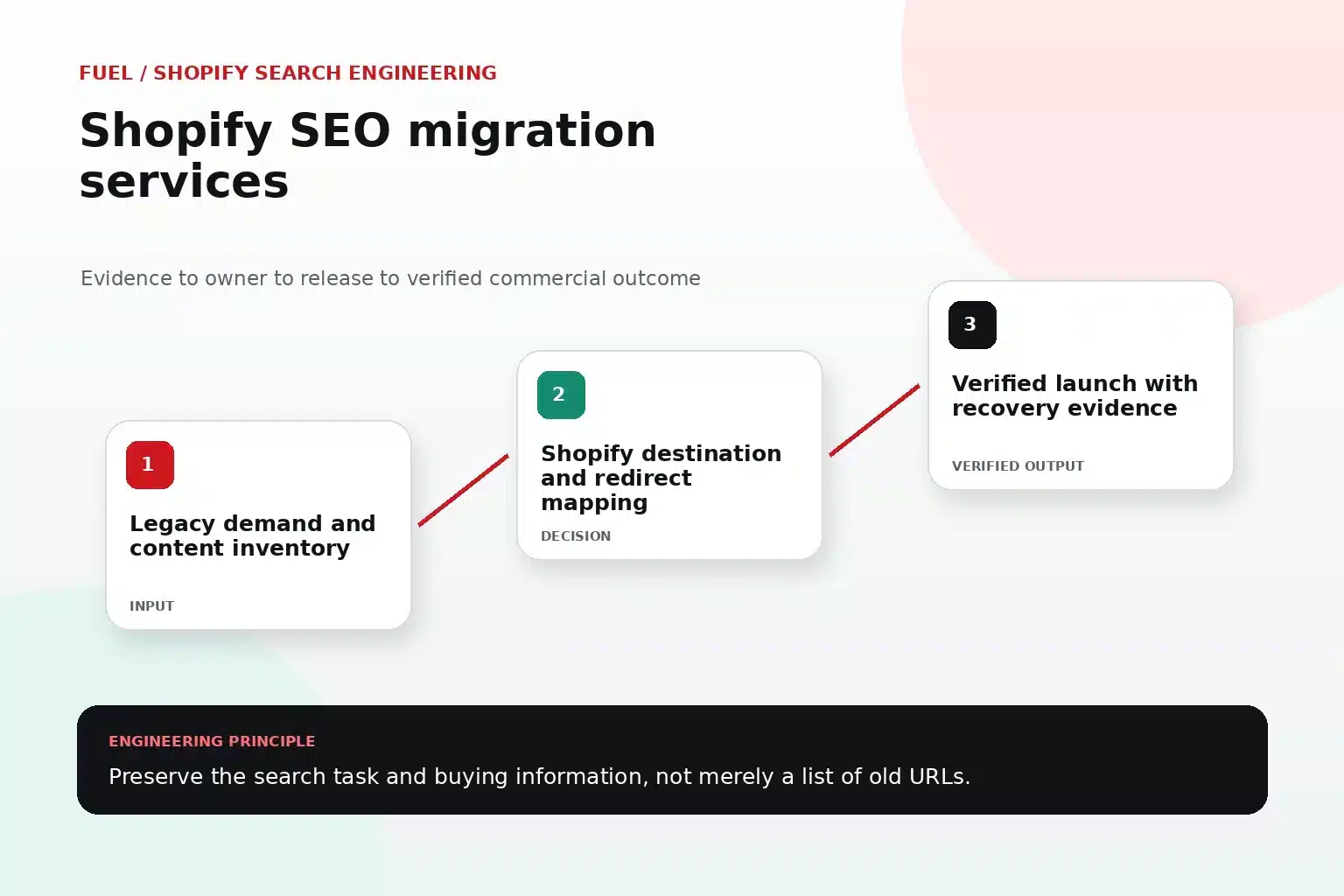
Shopify SEO migration services: evidence to verified release.

Use the decision map on a representative Shopify SEO migration and replatforming cohort. Validate the same fixtures before and after release, then interpret valuable legacy URLs with verified destination decisions, redirect, canonical, indexing, and crawl outcomes by migration cohort, organic landing revenue and conversion compared with annotated baseline on their appropriate timelines.
AI SEARCH + AGENTIC COMMERCE
How does Shopify SEO migration services affect AI search and shopping systems?
Direct answer: Migration continuity includes machine-readable identity, not only redirects. Product names, identifiers, variants, policies, organization references, and authoritative URLs should remain connected so search and AI systems can reconcile the old and new catalog.
Fuel tests a fixed set of high-intent questions against dated systems and records the cited URL, answer accuracy, market context, and downstream behavior. A model mention is never reported as attributable revenue.
WHAT WE VERIFY
What Fuel verifies for Shopify SEO migration and replatforming in AI discovery.
- Legacy authoritative URLs resolve through one meaningful redirect
- Product identifiers remain traceable across the platform change
- Visible facts, schema, feeds, and Shopify Catalog agree at launch
- High-value answers and policies survive content transformation
- AI prompt panels record cited URLs before and after migration without treating mentions as revenue
ENGINEERING PROCESS
Four controls between diagnosis and production.
01
Define the commercial cohort
Select representative URLs and states for businesses moving to Shopify or Shopify Plus from another ecommerce platform, domain, subdomain, catalog model, or headless architecture. Acceptance: the sample includes valuable pages, ordinary pages, and the exceptions most likely to fail.
02
Trace the controlling system
Source inventory, Catalog transformation review, Destination readiness test establish what produces the current result. Acceptance: every confirmed problem has a reproducible source and accountable owner.
03
Implement and test the rule
Apply the smallest maintainable change that can transfer valuable URLs, content, product identity, internal authority, measurement, and customer journeys into a verifiable Shopify release. Acceptance: staging or preview fixtures preserve search, customer, analytics, and revenue-critical behavior.
04
Verify production and outcomes
Repeat the same evidence collection after release and monitor valuable legacy URLs with verified destination decisions, redirect, canonical, indexing, and crawl outcomes by migration cohort, organic landing revenue and conversion compared with annotated baseline. Acceptance: technical completion and commercial interpretation are reported separately.
INFORMATION GAIN + MEASUREMENT
Measure Shopify SEO migration and replatforming without mixing incompatible signals.
Fuel measures valuable legacy URLs with verified destination decisions, redirect, canonical, indexing, and crawl outcomes by migration cohort, and organic landing revenue and conversion compared with annotated baseline. Each metric is attached to the affected Shopify cohort rather than diluted inside a sitewide average.
The evidence record includes the exact URL, observation date, controlling layer, implemented decision, release annotation, and acceptance result. Search processing, AI answers, inventory, campaigns, and revenue can change on different clocks, so they are not collapsed into a single success claim.
| Evidence layer | Shopify-specific record | Decision use |
|---|---|---|
| Current output | Capture indexable URLs, canonical targets, organic entrances, backlinks, revenue, status codes, metadata, content, schema, and internal links before the source changes. | Confirms the starting state. |
| Commercial scope | Businesses moving to Shopify or Shopify Plus from another ecommerce platform, domain, subdomain, catalog model, or headless architecture. | Prioritizes the cohort worth changing. |
| Implementation | A versioned URL inventory with source value, destination decision, owner, status, redirect, and validation result. | Defines ownership and exceptions. |
| Machine observation | Legacy authoritative URLs resolve through one meaningful redirect. | Tests retrieval and accuracy without promising selection. |
| Business outcome | organic landing revenue and conversion compared with annotated baseline. | Connects the release to qualified commercial behavior. |
SHOPIFY SEARCH ENGINEERING LIBRARY
Continue with the relevant Shopify decision.
Primary technical references
Shopify and search controls change. These primary sources were reviewed for this Shopify SEO migration services page in September 2026. Fuel labels the platform documentation separately from our implementation judgment.
QUESTIONS SERIOUS BUYERS ASK
Clear answers about Shopify SEO migration and replatforming.
How much traffic is lost during a Shopify migration?
There is no responsible fixed percentage. Risk depends on URL changes, content parity, redirects, authority, catalog transformation, release quality, and search processing.
Does Shopify automatically create migration redirects?
Shopify can manage redirects, but the mappings and validation still require a complete legacy inventory and deliberate destination decisions.
When should SEO migration planning begin?
Before information architecture, product modeling, and URL decisions are finalized. Early involvement prevents expensive destination and redirect problems.
Should every old URL redirect to the Shopify homepage?
No. Redirect each valuable URL to the closest useful equivalent. Irrelevant homepage redirects confuse users and may not transfer meaningful signals.
How does Fuel verify migration recovery?
Fuel monitors defined URL cohorts for response, canonical, crawl, indexing, rankings, landing traffic, conversion, and revenue while annotating other commercial changes.

Qualified
organic traffic
Peel Appliance Repair, SEO and PPC engagement. Approximately two months. Client-reported on Clutch in February 2026. Baseline indexed to 100. This is not a forecast or a Shopify-specific result.
Read the client reviewPUT FUEL ENGINEERING TO WORK
Put Fuel engineers on your Shopify SEO migration services challenge.
SHOPIFY SEO MIGRATION AND REPLATFORMING / ENGINEERING + EXECUTION
Bring Fuel the affected Shopify URLs, catalog states, and commercial outcome. Our digital marketing engineers will trace the controlling system, define the implementation rule, test the exceptions, and verify production.
- Migration source of truth
- Redirect specification
- Content and metadata parity report
- organic landing revenue and conversion compared with annotated baseline
No sales team. Real strategists and engineers.
Share your URL, priorities and timing in the form below.
Prefer a conversation? 1-888-475-2552