Call 1-888-475-2552

Best SEO Agency for Rhinoplasty Practices: How to Choose an SEO, AEO and GEO Partner
Choosing a rhinoplasty marketing agency is a high-stakes decision in a medical, cash-pay category where accuracy and trust decide who patients call. This guide gives you a scorecard to judge any agency on proof, staffing, reporting, and contract terms, so you can compare proposals on evidence instead of promises.
How to choose an SEO, AEO, and GEO agency for a rhinoplasty practice
Choosing an agency for a rhinoplasty practice comes down to one question: can this partner prove it will earn qualified consultations in a medical category where accuracy, patient trust, and local visibility all decide who gets the call? The right agency shows verifiable results, staffs the work with real experts, reviews clinical content properly, plans for AI search as well as Google, and reports on booked consultations rather than vanity traffic. This guide hands you a scorecard you can hold any agency against, so you compare proposals on evidence instead of promises.
The advice here is meant to help you judge any agency fairly, not just ours. It sits inside our broader rhinoplasty marketing resources and our wider plastic surgery marketing work, and you should use it to pressure-test every proposal on your desk, including a Fuel Online one. Rhinoplasty is a high-consideration, cash-pay procedure that patients research for weeks, so the cost of hiring the wrong partner is measured in months of lost visibility and consultations that went to a competitor.
Why rhinoplasty raises the bar for an agency
Rhinoplasty search is unusually demanding, and that changes what a competent agency has to be able to do. Patients compare open versus closed technique, preservation and revision approaches, recovery timelines, candidacy, and cost across dozens of searches before they book. They read as much about the surgeon’s credibility as the procedure itself. An agency that treats your practice like a generic local business will produce thin content that never earns trust or rankings in this category.
There is also a medical-trust dimension that lower-stakes industries never face. Search engines apply a higher standard to health topics, and so do patients weighing a five-figure elective surgery. Content has to be accurate, expert-reviewed, and honest about outcomes, because a single overreaching claim can cost you credibility with both. When you evaluate an agency, you are really asking whether they can operate to a clinical standard while still winning a competitive commercial search landscape. Most agencies can do one or the other. The scorecard below helps you find the few that do both.
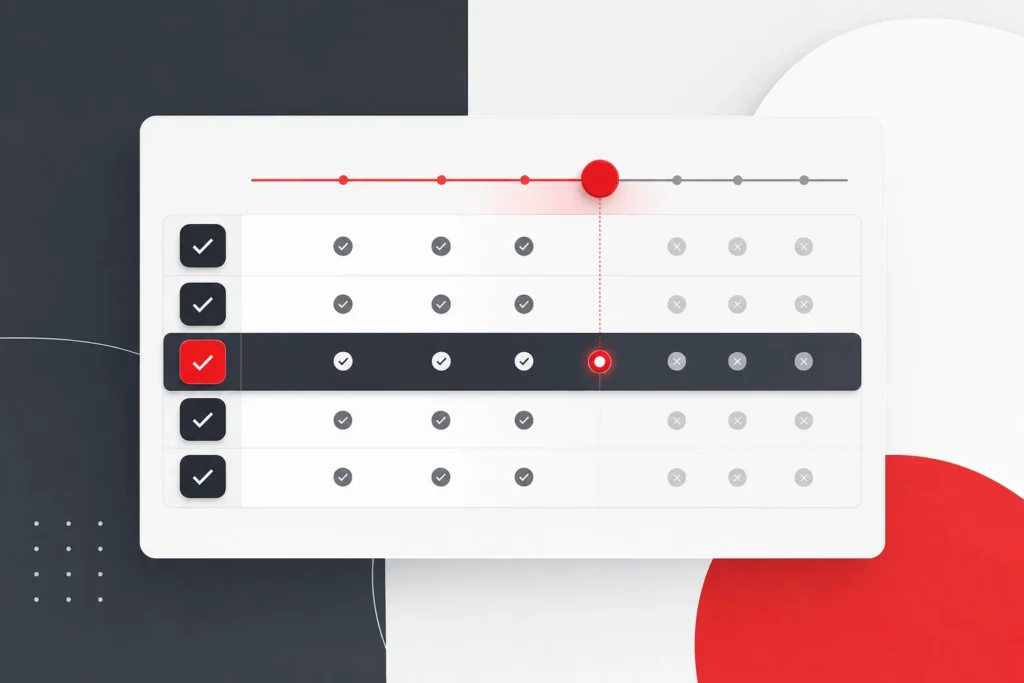
The rhinoplasty agency evaluation scorecard
Score every agency you are considering against the same six criteria. Ask for evidence on each one, not assurances, and treat a vague or defensive answer as a data point. A strong partner will welcome the questions because the answers are where they separate themselves.
- Proof standards and verifiable results. Can they show real, checkable outcomes and references, ideally in medical or other high-consideration categories, rather than screenshots with no context? Ask to see how they measure and report growth over time.
- Medical-content and expert-review capability. Who writes the clinical content, and who reviews it for accuracy before it publishes? In a health category, expert review is a requirement, not an upgrade.
- AI-search capability across AEO and GEO. Do they have a real method for answer engine optimization and generative engine optimization, or do they only talk about Google rankings? Patients now research rhinoplasty inside AI tools, and that visibility is earned differently.
- Staffing and who actually does the work. Are the strategists, writers, and reviewers in-house and U.S.-based, or is the work quietly outsourced? Ask who will sit on your account and where they are.
- Reporting and attribution. What exactly lands in your inbox each month, and does it tie effort to booked consultations through call tracking and form attribution, or stop at traffic and impressions?
- Contract terms and ownership. If you part ways, do you keep the website, the content, the analytics, and the local profiles? Long lock-ins where you own nothing are a structural risk, not a detail.
Weight these to your situation, but do not skip any of them. A practice with a weak website may care most about staffing and content depth, while a multi-location group may weight reporting and ownership more heavily. Either way, an agency that scores well on proof, expertise, and honest measurement is the one most likely to grow a rhinoplasty practice over the long research windows these patients take.

How to judge proof and verifiable results
Proof is where most agency evaluations should start, because it is the hardest thing to fake and the easiest thing to check. Ask for outcomes you can verify: how a client’s visibility, calls, or consultations changed, over what period, and how the agency attributed the change. Be skeptical of a single ranking screenshot or a traffic chart with no revenue context. Traffic that never books a consultation is not a result in a cash-pay category.
It is reasonable to ask an agency how long it has operated, what recognition it has earned, and whether independent parties have vetted its work. A track record across many years and clients is harder to manufacture than a polished pitch. When an agency shows you how it reports growth to existing clients, you learn as much from the format as the numbers, because clear, consultation-linked reporting is itself a proof point.
How to judge medical content and expert review
In a medical category, content is only as valuable as it is accurate. Ask who writes your procedure pages, candidacy guides, and recovery content, and ask who reviews that material for clinical accuracy before it goes live. An agency that cannot name a review process, or that treats expert review as an optional extra, will eventually publish something that misstates a technique or overpromises an outcome. In rhinoplasty, that erodes the exact trust you are trying to build with patients, and it can undercut rankings on health topics.
Good content in this space reads like it was written for a patient making a serious decision: honest about candidacy, clear about recovery, careful never to guarantee a result, and structured so search engines and AI tools can understand it. If an agency’s sample content is generic, keyword-stuffed, or interchangeable with content for a med spa or a dentist, it will not carry the authority a rhinoplasty practice needs.
How to judge AI-search, AEO, and GEO capability
Rhinoplasty patients increasingly start inside AI tools, asking ChatGPT, Gemini, Claude, or Perplexity to explain techniques, compare options, and suggest surgeons. Being cited and recommended there is a distinct discipline from ranking on Google, and it is worth asking every agency how they approach it. Answer engine optimization and generative engine optimization draw on the same authority that wins search, but they require deliberate structuring of content and entity signals so machines can quote you accurately.
A useful way to test an agency here is to ask what they would measure and where you stand today. A structured AI visibility audit tells you whether your practice currently surfaces in AI answers and why, and an agency that can run and explain one is usually further ahead than one that treats AI search as a buzzword. If an agency only sells Google rankings and has no view on AI search, you are hiring for half the landscape.
How to judge staffing, reporting, and ownership
Ask plainly who will do the work. Some agencies win accounts with senior strategists and then hand delivery to offshore teams you never meet, which matters in a category where medical nuance and clear English are non-negotiable. A U.S.-based, in-house team with no outsourcing is easier to hold accountable and better positioned to review clinical content. This is the same staffing standard we hold across our core SEO agency team, and it is a fair bar to set for anyone you hire.
On reporting, insist on specifics. A strong agency ties its work to booked consultations through call tracking and form attribution, and it shows you which markets, pages, and searches produce them. Reporting that stops at traffic and impressions hides whether the money is working. Pricing belongs in this conversation too, and it should be transparent rather than a flat number pulled from the air; our rhinoplasty SEO pricing guide explains how a custom budget is built around your markets and goals. Finally, read the contract for ownership: you should keep your website, content, analytics, and Google Business Profile if the relationship ends. If you would walk away empty-handed, that is leverage working against you.
What good looks like versus the red flags
Once you have scored an agency, a few patterns separate a durable partner from a risky one. The warning signs below are not always disqualifying on their own, but two or three together should give you pause before you sign.
- Guaranteed rankings or guaranteed consultation numbers. No honest agency can promise a specific position or a set number of patients, because no one controls the search algorithms or the market. A guarantee is a sales tactic, not a plan.
- Outsourced or offshore content with no medical review. Cheap, high-volume content written far from any clinical oversight will misstate procedures and read generically, which fails both patients and search engines in a health category.
- No expert review of clinical claims. If no qualified reviewer signs off on candidacy, technique, and recovery content, accuracy is a matter of luck, and one bad claim can cost you trust.
- Vanity-metric reporting. Dashboards full of impressions and pageviews with no line connecting the work to booked consultations are designed to look busy rather than prove value.
- Long lock-in contracts where you own nothing. A partner confident in its work does not need to trap you, and you should never risk losing your own site, content, or profiles when a contract ends.
What good looks like is the mirror image: candid about what it cannot promise, transparent about who does the work and where, rigorous about expert review, and precise in tying results to consultations and revenue. A strong agency treats your contract as a partnership you can leave with everything you paid for, and it is comfortable being measured on outcomes rather than activity. When an agency behaves that way in the sales process, it usually behaves that way in the work.

Questions to ask before you sign
Bring the same short list of questions to every agency conversation. Consistent questions produce comparable answers, and the differences will tell you more than any pitch deck.
- Can you show verifiable results and references, ideally in medical or other high-consideration categories, and explain how you measured them?
- Who writes and who reviews our clinical content, and is that team in-house and U.S.-based?
- How do you approach AI search through AEO and GEO, and where does our practice stand in AI answers today?
- Exactly what will your monthly report show, and how do you tie the work to booked consultations rather than traffic?
- If we end the relationship, who owns the website, the content, the analytics, and the Google Business Profile?
- What are the contract term and the total investment, and how is the budget built around our markets and goals?
You are not looking for perfect answers so much as honest, specific ones. An agency that meets a hard question with a clear explanation, an example, or a candid limitation is showing you how it will communicate once it has your account. Vagueness, deflection, or pressure to sign quickly are answers too.
How Fuel Online meets the bar
Measured against this scorecard, here is where Fuel Online stands, stated plainly so you can check it. We have grown businesses through search since 1998, we have earned more than 100 industry awards, and we have been named a top agency by Forbes, Yahoo, and Clutch. Across our client work we have generated 4.25 million marketing leads and delivered 143% average traffic growth for enterprise brands. We do not translate those into a promise about your rankings or consultation count, because an honest agency cannot, and you should treat anyone who does with caution.
On the criteria that matter most in a medical category, our team is 100% U.S.-based with no outsourcing, so the people who write and review your content are accountable and reachable. We run the only in-house AI SEO research department in the space, and our proprietary Fuel AI Index gives the content we produce a measured information-gain advantage over competing pages, which is how we build for AEO and GEO alongside traditional search. You can review our client case studies to see how we measure and report growth, and our awards and certifications for the independent recognition behind those claims. Whatever you decide, hold every agency, including us, to the same standard, because that is how a rhinoplasty practice ends up with a partner worth keeping.
Choosing a rhinoplasty agency: questions we answer often
Get a Second Opinion on an Agency Proposal
Have a proposal on your desk and want an honest read before you sign? Share it with us and we will help you pressure-test it against the scorecard on this page, then show you how we would approach your rhinoplasty markets. Fill out the form below to schedule a meeting and get a custom quote.
Prefer a direct line? Visit our contact page or call 1-888-475-2552.