
Personal Injury Law Firm in New York, NY built around qualified case evaluations, urgent search demand, local authority, and intake quality.
Redacted Client Case Study
Law Firms · SEO · New York, NY
New York Law Firm SEO Case Study
New york law firm SEO case study showing SEO, PPC, AI SEO, digital marketing, lead generation, search visibility, and conversion improvements for law firm buyers.
Lead outcome
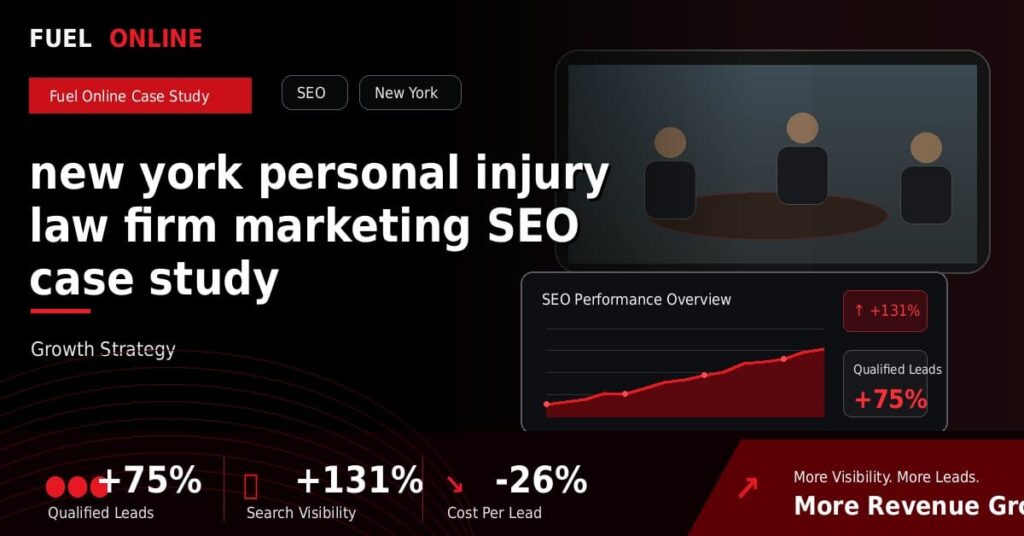
+109% Qualified Case Leads
Performance Snapshot
The growth brief
Context before conclusions.
CLIENT (Redacted), personal injury law firm in New York, NY focused on car accident cases, truck accident claims, catastrophic injury matters, and wrongful death intakes
- Market
- New York, NY
- Timeline
- 5 Months
- Industry
- Law Firms
- Services
- SEO
Case-type landing pages, intake-focused PPC, local SEO, review signals, and serious-case conversion tracking
Measured performance
The signal, made legible.
Reported outcomes, before-and-after performance, and the campaign timeframe.
Performance measure
+109% Qualified Case LeadsQualified Case Leads
Performance measure
+142% Search VisibilityPriority Search Visibility
Performance measure
+46 AI Mentions and Citation TargetsAI Mentions and Citation Targets
Performance measure
Stronger lead capture and buyer intent alignmentVisitor to Lead Conversion Rate
Performance measure
-30% Cost Per LeadCost Efficiency
- Before
- 137 qualified case leads
- After
- 286 qualified case leads
- Timeframe
- 5 Months
What improved
+109% Qualified Case Leads after aligning the offer, search intent, landing page structure, trust signal placement, and conversion path.
+142% Search Visibility through deeper service coverage, stronger internal linking, clearer topical authority, and better New York, NY relevance.
+46 AI Mentions and Citation Targets by adding answer-ready explanations, entity clarity, trust modules, FAQs, and citation-friendly content.
+107% Qualified Pipeline by moving the campaign from traffic reporting into opportunity-value reporting for leadership.
The before-and-after performance view makes it easy for owners and decision makers to see where demand improved and where budget waste was reduced.
Results qualification: Draft data is visible to editors only. Replace with verified analytics, CRM, call tracking, ad platform, revenue, ranking, or AI visibility data before using as a public client claim.
The full story
From business pressure to focused execution.
Expensive paid clicks, attorney directories, LSAs, local map pack volatility, and aggressive competing PI firms in New York, NY
New York Law Firm SEO Case Study Overview
New york law firm SEO case study for CLIENT (Redacted), personal injury law firm in New York, NY focused on car accident cases, truck accident claims, catastrophic injury matters, and wrongful death intakes focused on one business outcome: more qualified qualified case leads from the buyers most likely to convert. Fuel Online structured the campaign around SEO, New York, NY competition, high-intent search behavior, AI search visibility, conversion architecture, and executive-level performance reporting.
Marketing Results From This Personal Injury Law Firm Marketing Campaign
The growth story centers on +109% Qualified Case Leads, +142% Search Visibility, +46 AI Mentions and Citation Targets, and +107% Qualified Pipeline. This SEO case study is structured to help owners, CMOs, partners, and decision makers understand what improved, why it improved, and how a similar growth system can be adapted for their company.
Why This SEO Case Study Matters
Decision maker takeaway: The firm needed more serious case inquiries and less wasted intake volume. The campaign needed to connect visibility, trust, content depth, lead quality, tracking, and conversion into one measurable system instead of treating marketing channels as disconnected tactics.
Strategy system
The constraint. The response.
The challenge
Expensive paid clicks, attorney directories, LSAs, local map pack volatility, and aggressive competing PI firms in New York, NY.
High-intent buyers were comparing providers across Google, local results, paid ads, reviews, directories, competitor landing pages, and AI-assisted research before contacting anyone.
The company needed more than traffic. It needed stronger trust signals, sharper positioning, deeper service pages, cleaner tracking, and a conversion path built for serious buyers.
Leadership needed reporting that connected visibility, lead quality, cost efficiency, pipeline value, and revenue contribution.
The strategy
Fuel Online built the campaign around one outcome: make the company easier to find, easier to trust, and easier to choose.
The primary growth lever was case-type landing pages, intake-focused ppc, local seo, review signals, and serious-case conversion tracking.
The strategy connected service authority, market relevance, industry expertise, trust modules, sales-ready copy, conversion tracking, and AI answer clarity into one growth system.
The SEO layer focused on technical cleanup, crawlable information architecture, keyword mapping, internal linking, content depth, local relevance, authority signals, and conversion-ready service pages.
Execution plan
How the work moved.
- 01Month 1
Executive growth audit, tracking cleanup, KPI definition, competitor teardown, keyword intelligence, AI visibility baseline, and conversion friction review.
- 02Month 2
Technical SEO fixes, service page architecture, landing page plan, call tracking, CRM alignment, and trust module layout.
- 03Month 3
Core page rebuilds, industry-specific content expansion, internal linking, offer testing, and conversion path improvements.
- 04Month 4
AI search optimization, answer-ready content blocks, FAQ expansion, entity reinforcement, review integration, and citation-source planning.
- 05Month 5
Paid media or organic expansion, local authority reinforcement, retargeting or nurture support, and revenue-quality reporting.
- 06Month 6
Before-and-after performance review, CRO refinement, budget reallocation, next-market expansion, and executive growth roadmap.
Evidence and interpretation
Why the result held together.
Why it worked
The campaign worked because it connected visibility to buyer intent instead of treating SEO as a checklist.
The site became more useful for real buyers because it answered specific questions, showed stronger trust signals, clarified the offer, and reduced friction before the first conversion.
The growth system also made the company easier for buyers to understand, compare, trust, and contact when they were actively researching options.
For Personal Injury Law, that combination matters because decision makers are trying to reduce risk before choosing a provider.
Hypothetical future source-context and publishing exercise.
This fictional firm exercise describes future marketing planning, not further actions or outcomes of the historical case. It provides no legal advice or assessment of a possible matter.
A law firm comparing SEO proposals should ask what each source helps a prospective reader understand. A practice-area description explains the firm's approved offering. An attorney biography identifies a professional and the context of the information presented about that person. A historical case resource describes a particular published account. Those resources can support the same research journey without performing the same job. A useful proposal clarifies their relationships and the next contact route instead of treating every indexed page as another interchangeable opportunity to attract inquiries.
Consider a fictional firm reviewing three resources before a future publishing assignment: an approved practice-area page, a current biography and an older case resource. The exercise does not describe additional work or results from the historical campaign above. Its purpose is to compare marketing scope. The reviewer is not deciding whether any reader has a case or whether a service is suitable. The question is whether the public sources describe their own roles clearly enough for someone to understand the firm's information and find an appropriate business contact route.
Start with the practice-area explanation supplied by the firm. Record what the approved page says the firm wants to discuss, which information supports that explanation and who owns changes to it. Do not expand that offering because another firm publishes a broader list or because a search term suggests demand. When a proposed topic exceeds the available description, flag the missing approval or source. The marketer can identify the communications question and organize the work; the firm supplies the authoritative explanation of its own offering.
Review the biography as a separate source. Confirm which person the page identifies, which statements the firm has approved and how the biography connects to the current practice-area explanation. A historical mention of a professional is not automatically the current biography. Nor does a biography's existence establish that every service on the website should be attributed to that individual. The publishing task is to preserve accurate relationships between person, firm and resource. It should not manufacture an endorsement, responsibility or availability claim to make internal linking easier.
The historical case resource needs its own context. A published account can remain useful as an account of that particular matter without becoming a general promise to every reader. Keep its original facts and claims in their historical setting. When connecting it to a practice-area page, explain why the resource is relevant to the reader's research rather than implying that another situation will have the same result. This exercise does not reinterpret the underlying matter or advise anyone about a possible claim. It examines the navigation and source relationship around the existing account.
Suppose the fictional review finds that the older resource names an attorney while the current biography uses a different public presentation. The agency should not silently choose whichever version produces a simpler page. Record the discrepancy and ask the firm's publishing owner which current source controls the identity description. The original historical text may need to remain in context even when a current navigation label changes. Distinguishing the historical account from today's biography can resolve the reader's confusion without rewriting the record or inventing an explanation for the difference.
Build a source-role map that makes these decisions inspectable. For each resource, record its purpose, current publishing owner, related destination and unresolved question. The practice-area page may depend on approved service wording. The biography may depend on a current professional profile. The historical resource may depend on preserving the original account while clarifying its connection to current information. A proposal that lists only page titles misses these dependencies. A source-role map helps the buyer see which decisions must precede copy, linking or implementation work.
Compare three scopes against the observed problem. An archive-maintenance assignment can clarify historical resource context and navigation. A current-offering assignment can improve approved practice-area explanations and their connections to biographies. A connected journey assignment can also review the appropriate prospective and existing-client contact routes. These are different commitments. A firm with clear current pages but confusing archives may need the first scope. A firm with accurate archives but an unclear current offering may need the second. More deliverables are useful only when they address the actual missing relationship.
Keep prospective inquiries distinct from existing-client communication. A reader asking about possible representation and an existing client looking for an administrative contact have different purposes, even when both arrive from a biography or a search result. Record the actual routes the firm has approved for those purposes. The marketer should not invent a portal, intake process or response commitment. If the correct route is unresolved, identify the responsible owner and leave that implementation dependency visible. Publishing a clearer invitation is not the same as establishing the process that receives it.
Test the proposed journey with a neutral reading exercise. A reviewer should be able to identify whether a page is a current offering, an individual profile or a historical account. From there, the reviewer should be able to find the firm's approved next contact destination and distinguish it from an existing-client route. The exercise tests public information and navigation, not the legal significance of a reader's circumstances. It can reveal that the pages are individually understandable while their combined journey still sends readers to an unsuitable business destination.
Specify acceptance evidence before commissioning a broad rewrite. A source-context task can be accepted when the agreed historical and current roles are clear. A biography connection can be checked against the approved identity source. A route implementation can be checked by the receiving owner against the intended administrative purpose. Separate those checks so an unresolved destination does not disappear inside a report that marks all content complete. This also allows a buyer to distinguish finished editorial work from a dependency controlled by another website or business team.
Plan maintenance around actual changes rather than a fixed volume of new pages. A changed approved practice description, a revised biography or a new destination owner can affect several resources. Record which relationships need review when that change occurs. An agency may maintain the map while the firm supplies current information; alternatively, the firm may keep the map and commission specific updates. Compare those responsibilities when evaluating recurring fees. The point is to understand what the assignment maintains, not to suggest an industry price or a required publishing frequency.
The result is a more useful basis for selecting marketing work: a source map that distinguishes current offering, person and historical account, plus an approved route for the intended contact purpose. The buyer can assess the proposal against those concrete dependencies instead of assuming that every additional page creates equal value. The historical case retains its original reported outcomes. Any future assignment described here needs its own publishing and receiving evidence before the firm can say what the new work accomplished.
How discovery improved
The AI search layer was designed to make the company easier to understand when buyers research options in Google AI Overviews, ChatGPT-style tools, Perplexity, Gemini, and other answer engines.
Fuel Online strengthened the connection between the business, its services, its market, its trust signals, and the buyer questions most likely to trigger recommendation-style answers.
The content protocol included concise answer blocks, specific service definitions, comparison sections, FAQs, trust modules, internal links, and entity-rich descriptions for Personal Injury Law in New York, NY.
The goal was to give buyers clearer evidence that this brand belongs in the conversation when buyers ask who to trust.
Hypothetical future discoverability and administrative-receiving exercise.
All message and conversation counts below are invented business examples, not private case records, historical results or predictions about representation.
Review future discoverability and receiving activity as related evidence sets, not as the same event. A dated search result or answer can show how a source was presented in an observed research interaction. A website visit can show available visit information. A received inquiry can show that someone contacted the firm. An administrative next step can show what the receiving team actually recorded afterward. None automatically proves the others. A useful marketing review makes those relationships explicit while leaving unknown connections unknown.
Begin with a small source observation rather than a claim about what every prospective client sees. Record the actual research question, observation date, displayed answer or result and linked destinations when available. Identify whether each destination is the firm's practice-area page, a biography, a historical resource or another publisher's page. This classification gives the reviewer something concrete to inspect. It does not establish that the observed answer is universal, that every reader receives it or that a particular inquiry came from that interaction.
Suppose a future observed answer cites the historical resource while describing it as the current practice offering. Compare the answer with the actual sources before changing anything. The practice-area page may already explain the offering accurately, while the old resource needs clearer navigational context. Alternatively, the owned sources may genuinely conflict. The useful task is to identify the precise relationship that is unclear. Do not erase a historical account or attach a new outcome claim merely to make the answer resemble a preferred marketing summary.
A correction plan should distinguish ownership. The firm can approve its current offering and biography information. Its publishing team can implement agreed changes on owned resources. An external publisher controls its own page, so an agency can identify or request an appropriate correction without promising that the publisher will make it. Keep the completion evidence for those tasks separate. A changed owned page is observable work; an external response is another event; a later answer using the revised information requires another observation.
For receiving evidence, consider a fictional period with fourteen incoming messages. Eight concern prospective conversations, three concern existing-client administration, two seek a public resource and one is a supplier introduction. Those groups total fourteen messages. The classifications describe administrative purpose only. They do not evaluate a legal matter, establish eligibility or record confidential circumstances. The receiving owner supplies the aggregate categories needed for the marketing review rather than asking an agency to infer purpose from a page visit alone.
Within the eight prospective messages, suppose two relate to one continuing conversation and another two relate to a second continuing conversation. The other four messages concern four separate conversations. The eight messages therefore represent six distinct prospective conversations in this example. Retain both counts and explain the relationship. A follow-up is still a received message, but it is not automatically a new prospective relationship. The example specifies the relationships for clarity; it does not prescribe how the firm must identify or manage its underlying records.
At the cutoff, suppose three of the six conversations have an agreed administrative next step, two are waiting for a response and one has received information without an agreed next step. Those statuses total six. The report can state which administrative stages were observed without saying whether any matter is accepted or likely to succeed. An agreed next step is not a client engagement, and a response is not an agreement. Keep later professional decisions outside these marketing labels unless the firm supplies separately defined aggregate evidence for a distinct business question.
Retain the observation period when the statuses change. A conversation first received in one period may reach an agreed next step later. Following that original group can explain how receiving activity developed over time. A different report that groups all next steps by the date they were recorded answers a different question. Label that basis rather than combining the latest inquiry count with unrelated earlier conversations. An unfinished group is not proof that the source failed; the review may simply precede the next recorded event.
Discovery attribution adds another layer. An inquiry may follow several research steps, and a person may mention a source that differs from available visit information. Record those as different observations rather than forcing one to replace the other. A clearly identified prospective conversation may still have no known discovery source. Likewise, a visit from a historical resource may lead to an existing-client administrative message. Reporting those distinctions prevents the review from describing every source visit as newly acquired demand or every later inquiry as a result of a particular answer.
Use the source and receiving reviews together to choose a bounded repair. If the observed answer confuses a biography with a practice-area description, examine that source relationship. If prospective readers find the right explanation but reach an existing-client route, examine the destination and its invitation. If the receiving team cannot explain pending statuses at the cutoff, clarify the reporting definition. These tasks can involve different owners and different evidence. A broad content expansion is not a precise substitute for identifying which relationship is actually unresolved.
Ask a proposed reporting provider to demonstrate the fourteen-message example without simplifying away its stages. It should be possible to show fourteen total messages, eight prospective messages, six distinct conversations and three agreed administrative next steps while retaining the other purposes and pending statuses. Ask which evidence comes from public observations, which comes from aggregate receiving records and who supplies each definition. This comparison distinguishes a discoverability report from a connected receiving review without requiring a marketing provider to assess legal matters or view private case details.
Finish each review with an evidence-based next assignment. A source conflict calls for a publishing decision. An unclear contact purpose calls for an approved route explanation. An unknown discovery connection calls for an honest statement of what the records do and do not establish. Preserve the historical account and its original period throughout. This future framework helps a firm compare marketing scope through source context, reader navigation and observed administrative activity, while keeping case assessment, professional advice and historical client outcomes outside the exercise.
Buyer questions
Case study FAQs.
What makes this SEO case study useful?
This case study describes the client market, campaign approach, measurement period, and reported outcomes. Use those details to assess relevance to your own goals.
Why redact the client name?
Many companies do not want competitors seeing their traffic, lead, revenue, or acquisition strategy. Redaction protects the client while still allowing the case study to show the business type, market, strategy, and performance story.
Why does this matter for Personal Injury Law?
Buyers in Personal Injury Law compare providers carefully. Relevant results, clear results, and relevant market context help reduce risk and increase confidence.
Could a similar strategy work in New York, NY?
Yes, but the page should be localized with market demand, competition, service-area signals, and examples that match the buyer journey in New York, NY.
Why include AI search visibility?
AI search increasingly influences how buyers research vendors, compare options, and ask recommendation-style questions. Clear, useful, result-focused content makes the brand easier for buyers to understand and trust.
What happens after someone requests a strategy?
Fuel Online reviews the market, competitors, funnel, tracking, visibility gaps, and growth opportunities, then builds a custom strategy and proposal instead of sending a generic sales package.
SEO · Law Firms
Talk to an Expert in Your Industry Today
No salesman. No canned pitch. Get a fully custom strategy and proposal built around your market, your competition, your numbers, and the growth levers that can actually move your business.