Could your Insurance Agency use more clients?
SEO for Insurance Agents & Brokers
World Class Insurance Industry SEO Services specifically Tailored to the industry. We have worked with and grown some of the largest Insurance companies in the world.
For the broader buyer journey across commercial, independent, Medicare and health, and life insurance, review Fuel Online’s Insurance Marketing Agency overview.
Leading Digital Marketing For Insurance Agencies and Insurance Brokers
Insurance SEO & Marketing
Driving Policy Leads & Premium Growth Through Proven Insurance SEO Strategies
Do you find yourself searching “how to get more insurance clients online” or “should insurance agencies invest in SEO?”
The reality is: 100% of your top competitors already are—and at a very high level.
In fact, SEO and PPC now make up over 60% of digital marketing spend in the insurance industry. Why? Because online visibility directly translates to quote requests, policy signups, and long-term clients.
Improving your agency’s presence in search engines requires a strategic blend of keyword optimization, local SEO, geo-targeted landing pages, consistent content, and high-authority backlinks. Done right, this increases your visibility in Google, drives targeted traffic, and converts that traffic into real, qualified insurance leads.
Most agencies begin seeing meaningful growth within 3–6 months of proper SEO implementation.
Why SEO for Insurance Agencies Is Critical
When selecting the best insurance SEO company, it’s essential to work with an agency that understands the highly regulated, hyper-competitive insurance space. At Fuel Online, we’re not just another digital marketing firm — we’re a top-ranked SEO powerhouse with a proven track record of growing insurance businesses through smart, scalable, and fully-compliant strategies.
Whether you’re an independent broker, a multi-location agency, or a specialized insurance provider, our SEO solutions are built to increase your visibility, generate more leads, and deliver measurable ROI.
As a top-rated marketing partner in the insurance space, we blend ethical, Google-compliant content strategies with cutting-edge technical SEO to ensure your brand not only ranks — but converts.
If you’re looking for a results-driven SEO agency for the insurance industry, you’ve just found the right one.
As an insurance professional, SEO might not be your daily focus. You’re busy quoting policies, managing clients, and staying on top of regulation. But in today’s search-first world, SEO isn’t optional—it’s essential for long-term digital growth.
Let’s connect — and find out why Fuel Online is the #1 Rated Insurance SEO Company in the U.S.

🚀 SEO for Insurance Companies: Dominate Search, Capture Clients, Scale Profitably
Award-Winning SEO Services for Life, Health, Auto, Home, and Business Insurance Providers
Why SEO Is Crucial in the Insurance Industry
The insurance industry is one of the most competitive digital landscapes in existence. With CPCs often topping $50+ for keywords like “best life insurance” or “small business liability insurance,” it’s not just about ranking—it’s about survival.
Today’s insurance shopper is savvy, mobile, and geographically aware. Whether they’re looking for “health insurance in Miami” or “commercial truck insurance for Texas fleets,” one fact remains:
If your agency or brokerage isn’t showing up in the top 3 results—someone else is closing your leads.
Fuel Online helps insurance companies—independent agencies, national carriers, and niche brokers—own their SEO footprint with customized strategies built for Google’s AI search, SGE (Search Generative Experience), and local lead dominance.
We Specialize in SEO for These Insurance Verticals:
-
✅ Life Insurance SEO – Term, whole, and final expense search funnels
-
✅ Health Insurance SEO – ACA, private, group, supplemental plans
-
✅ Auto Insurance SEO – Local, high-risk, bundled, and niche queries
-
✅ Homeowners Insurance SEO – Geo-targeted SEO for catastrophe-prone zones
-
✅ Business/Commercial Insurance SEO – Industry-specific policy targeting (e.g., liability, E&O, workers comp)
We don’t just rank “insurance agency near me.” We rank intent-driven phrases that produce calls, form fills, and conversions—across all devices and formats.
How Competitive Is SEO in the Insurance Industry?
In a word: brutal.
Here’s why insurance SEO is a different beast:
-
💰 CPCs are among the highest of any industry.
Insurance keywords rank in the top 5 most expensive keywords in Google Ads worldwide. -
🧠 AI and SGE are rewriting the rules.
Google’s Search Generative Experience now pulls answers from high-E-E-A-T (Experience, Expertise, Authoritativeness, Trust) content. If you’re not optimized for AI, you’re invisible. -
📍 Location-based search is the new battlefield.
Insurance queries are highly geo-sensitive. Ranking “general liability insurance” is meaningless if you don’t also rank in [Your City + County]. -
🧭 Aggregator sites are swallowing organic space.
You’re not just up against local brokers—you’re competing with NerdWallet, Policygenius, and Progressive’s $1B+ ad budgets.
To win, you need precision-engineered SEO, executed by experts who live in this space.
What Makes Fuel Online the #1 SEO Agency for Insurance Companies?
Fuel Online has been helping insurance brands dominate digital search for over 20 years. From top-level carriers to high-performance local agencies, our SEO strategies are rooted in real-world results, not theory.
We don’t sell “one-size-fits-all SEO packages.” We engineer custom search systems built on the following pillars:
🔍 1. Technical SEO Infrastructure
-
Lightning-fast Core Web Vitals compliance
-
Schema markup for InsuranceAgency, Service, and LocalBusiness
-
Indexation, crawl budget control, and site health audits
-
AI-readiness optimization for Google SGE + voice search
-
Mobile-first insurance UX design
📈 2. Advanced Content Strategies Built for SGE
-
AI-generated snippet modeling (training your content to be quoted by Google AI)
-
NLP-rich topic clusters for every policy type
-
State-specific and city-specific insurance FAQs
-
Experience-driven authority content with quote funnels
🌎 3. Local and Geo Insurance SEO Domination
-
We build geo-hub pages for every county, metro, and zip you serve
-
Google Maps 3-Pack optimization for local lead gen
-
Hyperlocal landing pages for queries like:
“Best business insurance in Austin TX” or
“Health insurance brokers in Broward County”
We’ve helped insurance companies 10x their organic quote requests using nothing but localized organic traffic.
📣 4. Off-Page SEO and Authority Building
-
Insurance-specific backlink campaigns
-
Press & digital PR placements in high-trust publications
-
E-E-A-T optimization: Author bios, third-party credentials, testimonials
-
Citations and directories built to dominate “near me” searches
💡 5. Full-Funnel Conversion Optimization
-
Integrated quote call-to-actions (CTAs) tied to landing intent
-
CRM/API integrations (e.g., Salesforce, Zoho, AgencyBloc)
-
Split-testable quote forms and live chat for lead capture
-
Dynamic insurance form UX tailored by policy type
Our Clients Include:
-
National life insurance carriers
-
Regional health plan administrators
-
Niche commercial insurers (construction, trucking, liability)
-
Independent brokers looking to scale locally
-
B2B and B2C insurance tech startups
Case Study Snapshot:
Local Insurance Broker → 6X Organic Quotes in 9 Months
A health & life insurance broker serving Florida partnered with Fuel Online after plateauing on Google. We built city-specific quote funnels, restructured their content using AI-rich schema, and cleaned up their backlink profile.
✅ 187% increase in organic sessions
✅ 600% increase in quote form submissions
✅ First-page rankings for “life insurance Fort Lauderdale,” “health insurance Miami broker,” and more
Why Fuel Online Outranks the Competition
Fuel Online isn’t just an SEO agency. We’re a results-driven digital growth partner with decades of experience ranking the toughest industries.
-
🏆 Voted Top U.S. SEO Agency by Forbes, Clutch, and DesignRush
-
🔬 Dedicated AI/SGE SEO R&D division — Future-proof strategies
-
🛡️ Experience in regulated and compliance-heavy sectors
-
🎯 100% in-house, senior-level SEO execution—No outsourcing. No fluff.
-
📊 Custom reporting dashboards built for CMOs, marketing directors, and agency principals
SGE Optimization: The Future of Insurance SEO
Google’s Search Generative Experience (SGE) is rapidly becoming the default search interface. That means:
-
Google summarizes the answer
-
Pulls from high-E-E-A-T content
-
Pushes websites down unless they’re directly cited
We ensure your insurance site is:
✅ Cited by AI-generated search results
✅ Optimized for answer boxes and featured snippets
✅ Trained using LLM-friendly content formats
SGE optimization is not optional—it’s critical.
Location-Specific Insurance SEO (Examples We Target)
-
“Life Insurance Agency in Scottsdale, AZ”
-
“Best Commercial Auto Insurance in Houston, TX”
-
“Independent Health Insurance Broker Chicago IL”
-
“Contractor Liability Insurance Sacramento”
-
“Business Insurance Quotes New York City”
We build geo silos that allow you to rank for dozens—even hundreds—of city + insurance combinations without diluting brand trust.
Ready to Outrank Everyone?
If you’re tired of burning money on PPC and directory leads…
If you’re ready to stop relying on referrals…
If you’re serious about growing your insurance firm sustainably—
Then it’s time to speak with Fuel Online.
💬 Schedule Your Free Insurance SEO Strategy Call Today
Talk with a senior strategist who knows your industry inside and out. We’ll show you how we build search systems that convert, not just rankings that look good.
Fuel Online – The Most Trusted Name in Insurance SEO.
20+ Years. 100+ Industries. Billions in Tracked Revenue.
🔥 Real SEO Performance: Insurance Company Rankings
At Fuel Online, we don’t deal in hypotheticals — we deliver real SEO results for insurance companies across the most competitive markets in the U.S. Whether it’s local brokers or national providers, our clients dominate the search landscape for high-intent insurance keywords.
📈 Recent Ranking Wins:
| Client Type | Location | Top Ranked Keyword | Google Rank | Result |
|---|---|---|---|---|
| Life Insurance Broker | New York, NY | “Best term life insurance NYC” | #1 | +220% Organic Leads |
| Independent Health Agency | Miami, FL | “Affordable health insurance Florida” | #2 | 3X Quote Submissions |
| Auto Insurance Provider | Dallas, TX | “Auto insurance for new drivers Dallas” | #1 | +175% Website Traffic |
| Commercial Insurance Firm | Los Angeles, CA | “Business liability insurance California” | #1 | 5X Increase in Form Fills |
| Homeowners Insurance Agent | Denver, CO | “Home insurance quotes Denver” | #3 | +162% Local Call Volume |
✅ What These Rankings Translate To:
-
🚀 Higher Quote Requests
-
📞 More Inbound Calls
-
📬 Increased Signed Policies
-
💰 Better Lead Quality at Lower Cost
-
📍 Location-Based Domination in Maps & Organic
Want results like these?
Let’s talk. We’ll show you where your insurance brand stands today—and exactly how to outrank your competitors tomorrow.
SEO Services For these Insurance Industries and more!
-
Life Insurance
-
Health Insurance
-
Auto Insurance
-
Homeowners Insurance
-
Renters Insurance
-
Commercial/Business Insurance
-
General Liability Insurance
-
Workers’ Compensation Insurance
-
Professional Liability (E&O) Insurance
-
Cyber Liability Insurance
-
Disability Insurance
-
Long-Term Care Insurance
-
Annuities & Retirement Insurance Products
-
Medicare Supplement Plans (Medigap)
-
Group Health & Employee Benefit Plans
-
Trucking & Fleet Insurance
-
Restaurant & Hospitality Insurance
-
Contractor Insurance (General & Specialty)
-
Real Estate Investor & Landlord Insurance
-
Nonprofit & Church Insurance

How Long Does Insurance SEO Take?
Generally, Insurance search engine optimization requires at least six months to show significant results. In some cases, practices may start noticing increased traffic, phone inquiries, and appointments within four months. This timeline is typical since SEO is a long-term strategy, unlike short-term methods such as pay-per-click (PPC) advertising.
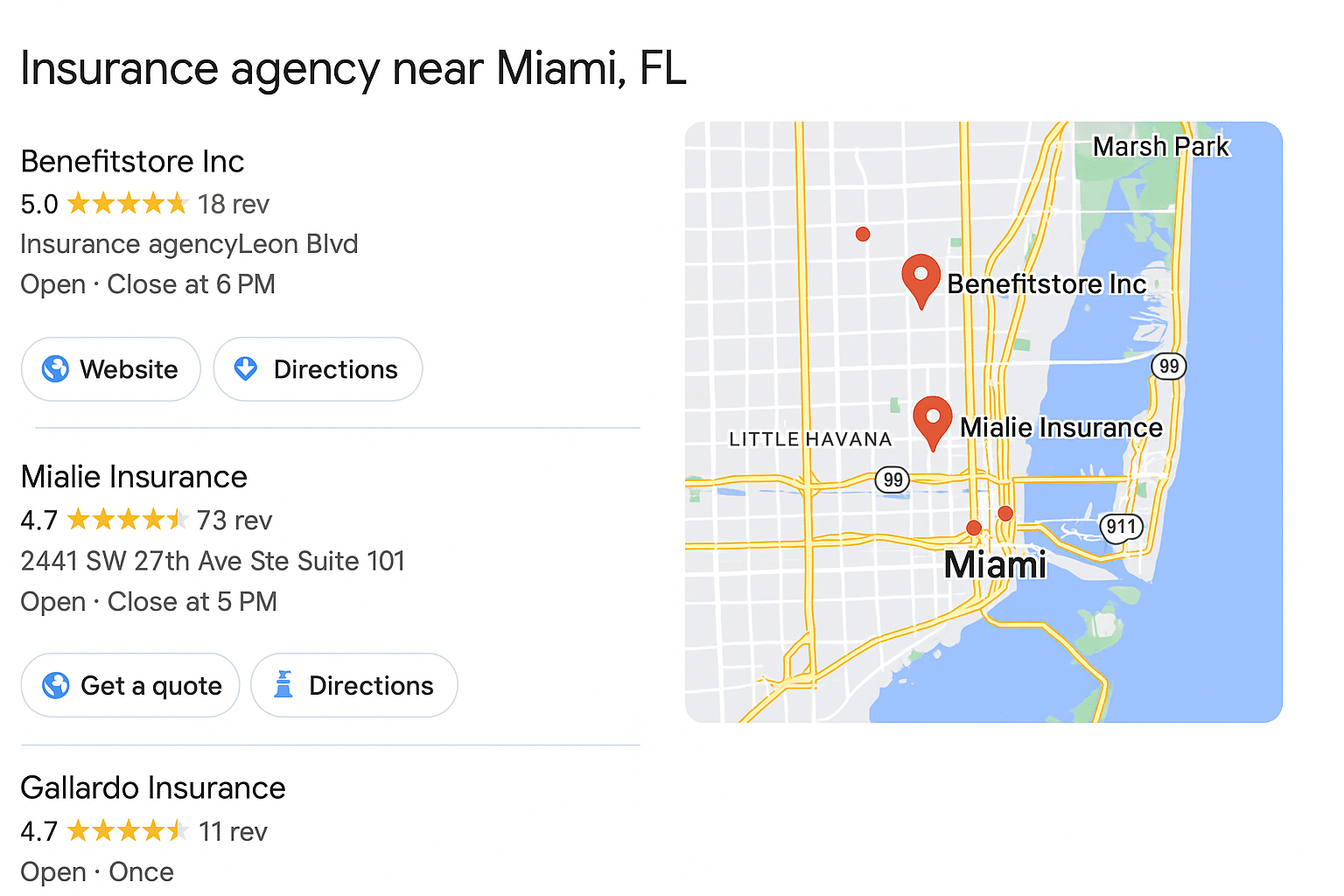
📍 Stand Out Online as the Top Choice for Local Insurance Services
As more people search for the “best insurance agency near me,” it’s critical that your brokerage or agency has a strong and visible online presence. Our seasoned team at Fuel Online is ready to launch and manage a high-impact SEO campaign tailored specifically to your insurance products, customer demographics, and geographic markets.
We specialize in helping insurance providers connect with high-intent policy seekers searching for life, health, auto, home, and business insurance solutions. Whether you’re an independent agent or a multi-location firm, we’ll position your brand at the top of local and organic search results.
🏆 Our Standing as the Best Insurance SEO Agency
Our reputation as a top SEO agency for the insurance industry is built on one core principle: measurable performance with full transparency. We deliver real keyword rankings, lead growth, and detailed SEO reporting—no smoke and mirrors.
Our work has earned us numerous accolades and recognition in publications like Forbes, Clutch, DesignRush, and Inc., and our insurance SEO clients consistently outperform national competitors and aggregators in organic rankings.
Ready to start your insurance SEO campaign?
Let’s talk. Your next policyholder is searching right now.
On Page SEO
- Ai Analysis
- Content Implementation
- Internal Linking Improvements
- Keyword Research & Analysis
- Organic CTR Optimization
- Keyword & On-Page Optimization
- Internal Linking Implementation
- Content Calendar Strategy
Technical SEO
- Schema Markup Strategy
- Technical Code Analysis & Audit
- Technical Code Audit Remediation
- Search Engine Accessibility Testing
- Page Speed Analysis & Tuning
- Robots.txt File Setup / Verification
Link Building
- Domain Authority Improvement Strategy
- Backlink Profile Audit
- Competitor Profile Analysis & Targeting
- Advanced High Quality Link Standards
- Digital Public Relations & Outreach
- Journalist / Blogger Outreach
- Digital Asset & Content Marketing
- Competitor Profile Targeting
How to Choose the Right Insurance SEO Company
Choosing an SEO agency for your insurance business isn’t just about getting ranked — it’s about compliance, lead quality, and sustainable growth in an ultra-competitive space. Here are 5 key factors every insurance provider should consider:
✅ Choose an Agency That Specializes in Insurance SEO
Generic SEO agencies often miss the mark when it comes to understanding insurance-specific regulations, policy terminology, and geographic targeting. Look for a team that’s worked with brokers, agencies, and carriers across health, life, auto, home, and commercial insurance lines.
✅ Ensure Content Is Compliant with Insurance Advertising Regulations
Your SEO content must avoid making unverified claims, rate guarantees, or misleading promises. The right SEO partner knows how to craft persuasive, accurate messaging that aligns with state-level insurance marketing laws and carrier compliance guidelines.
✅ Ask for Real-World Results in Competitive Insurance Markets
Markets like Florida, Texas, California, and New York are flooded with insurance providers. Ask your SEO partner for case studies from high-CPC, high-competition cities that show actual quote volume, lead quality, and keyword wins.
✅ Expect Transparent Strategy and Real Reporting
You should receive clear monthly reports showing keyword rankings, quote form conversions, local visibility, and traffic trends. If the agency only reports on impressions or hides behind “brand visibility” metrics, that’s a red flag.
❌ Avoid Agencies That Promise Instant Results or Guaranteed Page 1 Rankings
True SEO for insurance agencies takes time, technical effort, and high-quality content. Any agency offering “quick fixes” or “instant #1 rankings” is either using black-hat tactics or setting you up for disappointment—and penalties.
Bonus Tip: Work with an SEO partner who understands how to prepare your site for AI Search and Google SGE — because that’s where insurance customers are heading next.
Keep the insurance agency offering, educational topic and contact purpose clear
SEO for insurance agencies should help a person distinguish the agency's actual offering, general insurance information and the correct contact route. Fuel Online can organize those resources around the agency's maintained facts and the purpose of the search. Begin with the information relationship that is unclear rather than a list of new city-and-topic pages. A request to discuss insurance, a current-client service message and an issued policy are different observations. The search program should make those distinctions easier for the agency to explain and measure.
Define the agency resource before the educational topic
An agency resource explains the business and the insurance conversations it actually supports using the facts the agency supplies. An educational resource answers a general topic within its stated scope. A current-client resource provides the agency's published administrative instructions. These resources can connect without implying that every product or scenario mentioned in an article is available through the agency or appropriate for a particular person.
Ask the agency team which source governs each public statement. A general insurance term can be familiar while the business relationship remains unclear. The SEO brief should identify the actual offering, relevant audience and supported next step before choosing a page structure. Marketing can express that relationship clearly without deciding coverage, recommending a policy, determining eligibility or making a statement about an individual's financial situation.
An agency may discuss several lines of business through different administrative paths. The website should reflect the actual arrangement the business supplies. A shared introduction can provide background, while a specialist resource retains the information that changes its meaning. The search supplier should not create a broader product promise simply because a general topic phrase attracts attention or appears on a competitor's page.
| Resource or stage | Responsibility | Boundary to preserve |
|---|---|---|
| Agency offering | Actual business-supplied service relationship. | An educational example is not universal product availability. |
| Educational topic | General explanation within its stated context. | Information is not an individual recommendation. |
| Office information | Maintained public business facts. | A place reference does not create another office. |
| Initial request | The contact action actually supported. | Submission is not a quote or issued policy. |
| Current-client route | Published administrative instructions. | Continuing service is distinct from new acquisition. |
The worksheet is an information and marketing model. It does not establish current policy terms, legal requirements or individual suitability. The agency supplies its actual facts and responsible review process. The SEO provider's useful contribution is a clear page responsibility, source relationship and next action that a reader can understand without confusing educational context with a personal insurance decision.
Work through a fictional educational-page mismatch
Imagine a fictional agency with a general article explaining questions people often ask about business insurance. A reader reaches the article and assumes that every example describes a product the agency can arrange. The actual agency offering is stated elsewhere, but the article never connects to it. Ask the search supplier to inspect whether a concise supported explanation and descriptive link would resolve the ambiguity before commissioning another broad article.
The agency confirms the public offering and what an initial inquiry starts. The editorial repair should make that relationship understandable while retaining the educational article's actual context. It should not add a policy recommendation, guarantee a quote or imply that the reader qualifies for a product. A useful article can guide the person toward an appropriate conversation without pretending that the page has performed the agency's professional review.
Now change the example: the educational passage describes a topic the agency does not offer. The relationship needs to remain clear. The supplier should not invent a service page merely to capture the topic's traffic. The business can choose an accurate explanation or supported information route. The SEO decision should follow the agency's offering rather than treating search volume as permission to create an unsupported commercial invitation.
Separate agency identity from place and topic references
An office address, a service relationship and a place mentioned in an example establish different facts. The agency supplies its actual public geographic information and any conditions that need responsible review. A topic article mentioning a place should not silently create another office or establish a broader ability to transact business. Marketing should preserve those boundaries without turning the SEO guide into legal or regulatory advice.
For a proposed location resource, ask what useful agency-supported information changes for that audience. The page may need a genuine local relationship or a distinct administrative explanation. If the proposed text only exchanges city names in a general paragraph, inspect whether one maintained agency resource and clearer navigation would answer the question more accurately. Another URL should earn its role through substantive information the business can maintain.
Use a fictional office-contact change to test maintenance. Identify the business resource, selected local references and links that depend on the changed detail. Preserve educational examples that remain accurate in their context. The source map should distinguish the office update from a change to the agency's broader offering. That prevents one administrative revision from becoming an unreviewed expansion or contraction of a commercial claim.
Give the quote-request invitation an exact meaning
A public action might invite the person to request contact, provide initial information or begin another agency-supported process. Use the actual wording supplied by the business. A successful form does not establish that a quote has been provided, coverage is effective or a policy has been issued. The page can be clear and persuasive while retaining the difference between an initial request and a later professional or operational decision.
Ask what information changes the initial routing or preparation. The form should support that step rather than collect every document that might eventually be needed. Use the agency's actual approved systems for later sensitive information. A marketing acceptance exercise can use clearly fictional administrative values; it should not require real policy documents or personal financial details merely to demonstrate that a page and received record agree.
Compare the invitation, confirmation and receiving view. If the public action says request a conversation, the confirmation should preserve that meaning. If a particular inquiry category is uncertain, the receiver should see the uncertainty rather than a guessed product selection. The agency's actual process supplies the next action. The SEO provider should not use a more definitive stage label simply because it produces a more attractive conversion report.
Keep prospective and current-client purposes recognizable
A current client can arrive through an acquisition page while seeking help with an existing relationship. That contact can matter operationally without being newly acquired demand. Ask whether the website exposes the agency's established instructions and whether the receiving record preserves the person's stated purpose. The agency determines the actual service process; marketing should make the supported route easier to find.
The same contact details can also appear in more than one genuine prospective inquiry. A shared email address should not automatically merge different stated needs, while a repeated form about one conversation should not automatically create another prospect. Ask the agency which evidence establishes the relationship and what remains pending. The reporting method should preserve uncertainty instead of choosing whichever grouping creates the largest lead total.
Keep arrival context separate from the actual request where the approved configuration supports it. A person may enter through one educational topic and ask about another agency offering. The page label helps explain discovery but should not overwrite the stated need. A later clarification also should not erase the initial source history. These distinctions help the business investigate both acquisition quality and receiving continuity.
Use a fictional reconciliation set before accepting the report
Consider a fictional review with six contact events. Two relate to one new prospective conversation, one corrects that conversation's initial category, one concerns a different new request, one continues a current-client matter and one is a marked test. Under those assumptions, six events describe two candidate new inquiries, one continuing client interaction and an excluded test. The correction remains part of its original conversation.
Those units do not establish quotes, policies or revenue. If only one candidate inquiry has reached an agency-defined reviewed stage, report that observation separately. If the relationship between two contacts is uncertain, keep it pending. The arithmetic is a check of the stated reporting rules, not a claimed client result or forecast. A colleague should reproduce the grouping from the fictional records without knowing the campaign manager's private interpretation.
Use the exercise when comparing agency proposals. Ask how each supplier would preserve the public purpose, clarify uncertainty and explain the stage denominator. A report that shows fewer but reproducible observations can be more useful than a large lead figure combining current clients, tests and repeated contacts. The supplier should identify the actual receiving or measurement repair needed rather than solve the discrepancy by renaming every contact as a conversion.
Distinguish technical identity from another content assignment
A useful agency page can still be difficult to discover through internal links. It can also be affected by a redirect, canonical or access condition that points elsewhere. Ask the supplier to identify the intended destination and the exact observed obstacle. A new article does not repair a technical route that sends readers to another page, and a successful administrative view does not establish every public retrieval condition.
A technical task needs its own evidence and implementation check. A content task should name the question answered and agency source used. A link task should name the reader purpose and destination. These artifacts make the SEO scope more inspectable than a broad promise to improve visibility. Later search observations remain separate from completed implementation and should not be inferred from a checklist alone.
Where a consequential public fact is time-sensitive, identify the responsible current review rather than assume an old source remains sufficient. The SEO supplier can flag the dependency and continue other supported work. It should not invent an updated product statement, platform feature or legal interpretation. Preserving the agency's actual factual review boundary is part of making the content useful and maintainable.
Accept one usable organic journey before expanding it
Choose a supported agency offering and representative search purpose. Follow the relevant resource, educational connection and actual contact action using a clearly marked fictional test through an authorized route. Ask an unfamiliar reviewer to explain the offering and next step from the public material. Compare the confirmation and received record with the original request. The exercise should not depend on a private explanation from the implementation team.
Save the delivered artifacts: revised source passage, implemented link, accurate invitation and accepted receiving test. These establish completed work. Later visits, reviewed inquiries and agency-controlled outcomes need their own observations. If several items change together, acknowledge that the later result does not isolate each contribution. A coherent release can still resolve a clear gap without supporting a claim that one headline caused every subsequent business outcome.
At recurring review, identify which question remains: discovery, missing offering context, unclear educational connection, current-client routing or a reporting relationship. Choose the next bounded assignment from that finding. SEO for insurance agencies becomes more commercially useful when the business can maintain its actual offering, readers can recognize the correct conversation and reported stages retain a meaning the agency can reproduce.
Compare an acquisition inquiry with a continuing client request
Return to the fictional agency page with two messages using similar insurance terminology. The first person asks to begin a new conversation about an agency-supported offering. The second identifies an existing relationship and seeks the agency’s established administrative help. The words alone may overlap, but the purposes differ. Ask the supplier to preserve what each sender actually states and identify the supported public route, rather than classify both as newly acquired policy demand.
Now remove the relationship context from the second message. The receiver should see what remains uncertain and which clarification is needed. A matching email address can be evidence without proving the purpose of every interaction. The agency’s actual process supplies the decision. The marketing report should not count a guessed prospective inquiry simply because that category produces a larger acquisition total, nor should it automatically discard a genuinely separate request from a familiar contact.
Use a marked fictional review set with the receiving team to test the distinction. Ask two reviewers to apply the documented definitions independently and compare the unresolved cases. A disagreement can identify a missing public instruction, unclear field meaning or reporting rule. The useful output is a specific repair with an owner and repeatable check. The exercise does not require real policy information or a judgment about what insurance someone should choose.
When comparing SEO suppliers, ask who will implement the resulting change. One may deliver a revised contact instruction while another includes deployment and receiving validation. Similar package descriptions do not establish equivalent scope. Identify the factual agency input, website responsibility, operational dependency and acceptance evidence. A completed recommendation is different from a usable public route, especially when another provider manages the agency’s website or customer systems.
Keep the review focused on the original observation. If the information route becomes clear but intended prospects rarely find it, discovery becomes another assignment. If suitable requests arrive yet lose their stated purpose, receiving continuity still needs attention. The next action should follow that evidence rather than prescribe another broad insurance article for every issue. This makes recurring organic work more useful without asking the marketing page to perform the agency’s professional service decisions.
For coordination across the wider agency journey and supported lines of business, compare the insurance marketing overview while retaining this page’s organic-search focus.