
SENIOR LIVING, HOME CARE AND HOSPICE MARKETING
Senior Living, Home Care and Hospice Marketing Agency
More visibility. Better-qualified demand. Stronger growth.
Fuel Online combines the specialist expertise of a Senior Living, Home Care and Hospice Marketing Agency with the integrated capabilities of a Senior Living, Home Care and Hospice Digital Marketing Company. Reach more qualified buyers across Senior Living, Home Care and Hospice with specialized SEO, AI search, paid media and conversion strategy. Every recommendation is tied to cost per qualified inquiry and occupancy or census contribution.
Your strategy should reflect your market, capacity, buyer journey and revenue goals, not a generic agency template.

Compare senior-care marketing through actual services and distinct inquiry journeys
Compare a senior-care marketing agency through the way it represents your actual services and preserves the purpose of each inquiry. A broad organization can publish information about different offerings, locations and administrative routes without sending every reader through the same journey. Start with the service line and reader task in scope. A useful proposal connects maintained facts, channel messages, public destinations and receiving records so the organization can inspect what the first release changes before judging later commercial outcomes.
Map the actual service lines and public sources
Build the proposal from the organization's actual service map. Identify which senior-living, home-care or hospice offerings it publicly describes and which locations or service relationships apply to each. The organization supplies those facts. The agency should not assume that every location provides every service because a broad category appears in the organization introduction. The source map gives each message a maintained basis and makes missing business inputs visible before copy or campaigns expand.
Choose one information journey to lead the first release. A family researching an offered service, a professional seeking published referral instructions and a continuing customer seeking an administrative contact can need different destinations. Ask which task is currently unclear and what source resolves it. The marketing assignment can improve orientation and continuity while the organization retains its own care, assessment and admission processes. The proposal should describe the reader gain in plain language.
Give shared organization information a defined role. The organization introduction can explain its published identity and relationships, while a service resource develops the relevant offering and a location resource supplies its actual context. Those resources should connect without requiring every page to reproduce the same broad introduction. Ask the agency to show where each recurring fact is maintained and which resources use it. This makes a later update more manageable than searching for every mention of a category name.
| Journey or source role | Information to maintain | Useful agency acceptance evidence |
|---|---|---|
| Organization introduction | Actual identity and shared service relationships | Related resources connect without implying every location offers every service. |
| Service or location resource | Organization supplied scope and place context | The reader can identify the maintained fact and appropriate destination. |
| Family-information route | Supported inquiry purpose and next administrative action | The receiver interprets the fictional message as originally stated. |
| Professional-information route | Actual public referral instructions and established process | The resource remains distinct from a generic consumer form. |
| Continuing relationship | Organization supplied administrative contact path | Useful ongoing contacts remain separate from new acquisition. |
| Commercial report | Documented service-line stage and unit | Message, inquiry and later outcomes can be reproduced from their records. |
A service-line worksheet should identify the reader question, maintained source, public destination and receiving owner. Use the actual organization names for the services and stages it supports. A visitor should be able to recognize which information is relevant and where an administrative conversation continues. The worksheet is a procurement tool for evaluating a marketing system; it does not ask an agency or family-facing page to determine which care arrangement an individual should select.
Keep family, professional and continuing purposes legible
Family research needs clear orientation before a contact action. Ask whether a person arriving directly at the relevant page can identify the organization, the offering in scope and the supported next step. A general promotional statement may introduce the business while leaving the service relationship unexplained. The useful first revision could be a clearer introduction, a connection with a maintained explanation or a more legible contact route. The agency should identify the actual gap rather than apply the same redesign to every service.
Professional contact has its own information purpose. Ask the organization which referral instructions belong publicly and which steps continue through its established process. The agency can make that resource easier to find from the appropriate service or location context. A consumer inquiry form should not silently become a professional referral procedure. Clear routes help each reader reach the organization process without marketing creating clinical instructions or an acceptance promise that the receiving team has not supplied.
Continuing relationships also need a recognizable route where the organization supports one. A current client or family contact may arrive through a discovery page while seeking administrative information about an existing relationship. That interaction can be operationally important without being newly acquired demand. Ask how the public instructions and report retain that purpose. A campaign marker should not automatically turn every contact into a new service inquiry simply because it appeared on an acquisition-oriented resource.
Give channels a shared factual basis
Compare channel roles after the information map is clear. Search work can connect the relevant question with the maintained service answer. Advertising can introduce a supported message and destination. Content can resolve a specific service or location distinction. Website work can make the next action understandable. These tasks can reinforce one another when they use the same source relationships, while still having distinct artifacts and completion checks. The program becomes easier to compare than a package described only by channel count.
Ask each supplier to demonstrate one full introduction and one shortened adaptation using the same approved service source. Important conditions and location relationships should survive the shorter format. The agency should explain what has been shortened and where the reader finds the fuller context. A concise message can be direct without broadening the actual offering. This exercise lets the organization evaluate coordination before several channels begin maintaining separate descriptions of the same service relationship.
Work through location and organization source changes
Use a fictional location-source change to test that coordination. Suppose the organization revises the administrative contact destination for one location while its published service explanation remains accurate. Identify the location invitation, related service links and active message destinations that depend on the contact fact. Correct the affected routes and retain accurate unrelated information. The exercise tests a narrow information change rather than assuming that every organization page needs a new introduction.
Now change the service association in the fictional materials. The organization clarifies that one published relationship applies to a particular location or service area. Ask the agency to identify the exact passages and links that depend on the earlier association. The scope of the revision follows the supplied fact. It should not imply that the entire organization changed its offerings or that unrelated locations need identical wording. Keep the confirmation and its factual owner beside the change record.
A third source exercise can concern a shared organization contact route. Compare its dependent resources with the location-specific case. The sets may differ. A useful source map allows the agency to show which public invitations share that organization route and which continue through separately maintained destinations. This protects the clarity of distinct service journeys as the program develops. Another contributor should be able to understand the reason for each change without reconstructing a private conversation.
Inspect proof and photographs by the role they serve. An image can identify a setting or help orient a reader, while a documented example may establish a narrower fact. Ask which statement the organization can substantiate and what permissions govern the proposed use. A photograph alone should not supply an unconfirmed service, location or outcome relationship. The agency should retain the actual context in captions and surrounding information when adapting material to another channel or page.
Preserve the inquiry purpose at receipt
The inquiry route should preserve the service and place actually stated by the sender. Someone may enter through a general organization page and ask about one location, or reach one service resource while requesting a different conversation. Keep arrival context and the message separate where the configuration supports them. The receiving team should be able to explain the request without relying on a campaign or page label as if it proved the destination intended by the person.
Use clearly marked fictional details to test the public-to-receiving connection. Begin at the selected service resource, follow the supported invitation and inspect the confirmation and received record. Ask the receiver to identify the stated purpose and next administrative action. Compare that interpretation with the original test sheet. A successful browser event and a message understood by the relevant team establish different parts of delivery; retain both checks rather than assume one proves the entire journey.
Repeat the test with a corrected location or service preference. The available process may update a record, preserve linked messages or require staff review. Ask how that behavior is represented. A correction should not automatically become another newly acquired person or erase the original inquiry context. The report needs a documented relationship between those records so later comparisons can distinguish more interactions from more distinct new inquiries.
Several contacts may participate in one family or professional conversation. Conversely, similar names can represent unrelated requests. Ask which actual records support a match and how uncertain cases remain visible for review. A shared address or organization label should not silently determine the entire relationship. The organization supplies the unit it needs to measure; the agency should preserve the underlying messages and explain the rule rather than present an unexplained duplicate total.
Reconcile eight fictional received messages
Consider an explicitly fictional set of eight received messages. One family sends an inquiry and then a correction, creating two records for one stated conversation. A professional contact sends one separate information request. The other five records are a continuing-family administrative question, an existing professional follow-up, a vendor introduction and two clearly marked delivery tests. The set contains eight messages, one candidate new family inquiry and one separate professional-information request under those stated relationships.
The worksheet does not establish eight admissions, eight new clients or a completed referral. If the organization later records a next step for the family conversation, preserve that stage separately. The professional request retains its actual information purpose until the organization process establishes another stage. The correction remains linked to the family inquiry, continuing contacts retain their existing purpose and the tests stay outside acquisition reporting. These figures illustrate classification logic only, not campaign results or expected outcomes.
Ask the agency and receiving owner to reproduce that result from the sample records. If their totals differ, compare whether one counted messages, people, conversations or later organizational stages. The disagreement can reveal different definitions without proving lost records or poor campaign quality. Use names that identify the unit and source of each total. A report becomes more useful when another reader can explain both what it includes and what remains unresolved.
Keep later stages tied to the service line's actual process. The organization may record different administrative or business events across its offerings. A tour-related event, information inquiry, recorded assessment stage or completed organizational outcome should retain its supplied definition rather than collapse into one favorable conversion label. The agency can connect records where the systems support the relationship. Where evidence is unavailable, show the observed stage and the specific dependency needed for a fuller view.
Compare scope and acceptance through actual records
Compare the investment discussion using equivalent measures. Ask which spend, reporting period, service line and event are included in a cost figure. A cost per submitted message answers a different question from cost per organization-reviewed inquiry. Another service line may record a different later stage. Keep those differences visible before comparing budgets or reallocating work. A lower number attached to a broader event definition is not automatically a like-for-like improvement.
An agency scope should identify who prepares, confirms, implements and checks each artifact. The organization may own the service facts while a website supplier controls deployment and another team controls the receiving configuration. A finished draft, approved revision, public change and completed test are different states. Keep those states beside the task. This allows useful work to progress around a specific dependency without describing an unfinished connection as delivered or treating one blocked component as the entire program.
Use acceptance exercises that a new contributor can repeat. Give an unfamiliar reviewer one family-information task and one professional-information task. Ask them to locate the maintained source, explain the relevant service relationship and reach the supported next step. Then ask a different contributor to apply the fictional location-contact change using the source map. Record where either person needs an unstated assumption. Those findings create precise improvements rather than a vague request for more persuasive content.
At handover, retain the actual service map, source owners, active adaptations, completed change example and receiving worksheet together. The record should explain which information is shared and which remains specific to a location or service line. A future contributor should know why a resource exists and which fact would trigger review. This makes the program maintainable when an organization updates a public route, supplies a narrower service statement or changes the owner responsible for its information.
Choose the next assignment from the remaining demonstrated gap. Unclear service relationships, difficult professional-information routes, lost inquiry context and incompatible report definitions need different work. A useful senior-care marketing engagement makes those decisions understandable and grounds public changes in actual organization facts. Later discovery, inquiries and organizational outcomes can guide the program through observed evidence, while the completed source and website work remains concrete enough for the organization to inspect.
THE REAL MARKET
We understand Senior Living, Home Care and Hospice. We deliver real results.
The strongest strategy reflects the real people, pressure, proof and decisions behind the market.

Buyers evaluate the people, environment, trust and service experience behind the brand.
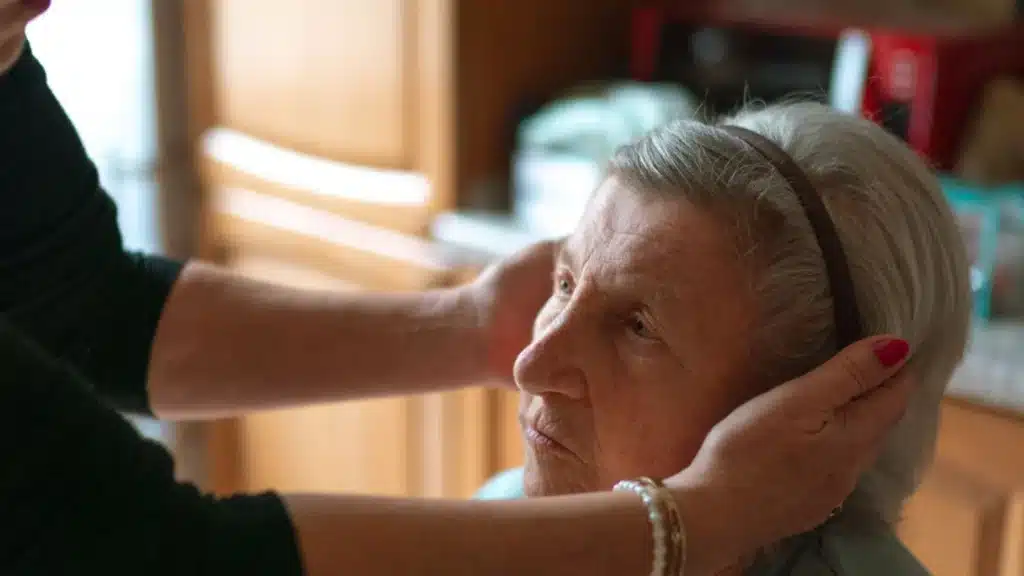
Marketing should help the right buyer understand fit and take the next qualified step.
PROVEN IMPACT. REAL CAMPAIGNS.
Why Senior Living, Home Care and Hospice leaders choose Fuel Online.
Choosing an industry-specialized digital marketing partner requires more than a broad capabilities list. Fuel Online has been an industry leader since 1998 and has earned hundreds of awards and recognitions. That legacy combines senior strategic ownership, nationally recognized expertise, BBB-accredited trust and published performance evidence with a clear understanding of the buyers, economics and conversion paths across this industry.
CASE STUDIES
Campaign Results
Three directly linked Fuel Online campaigns selected for industry, service, market and buyer-journey relevance.
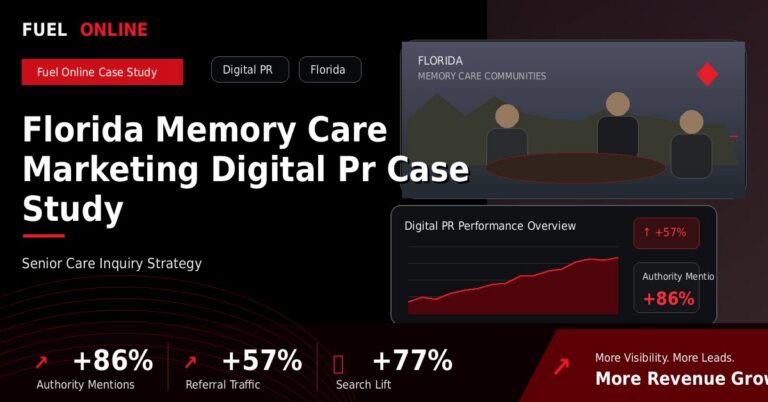
Florida Memory Care Marketing Digital PR Case Study
+292% Search Visibility | +63% Qualified PipelineSee the strategy, execution and complete campaign results.
View Case Study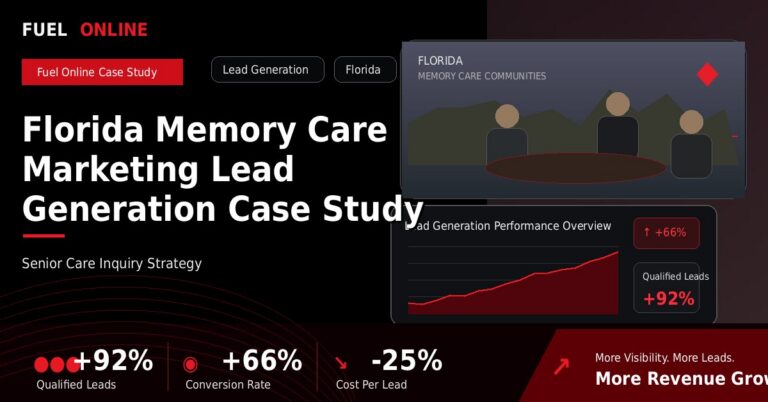
Florida Memory Care Lead Generation Case Study
+158% Search Visibility | +161% Qualified PipelineSee the strategy, execution and complete campaign results.
View Case Study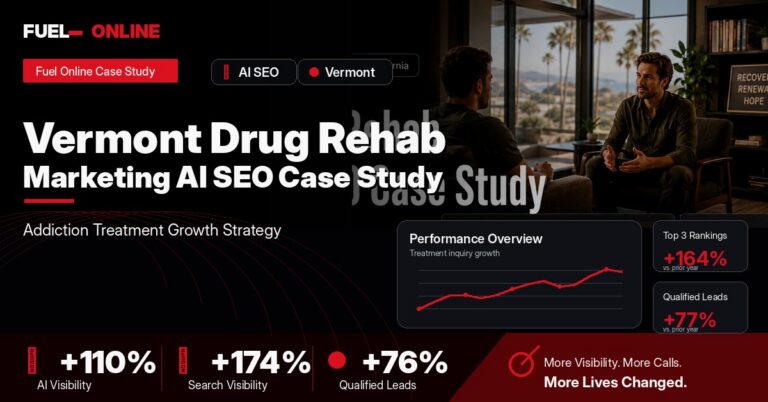
Vermont Drug Rehab AI SEO Case Study
+144% Admissions Inquiries | +244% Search VisibilitySee the strategy, execution and complete campaign results.
View Case StudyWE UNDERSTAND THE BUSINESS BEHIND THE MARKETING
What a Senior Living, Home Care and Hospice Marketing Agency must understand about real growth.
A high-performing senior living, home care and hospice marketing agency must translate visibility into measurable business growth.
INDUSTRY FUNNEL INTELLIGENCE
How senior living, home care and hospice organizations build a qualified growth pipeline.
An effective Senior Living, Home Care and Hospice Marketing Agency connects buyer discovery, comparison, validation and response to a measurable commercial outcome. The pipeline begins when the right buyer recognizes a need and becomes valuable only when a qualified next step progresses into move-ins, admissions or recurring care relationships. The role of a senior living, home care and hospice SEO agency is to keep discovery, proof, qualification and response connected to the same commercial outcome.
Families, older adults and professional referral sources evaluating care rarely decide in one visit. They may begin with care type, near-me, cost, availability, reviews, safety, comparison and family decision searches, compare providers, review referrals, ask an AI assistant for options and return later through another channel. The system must preserve intent across those touchpoints while making service fit, proof and the next step easy to understand.
Fuel Online maps that journey around the facts that determine fit in Senior Living, Home Care and Hospice: care level, community or agency capacity, location, availability, payer source, urgency, trust and occupancy or census value. Search architecture, paid media, answer-ready content, reviews, landing pages, calls, scheduling and follow-up are coordinated around buyer questions. Source, query and message are then connected to response, qualification, completion, loss reason and move-ins, admissions or recurring care relationships, revealing whether the constraint is visibility, demand quality, conversion friction, capacity or positioning.
Discover
Reach the right buyer through search, maps, referrals, reviews, paid media, content and AI-assisted recommendations.
Understand
Explain service fit, location, cost, timing, process and the tradeoffs that determine whether the organization belongs on the shortlist.
Validate
Use credible proof, expertise, reviews, case evidence and consistent facts to reduce perceived risk.
Act
Make the next qualified step clear through calls, forms, scheduling and the specific qualified inquiry, assessment or tour pathway buyers expect.
Revenue learning
Connect source and message to qualification, completion and move-ins, admissions or recurring care relationships so investment follows real value.
KNOW THE MARKET BEFORE BUYING MEDIA
The buyer journey, decision pressure and conversion risks that shape Senior Living, Home Care and Hospice growth.
Senior living, home care and hospice share an aging population and family-influenced decisions, but they are not one interchangeable market. Community-based care, in-home services and end-of-life support have different buyers, urgency, capacity, payer considerations, referral patterns and conversion events. A credible industry strategy must preserve those differences while giving leadership one clear view of qualified demand and occupancy or census contribution. A credible senior living, home care and hospice AEO agency prioritizes the market constraint most likely to improve qualified inquiries, assessments or tours.
Who shapes the shortlist
Different people bring different questions, urgency and proof requirements to the same commercial decision.
People comparing community-based care, support at home or hospice services while balancing safety, independence, urgency, cost and geography.
Discharge planners, physicians, care managers, social workers, senior advisors and community partners validating fit, access and responsiveness.
Families researching options before a crisis and comparing service models, care levels, reputation, availability and financial considerations.
WHERE GOOD DEMAND GETS LOST
The gaps a specialist agency should diagnose before increasing spend.
These breakdowns quietly waste qualified demand, distort reporting and make additional budget look less effective than it should.
The website blends community living, home care and hospice language instead of helping the family identify the correct care setting.
Marketing creates inquiries for locations, service areas, care levels or timing the organization cannot support.
Families and professionals cannot quickly confirm credentials, availability, responsiveness, reviews and service fit.
Calls and forms are not routed or answered fast enough when families are contacting several providers.
THE AUTHORITY DECISION MATRIX
How the Senior Living, Home Care and Hospice authority system connects specialties, buyer journeys and commercial outcomes.
| Decision stage | Buyer signal | Engineering requirement | Measured outcome |
|---|---|---|---|
| Discovery | High-intent search, local comparison and AI-assisted research | Clear service architecture, indexable answers and niche relevance | Qualified visibility |
| Validation | Reviews, proof, expertise, availability and fit | Entity consistency, third-party corroboration and decision-ready content | Shortlist inclusion |
| Conversion | Calls, forms, scheduling and the next committed step | Message match, friction control, response standards and qualification | Qualified inquiries, assessments or tours |
| Revenue feedback | Completed outcomes, value and loss reasons | CRM stages, offline attribution and budget reallocation | Move-ins, admissions or recurring care relationships |
DECISION ANSWERS AND VERIFIED CONTEXT
Direct answers and market evidence for choosing a Senior Living, Home Care and Hospice Marketing Agency.
High-stakes buyers need direct answers about fit, cost, timing, process, risk and the next step. The evidence below combines current market context, practical commercial answers and Fuel Online analysis in clearly attributable passages that are also easier for search engines and AI answer systems to interpret accurately. Buyers assessing a senior living, home care and hospice marketing agency need direct information about fit, evidence, process, risk and measurement.
People age 65 and older in the United States in 2024
The older population represented 18% of the country, but demand still varies sharply by care setting, geography, acuity, capacity and payer source.
Source: U.S. Census BureauGoogle says AI Overviews and AI Mode use existing search eligibility and foundational SEO best practices
The practical priority is an indexable, useful and technically sound page with clear internal links, visible evidence and structured data that matches the page. Google does not require special AI schema.
Source: Google Search CentralBing Webmaster Tools now reports citations, cited pages and grounding queries
AI visibility can be audited by question, cited source and recommendation pattern instead of being reduced to anecdotal prompt screenshots.
Source: Microsoft Bing Webmaster BlogQUESTIONS BUYERS AND ANSWER ENGINES ASK
What does an effective Senior Living, Home Care and Hospice Marketing Agency actually do?
It reaches families, older adults and professional referral sources evaluating care during discovery and comparison, explains the information required to judge fit, earns enough confidence for a qualified next step, and connects that activity to move-ins, admissions or recurring care relationships. The work normally combines search visibility, answer-ready content, paid demand, reviews, proof, conversion design and outcome measurement rather than relying on a single channel.
Decision implicationAn agency proposal should identify the buyer, conversion event, downstream outcome and feedback loop. A list of tactics without those connections is not a complete growth strategy.
Which questions do Senior Living, Home Care and Hospice buyers need answered before they inquire?
Buyers need to understand who the service is for, the conditions that determine fit, location or service-area limits, cost or pricing factors, timing, availability, process, proof, alternatives, common concerns and the next step. In this market, decisions are strongly shaped by care level, community or agency capacity, location, availability, payer source, urgency, trust and occupancy or census value, so those facts should be stated directly rather than buried behind generic promotional language.
Decision implicationClear answers to difficult commercial questions help qualified buyers self-select, improve sales conversations and create more precise passages that search and answer systems can understand and cite accurately.
How should success from Senior Living, Home Care and Hospice Marketing Agency be measured?
Success should be measured from visibility through qualified inquiries, assessments or tours and into move-ins, admissions or recurring care relationships. Useful diagnostics include query and page visibility, map presence, AI mentions, qualified calls and forms, response rate, scheduled next steps, completion rate, loss reasons and acquisition cost. The controlling measure is cost per qualified inquiry and occupancy or census contribution, because inexpensive leads can still be commercially weak.
Decision implicationThe reporting system should show where demand originates, where it leaks and which source produces the strongest downstream value. That evidence should determine priorities and budget.
How do organic search and AI-assisted discovery work together?
AI visibility still depends on strong search foundations. Indexable pages, clear entities, useful answers, internal links, structured data, trusted sources and consistent facts make the brand easier to retrieve and explain. Buyers may discover a provider through an AI answer and then validate it through Google, maps, reviews, the website and third-party sources before contacting anyone.
Decision implicationSEO, AEO and GEO should share one evidence system. The goal is accurate discovery and qualified action, not isolated screenshots of one favorable prompt.
How much should an organization invest in Senior Living, Home Care and Hospice Marketing Agency?
Investment depends on market competition, the number of locations and services, the technical condition of the site, the amount of content and authority required, available internal resources and the measurement infrastructure already in place. A responsible agency should define the work, assumptions, dependencies and commercial model before presenting a fee.
Decision implicationCompare scope, senior ownership, technical depth, content production, authority development, reporting and downstream measurement rather than choosing the lowest monthly number.
How long does Senior Living, Home Care and Hospice Marketing Agency take to produce meaningful results?
Timing varies by current authority, technical debt, competition, market demand, implementation speed and the type of result being measured. Technical repairs and early conversion gains can appear before durable visibility, authority and qualified pipeline growth. The roadmap should separate immediate repairs, near-term opportunities and compounding work.
Decision implicationA credible plan should include leading indicators, milestone dates, dependencies and the conditions that could accelerate or delay progress.
How should buyers choose the Best Senior Living, Home Care and Hospice Marketing Agency?
Buyers should compare direct market fluency, senior strategic ownership, technical capability, evidence quality, local and multi-location experience, conversion measurement, communication standards and the ability to connect activity to qualified commercial outcomes. The best choice is the provider with the strongest documented fit for the buyer, not the loudest self-awarded claim.
Decision implicationRequire a transparent diagnosis, specific priorities, relevant proof, clear limitations and reporting that follows performance beyond traffic or platform leads.
What should a serious Senior Living, Home Care and Hospice Marketing Agency proposal include?
A serious proposal should define the buyer, market, service scope, query and page architecture, technical risks, evidence plan, content and authority requirements, conversion path, measurement model, responsibilities, timing, assumptions and the commercial outcomes the work is designed to influence.
Decision implicationIf a proposal lists recurring deliverables but does not explain why those priorities fit the market and how they will be measured, it is a production schedule rather than a strategy.
How is a specialist Senior Living, Home Care and Hospice Marketing Agency different from a generalist agency?
A specialist should understand the buyer journey, service-line distinctions, economics, capacity limits, regulatory boundaries, local-market pressure, proof requirements and conversion events that define Senior Living, Home Care and Hospice. A generalist may still execute individual tactics well, but the burden is on the buyer to verify whether those tactics are connected to the market and commercial outcome.
Decision implicationCompare the diagnosis, examples, measurement model and strategic tradeoffs. Specialization is valuable only when it produces better decisions, clearer execution and stronger qualified outcomes.
Why should the major service lines inside Senior Living, Home Care and Hospice use distinct marketing paths?
Closely related service lines can share an audience and referral ecosystem while still having different urgency, eligibility, capacity, economics, regulations and conversion events. Combining them into one generic message makes it harder for buyers to identify fit and harder for leadership to understand which demand can actually be served.
Decision implicationThe strongest market strategy establishes the shared decision environment, then gives each service line, specialty and location a clear path with its own buyer questions, evidence, qualification standards and measurable commercial outcomes.
BUYER SEARCH INTELLIGENCE
6 questions serious buyers should ask before choosing a Senior Living, Home Care and Hospice growth partner.
Test fluency, proof, scalability, timing and accountability.
Does the agency understand this market deeply enough to change the strategy?
A credible comparison of the best senior living, home care and hospice marketing agency should reveal senior ownership, relevant proof, technical depth and the ability to connect execution to qualified outcomes.
Can the team translate local and service-line differences into a better plan?
The best senior living, home care and hospice digital marketing company should account for how search behavior, competition, availability and qualification standards change by service and location.
Can one strategy scale across locations without producing cloned execution?
The best senior living, home care and hospice marketing agency for multi-community and multi-location senior care organizations should pair centralized standards with differentiated local evidence, consistent entities and location-level reporting.
What exactly is included in the investment?
A proposal from an senior living, home care and hospice marketing agency should explain research, technical remediation, content production, authority development, conversion support, measurement and senior oversight.
What should improve first, and when should meaningful progress appear?
A roadmap for senior living, home care and hospice digital marketing company should separate immediate repairs, early visibility gains, content production and compounding authority work.
How will reporting prove commercial value instead of activity?
For senior living, home care and hospice marketing agency for multi-community and multi-location senior care organizations, reporting should connect discovery to qualified inquiries, assessments or tours, progression into move-ins, admissions or recurring care relationships and cost per qualified inquiry and occupancy or census contribution.
senior living, home care and hospice SEO agency tests specialist fit and proof.
senior living, home care and hospice AI SEO agency compares proof, ownership and measurement.
senior living, home care and hospice AEO agency signals specialist strategy intent.
senior living, home care and hospice PPC agency requires clear scope and outcomes.
Test intent, capacity and downstream value.
WHY FUEL ONLINE
Industry leadership since 1998, elite technical execution and senior accountability in one agency.
Fuel Online has been an industry leader since 1998 and has earned hundreds of awards and recognitions across SEO, digital marketing, paid media, social media and emerging AI search. That legacy is paired with veteran leadership, specialized channel engineering and commercial accountability without passing strategy to a junior account layer.
Fuel Online has led search and digital marketing through every major platform shift since 1998, combining long-term institutional knowledge with continuous research, testing and adaptation.
Experienced strategists own priorities, explain the tradeoffs and connect execution to cost per qualified inquiry and occupancy or census contribution rather than delegating the engagement to a disconnected junior account team.
Fuel Online preserves the differences between service lines, buyer groups, locations and conversion events instead of forcing the entire industry into one message.
Fuel Online has earned hundreds of awards and industry recognitions across SEO, digital marketing, paid media, social media and emerging search, backed by published results and transparent measurement.
INSIDE THE FUEL ONLINE ENGINEERING STACK
Inside the Fuel Online Authority Engineering Stack.
Fuel Online combines technical search, AI visibility, paid acquisition, conversion and measurement controls into one senior-led authority system for Senior Living, Home Care and Hospice.
READY TO OUTPERFORM?

Fill out the form below for rocket fast response
GET YOUR CUSTOM DIGITAL STRATEGY BUILT BY STRATEGISTS, NOT SALESPEOPLE.
No cookie-cutter templates. No recycled audits. We engineer custom digital strategies built by our top digital strategists and leadership for your unique market, goals and opportunities.
Decades of Experience.Senior strategists apply decades of digital growth experience to every recommendation, priority and proposal.
Built Around You.We engineer every strategy around your market, goals, competition, resources and strongest opportunities.
Several Smart Paths.We formulate multiple high-impact options so you can choose the right path, pace and investment.
Partners for Years.Our goal is to make every new client a long-term partner and valued member of the Fuel Online family.
YOUR NEXT STEP
STRATEGY SESSION WITH A MANAGING DIGITAL STRATEGIST
A focused call. A custom strategy. Real options.
- We dive into your business, market and growth goals
- We build a custom digital strategy tailored to you
- We deliver several high-impact options to choose from
- You decide the path forward
No sales pitch. No pressure.Just senior strategists engineering your best path forward, fast.