

What a specialist engagement should deliver
A healthtech SEO agency should connect buyer intent, technical execution and useful evidence to accepted demonstrations and qualified buying-team opportunities. Fuel Online specializes in this work for healthcare software vendors, digital health platforms and clinical technology companies. We define the audience, the page or campaign that serves it, the next useful action and the qualification standard before interpreting growth.
Fuel’s advantage is the connection between analysis and implementation. Our U.S.-based strategists and engineers work across search, AI discovery, content, paid media and conversion. Your scope identifies the pages and campaigns to improve, the people responsible and the evidence needed to make the next decision. That lets your team examine the work behind the report and connect it to commercial priorities.
Visibility earns attention. Clear evidence earns evaluation. A relevant next step turns that evaluation into a useful conversation.
How we build healthtech SEO agency around buyer intent
Own software use cases and integration intent
Healthtech SEO agency work should connect use-case pages, product categories and approved integration resources. The architecture needs enough specificity for a buyer to recognize their environment. We assign clear query ownership and maintain navigable connections between clinical workflow, technical deployment and commercial evaluation. Generic healthcare content can attract an audience that never needed the vendor’s product.
Create answers that preserve product scope
AI-generated comparisons can flatten important differences between products. Fuel builds concise, supported explanations of intended users, available capabilities, deployment responsibilities and integration requirements. Every answer connects to a page that supports it. Our review records what the engine mentioned, what it cited and whether the source matched the claim, rather than treating every appearance as a trustworthy recommendation.
Measure accepted demos and buying-team progression
Healthtech SEO agency reporting should follow the route from search to a relevant demonstration, then distinguish sales acceptance and opportunity progression. We classify patient queries, support traffic and existing-user questions separately. Where CRM integration supports it, we compare lead quality by landing page and buyer segment. If the conversion definition changes, the report marks the break rather than presenting an artificial growth trend.
| Search intent | Page responsibility | Useful next action |
|---|---|---|
| Clinical leadership | Workflow, intended use and supported evidence | Relevant clinical product evaluation |
| IT & integration teams | Architecture, supported systems and implementation requirements | Technical qualification conversation |
| Finance & operations | Defined inputs, deployment costs and operational assumptions | Business-case review |
| Procurement & security | Approved vendor information and documented product claims | Suitable buying-team opportunity |
Fuel’s technical and tactical healthtech SEO agency execution
Our proprietary protocols organize the work from diagnosis through implementation and follow-up. AI-assisted analysis helps our specialists examine patterns, compare page coverage and prioritize questions; expert review determines whether an answer is accurate and useful. We identify the constraint, specify the change and verify the shipped work. You receive a defined scope and accountable practitioners instead of a disconnected list of recommendations.
| Workstream | What Fuel builds or improves | What the work supports |
|---|---|---|
| Architecture | Query-to-page ownership, canonical review and important crawl paths | Relevant pages discovered and served consistently |
| Content & evidence | Expert briefs, answer blocks, internal links and approved factual material | Buyers can evaluate the actual offer |
| Technical delivery | Rendering, redirects, template QA and mobile usability | Important information remains accessible |
| Commercial measurement | Landing-page intent and qualified conversion definitions | Search evaluated against accepted demand |
A useful engagement also states dependencies. Your product, clinical or technical experts approve specialist claims. Your sales or intake team defines accepted demand. Fuel manages the agreed research, content, technical and campaign work. When access or implementation limits a measurement, the report explains that limit and identifies the practical next step. Aggressive execution means moving decisively on relevant work, with careful quality control.
Industry evidence and the decision it informs
Primary-source context. ASTP/ONC reports certified health IT adoption by hospital type and year using hospital survey data. Technology adoption is a market-context measure, not a count of buyers for an individual product. A vendor’s demand strategy still needs a specific workflow, buyer and integration requirement.
Source: ASTP/ONC hospital health IT data. Reviewed October 2026.
Our contribution is to connect that context to an actual buying decision. A market statistic should have a defined year, geography and population. A product claim should have an approved source. A worked calculation should show its inputs. Fuel builds content that can be understood and checked in its own right, giving a prospective buyer something useful to quote or take back to their team.
Applied buyer journey. A workflow-software vendor provides a solution page for clinical leaders, a supported-integration resource for IT and an implementation overview for procurement. The demo request captures organization type and use case before the sales team accepts the opportunity.
AI SEO, AEO and GEO for Healthtech
For healthtech, AI SEO, answer engine optimization (AEO) and generative engine optimization (GEO) need the same foundation: a clear offer, accessible pages and facts that support the answer. Fuel builds direct explanations of the buyer’s question, then connects each answer to deeper evidence and an appropriate next step. We avoid stripping out the conditions that make an industry answer accurate.
Fuel’s R&D lab informs our advanced AI capabilities and proprietary analysis workflows. Our specialists use them to review buyer questions, identify gaps in source coverage and examine how a brand is represented. The review records the engine, date, question, cited URL and exact claim. A mention, a recommendation, a linked citation and a referral visit are separate observations. That distinction turns an AI visibility discussion into something your team can inspect.
| Buyer question type | Answer design | Evidence needed |
|---|---|---|
| Fit | Who the product or service serves and where it stops | Approved capabilities and supported environments |
| Comparison | Relevant criteria with meaningful differences | Defined conditions and attributable sources |
| Implementation | Responsibilities, dependencies and next steps | Current technical or service documentation |
| Commercial next step | Appropriate inquiry, demo, consultation or RFQ | Actual team process and qualification criteria |
Our healthtech SEO agency work integrates AI discovery with organic search and conversion. A schema type or a writing format cannot force an engine to cite a source. We improve the material buyers can evaluate and report the appearances we actually observe. Explore Fuel’s AI SEO, AEO and GEO services for the broader scope.
WordPress SEO and technical delivery for Healthtech
Solution, integration and evidence resources should share consistent product terminology. We optimize WordPress delivery without exposing private clinical data in public analytics or placing unapproved patient information into page content.
Fuel reviews the templates that carry the offer, the URLs that own important queries and the integrations that carry inquiries. Technical priorities can include clean heading structure, self-canonicals, relevant internal links, rendering, redirects, image delivery and unnecessary archive exposure. Changes should improve the important buying journey and preserve working conversion paths. We verify the result on mobile as well as desktop.
Our healthtech SEO agency program can include WordPress implementation when the site requires it. We define the work needed rather than create a duplicate service page for every platform label. See WordPress SEO services and Fuel’s core SEO services for platform and organic-search delivery.
Measure healthtech SEO agency against qualified growth
Fuel evaluates accepted demonstrations and qualified buying-team opportunities alongside relevant visibility and delivered work. Agree on the acceptance criteria before comparing results. For this industry, exclusions can include patient treatment requests, unsupported clinical claims and organizations outside product fit. A search dashboard should not quietly count those audiences as sales demand.
| Measurement stage | Definition to agree before reporting |
|---|---|
| Relevant visits | Visits to pages serving the agreed buyer intent |
| Raw inquiries | Recorded contact, consultation, demo or RFQ events |
| Accepted demand | Organization type, intended workflow, deployment fit, relevant buying role and sales acceptance |
| Sales progression | Agreed next stage supported by the CRM or intake system |
Growth planning model / monthly inputs
Traffic matters. Conversion and fit multiply it.
Relevant visits × inquiry rate × acceptance rate
Starting inputs: 1,000 × 2% × 50% = 10.
Improved inputs: 1,500 × 3% × 60% = 27.
Scenario inputs demonstrate the calculation. Replace them with your measured baseline and agreed targets; they are not a reported client result or a forecast.
The model shows why traffic alone is an incomplete growth objective. Its visit input rises 50%, while accepted leads rise from 10 to 27 because conversion and acceptance improve as well. That is a calculation from the stated assumptions, not an industry benchmark. Fuel uses your actual baseline to determine whether the priority is discovery, page clarity, qualification or follow-up, then evaluates those changes with a consistent comparison period.
National organic rank checks use national settings. Location-specific measurements identify the actual geography and are reported separately. We also separate branded discovery, nonbranded search, paid traffic and AI referrals. If several channels influence one opportunity, their reports should not each claim the same revenue as an independent result.
Why choose Fuel as your healthtech SEO agency partner?
Choose Fuel when you want specialist positioning backed by technical depth, proprietary marketing protocols and hands-on execution. Our healthtech SEO agency approach connects the knowledge of your industry to a practical acquisition system. We work aggressively on the pages, campaigns and conversion constraints that matter, with advanced AI capabilities supporting the analysis and experienced specialists making the decisions.
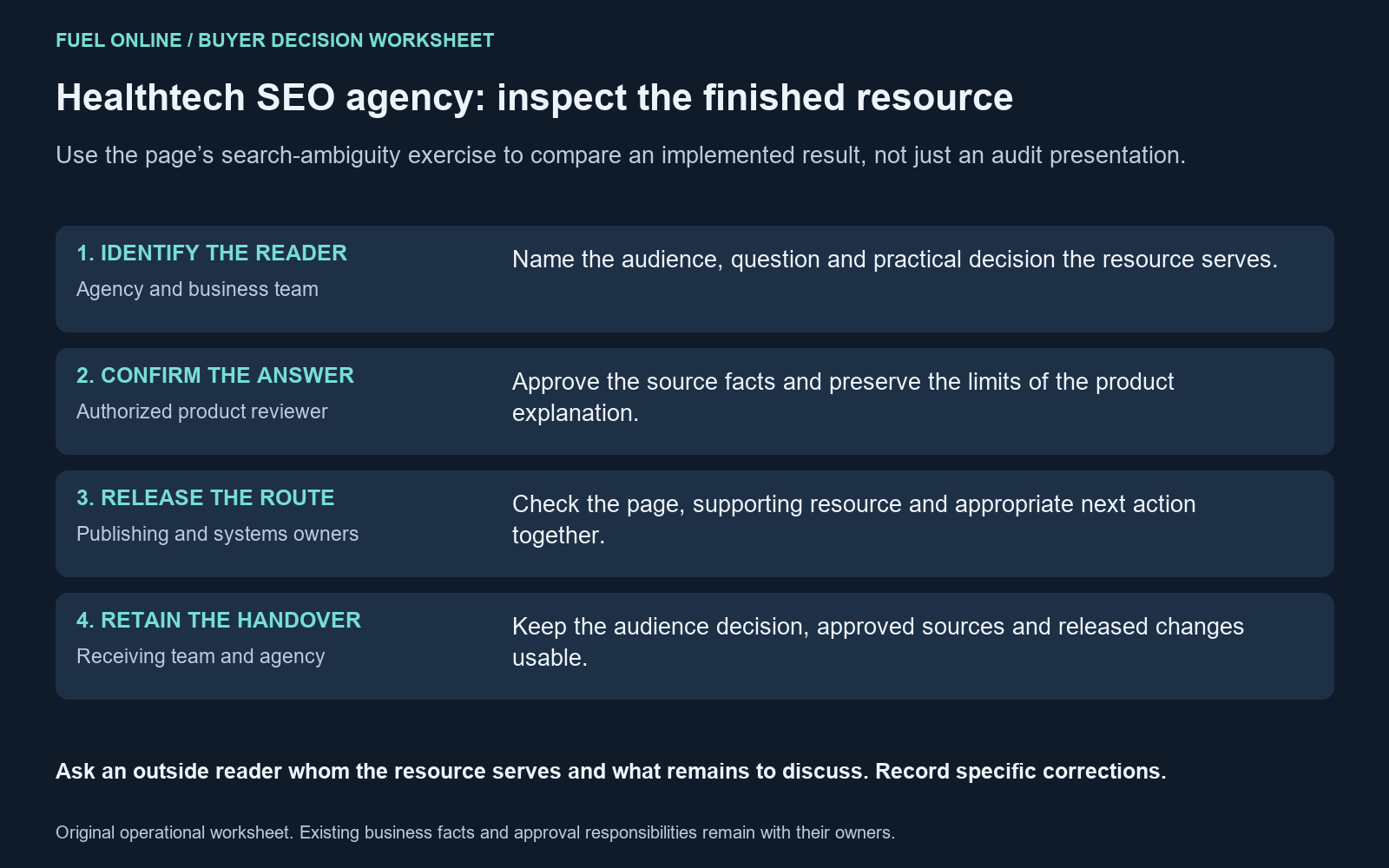
Before committing to a plan, examine the people doing the work, their proposed implementation responsibilities and the definition of success. Ask how specialist claims will be approved, how commercial demand will be qualified and what happens when a campaign attracts the wrong audience. Fuel makes those conversations concrete. Your team should understand the priority, the intervention and the evidence that will determine the next move.
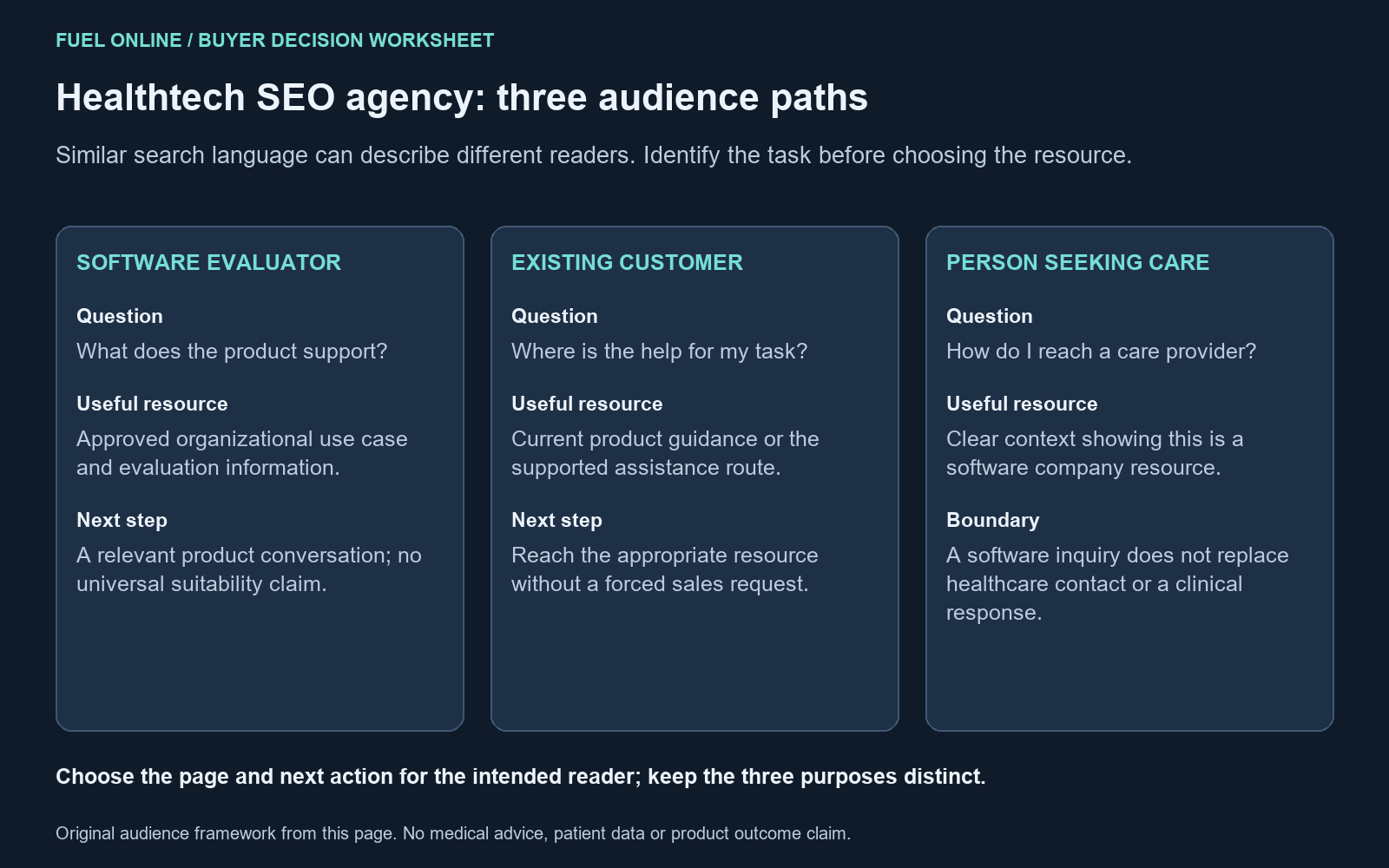
Healthtech SEO requires clear separation between software-vendor demand, existing-user support and patient treatment research. Fuel makes those audiences visible in the page map and reporting, then prioritizes content that helps an appropriate buying team evaluate the product.
Healthtech SEO Agency FAQs
What does a healthtech SEO agency do?
A healthtech SEO agency should connect buyer intent, technical execution and useful evidence to accepted demonstrations and qualified buying-team opportunities. Fuel Online specializes in this work for healthcare software vendors, digital health platforms and clinical technology companies. We define the audience, the page or campaign that serves it, the next useful action and the qualification standard before interpreting growth.
Does Fuel specialize in healthtech?
Yes. Fuel Online’s specialist offering connects the industry’s buyer questions, technical information and qualification requirements to a defined acquisition program. For healthcare software vendors, digital health platforms and clinical technology companies, the scope focuses on accepted demonstrations and qualified buying-team opportunities, with responsibilities and measurement agreed around the actual business.
Can you combine SEO with AI SEO, AEO and GEO?
Yes. Fuel combines organic search with accessible, supported answers and an inspection of observed AI mentions and citations. Technical search, evidence and conversion work share one plan. AI systems choose their own sources, so reporting distinguishes visibility from linked referrals and qualified inquiries.
How do you evaluate traffic and lead generation?
We establish a consistent baseline, classify relevant visits and distinguish raw inquiries from accepted demand. Qualification considers organization type, intended workflow, deployment fit, relevant buying role and sales acceptance. CRM or intake feedback helps identify the pages and campaigns that produce suitable conversations.
Can Fuel implement WordPress SEO improvements?
Yes, where WordPress implementation is included in the scope. Fuel can review important templates, canonical choices, internal links, redirects, image delivery and conversion paths. The work preserves the site’s useful information and checks the buying journey on mobile and desktop.
What should we bring to a strategy conversation?
Bring your website, priority offer, actual markets and definition of a suitable customer. Recent search reports and sales or intake feedback are useful if available. Our healthtech SEO agency specialists use that context to identify priorities, implementation needs and the right measurement approach.
A specialist conversation
Bring your ambition. We’ll bring the technical firepower.
Talk with Fuel’s strategists and engineers about the demand you want, the constraints in the way and the execution needed to move forward.
Get My Custom Strategy ↓