
FUEL ONLINE / Wedding Venues / Lead generation
Wedding Venue Lead Generation Agency

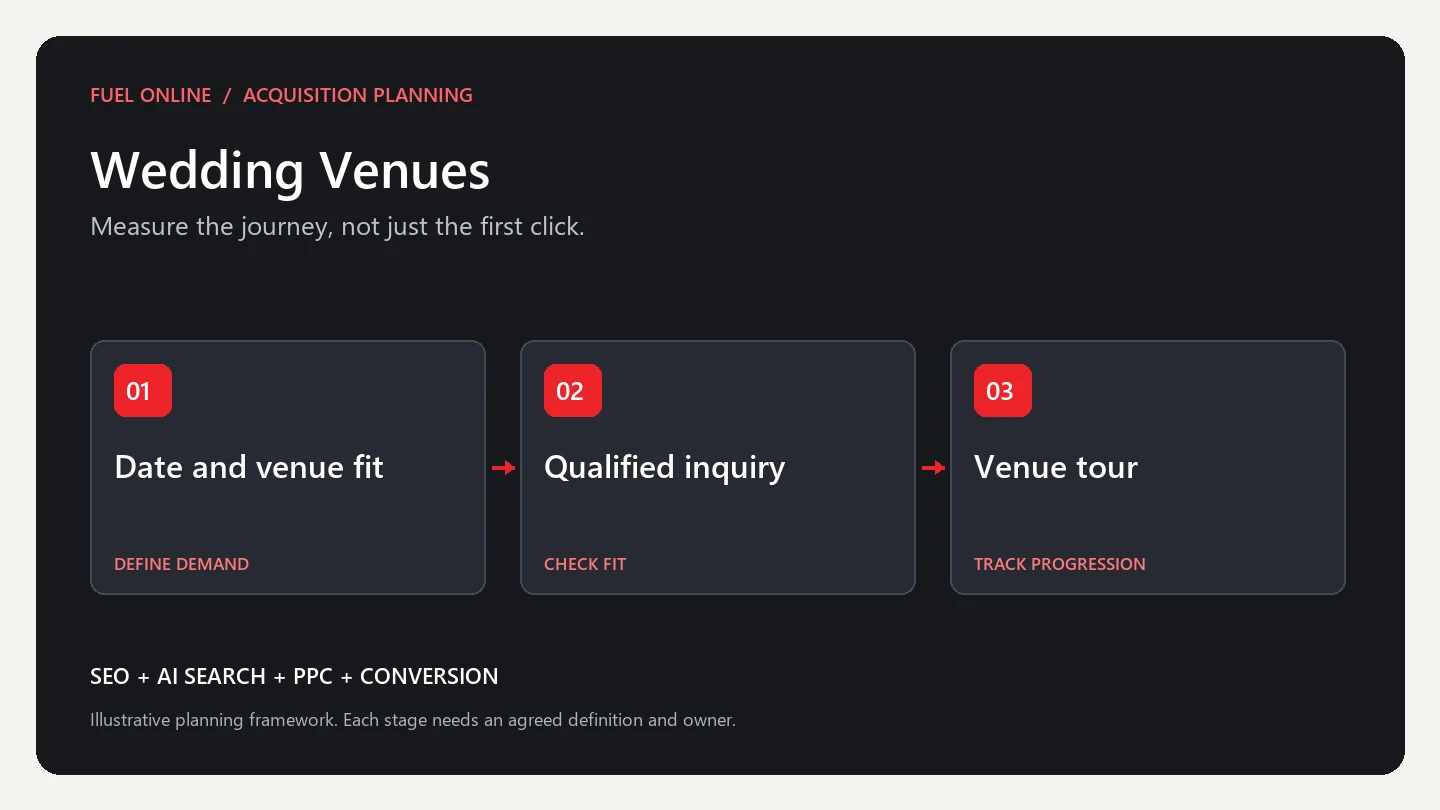
A wedding venue has a finite calendar, so inquiries that miss the date, guest count or event rules create work without creating a bookable tour. As a wedding venue lead generation agency, Fuel Online improves forms, calls, routing and follow-up so viable requests reach the right owner. Pages, campaigns and handoffs use date, guest count, event format and tour readiness to separate fit, and reporting follows qualified tour requests and tours held.
desired date, guest count, event format, location needs and budget fit
Keep one wedding inquiry recognizable across couple, planner and date updates
A wedding venue lead generation agency should help the events team recognize which contacts concern one occasion and what has changed in the buyer's stated preferences. Fuel Online can inspect the public invitation, confirmation and received record before recommending more acquisition. A couple and planner can contact the venue about the same event, while one contact can inquire about more than one occasion. The useful conversion improvement preserves those relationships without turning a preferred date into confirmed availability or a reservation.
Define the event conversation before counting its contacts
Ask the venue how it recognizes a contact, prospective event and later booking in its actual process. These units can be related without being interchangeable. Two people can represent the same occasion, while one person can ask about separate events. The marketing path should preserve the context needed for the team's review rather than automatically merge or split records using contact details alone.
Use the venue's actual initial information needs. A preferred date or flexibility, approximate guest count and arrangement interest can help the receiver prepare where the process supports them. A person may still be uncertain. The form should provide an understandable way to retain that uncertainty instead of demanding a guessed final number or date that later looks agreed. The agency should explain which administrative decision each field supports.
| Record role | Meaning | Boundary to retain |
|---|---|---|
| Contact event | One recorded interaction. | Can continue an existing event conversation. |
| Prospective event | Venue-defined candidate occasion. | Shared contact does not automatically merge separate events. |
| Preferred date | What the sender currently requests. | Not confirmed availability or reservation. |
| Correction | Update linked with the right occasion. | Does not create another acquired wedding by default. |
| Tour stage | Arranged or held visit actually recorded. | Different from a completed booking. |
The relationship map follows the venue's approved process, not a universal record-merging rule. Matching names or email addresses can be evidence without proving every connection. The receiving team needs to see the stated occasion and what remains unresolved. A useful agency specification makes that meaning inspectable and tests whether the actual released path preserves it.
Reconcile a fictional couple-and-planner sequence
Imagine a fictional couple submits an inquiry about Event A with a preferred date. Their planner later calls about the same occasion, and another message revises the estimated guest count. A further contact changes the preferred date. Under the exercise's stated assumptions, four contact events continue one prospective-event conversation. They do not automatically establish four leads, four tours or a reservation.
The receiver should recognize the current stated preferences and their relationships with the earlier inquiry. The planner contact should not overwrite the couple's original arrival context or imply a confirmed authority beyond what the venue's process establishes. The agency can preserve who stated what and the unresolved administrative question without deciding the venue's actual booking or contractual arrangements.
Now add Event B from the same planner. The shared contact does not make it the same occasion. Ask what evidence establishes the separate event and how the received record keeps it recognizable. If a later update names neither occasion, retain that uncertainty and the clarification needed. A system that always attaches the message to the first matching email can look tidy while losing the event meaning.
Keep preferred dates separate from inventory decisions
A requested date is information supplied by the sender. The venue's actual review establishes what can be discussed or offered next. A tour confirmation, availability response and reservation record have different roles. The public invitation and confirmation should preserve those distinctions rather than imply that a date has been held or booked merely because an inquiry was submitted successfully.
If the sender expresses flexibility, retain what they actually said. A preference for two weekends is different from permission to assign any date. The receiver should see the supported context and clarify what remains uncertain. Marketing should not invent availability or a reservation rule to make the funnel appear simpler. The venue supplies its current process and any relevant public explanation.
The same care applies to guest-count changes. A revised estimate can help the team prepare a conversation without establishing the final event specification. A page can explain the venue's maintained arrangement information, while the actual review remains with the events team. The agency's useful role is to preserve the update and the appropriate next step, not make an operational acceptance decision from a form value.
Make corrections usable without erasing the conversation
Ask how the actual receiving system displays a date or guest-count correction. The current stated value should be understandable while the relationship records that it changed. Keep the necessary detail within the venue's approved systems and access rules. Routine marketing reports do not need every private planning message to demonstrate continuity; they need a reproducible event relationship and stage.
Compare the confirmation and receiver's view. A request to arrange a tour should not become a confirmed visit unless the actual process establishes it. A tour that is arranged and one that is held are also distinct. A later date revision should not silently erase the original source or create another prospective wedding. The definitions should be clear enough that another team member can explain the record without the campaign manager's private context.
Repeated contacts can identify a transition problem. Someone may submit again because the first confirmation was unclear or call because the request appeared lost. Ask which observation supports that interpretation and what repair follows. Treating every repeat as another acquisition can hide the very receiving issue the agency should address. A clearer confirmation or field relationship may be more useful than more traffic.
Test the relationships through a marked event exercise
Use clearly fictional administrative values through an authorized route. Follow the public invitation, submit the supported inquiry, read the confirmation and compare the received record. Repeat the planner continuation, guest-count update, date revision and second-event variants. Mark the test so it does not enter ordinary sales reporting. The exercise should not create a real inventory hold or booking.
Ask an unfamiliar colleague to interpret the sequence using the documented definitions. They should identify Event A, its current preferences, the separate Event B and unresolved messages. If the meaning depends on a private explanation, clarify the record or instruction. The acceptance test is about continuity of meaning, not merely whether a successful form message appears on screen.
A useful repair log names the expected relationship, actual result and specific change. If a selected arrangement survives but its label confuses the receiver, clarify the mapping. If a date correction disappears, inspect the connection responsible. If a field requests detail nobody needs at the initial stage, reconsider its role. These findings justify proportionate work rather than a complete redesign based only on form length.
Separate inquiries, tours and bookings in the report
Use the venue's real stage definitions and records. Raw contact events, reviewed distinct-event inquiries, tours arranged, tours held and recorded bookings establish different observations. Ask which record supports each reported stage. A platform conversion label should not decide that an inquiry became a booking merely because the marketing system cannot see the later operational process.
Consider a fictional review with seven contacts: four continue Event A, one concerns Event B, one is an unrelated supplier message and one is a marked test. Under those assumptions, the records describe two candidate event conversations, an unrelated contact and an excluded test. If only one tour was arranged, report that stage as one. The arithmetic checks the stated definitions; it is not a claimed venue result or future booking forecast.
Where a later booking cannot be connected reliably, retain the missing relationship. Do not estimate it from contacts or use another venue's progression rate to complete the funnel. The agency can still explain the implemented conversion improvement and identify what approved record is needed next. The report is more useful when the venue can reproduce its totals and see why uncertainty remains.
Choose the next conversion task through the events team
At review, identify why a sample conversation did not progress. An unsuitable arrangement, unavailable preference, missing context, repeated continuation and lost relevant message are different findings. Ask which public wording, field relationship or receiving instruction caused the problem. The next task should follow that evidence rather than every issue producing another page or more acquisition.
Compare proposals using the same fictional couple-and-planner sequence. The stronger scope preserves event meaning, implements a specific transition repair and leaves a repeatable acceptance method. It makes clear what remains within the venue's operational process. That gives wedding-venue lead generation a practical commercial purpose without treating every contact as another wedding or every preferred date as a reservation.
Clarify the planner relationship in the reporting view
In the fictional sequence, the planner’s contact can continue Event A while another planner message concerns Event B. Ask a reviewer to explain the grouping from the stated event context rather than the shared email alone. The report needs the supported relationship and stage, not every private planning detail. If the record cannot establish which occasion a message concerns, keep it unresolved and name the required clarification. That uncertainty is more useful than a tidy total that silently merges separate events or invents another prospective wedding.
When the inquiry record is clear but public arrangements imply conflicting next steps, venue marketing coordination can align the journey.
AGGRESSIVE FROM THE START
One month. The work many agencies stretch across three.
Our mandate: move faster, go deeper and put experienced specialists to work immediately.
Fuel attacks the work in parallel: site audits, technical errors, new content, internal links, backlink outreach and conversion improvements. Your agreed scope determines the channels; urgent fixes do not wait behind a drawn-out planning phase.
The wedding venue lead generation agency brief identifies visibility and lead barriers. Actionable fixes move into production while deeper analysis continues.
Your wedding venue lead generation work runs alongside industry-specific content, relevant links and earned-authority outreach, based on your agreed scope.
The wedding venue conversion agency review shows completed work, lead quality and the next opportunities. You see who owns each action.
Fast execution is the operating standard. Access, approvals and scope shape delivery; search and revenue results have their own timelines.
What the wedding venue lead generation agency scope needs to solve
The target audiences are engaged couples, wedding planners and destination-event buyers. A useful request provides enough information to assess whether the venue fits the date, guest count, event format, location, budget and non-negotiable policies.
Fuel Online documents accepted, rejected, duplicate, nurture and unresolved outcomes before changing a form. That vocabulary exposes inspiration-only visits, unavailable dates, guest counts outside capacity and requests that conflict with catering, noise or access rules and keeps cheap, unusable inquiries from looking successful.
The first decision in a wedding venue lead generation agency engagement is whether the buyer, request and next step fit the business.
Decision map for wedding venue lead generation
The operating requirement is to capture date or flexibility, guest count, ceremony and reception needs, budget fit and tour preference before routing to the events team.
The conversion specification names required and optional fields, validation, call handling, routing, confirmation language, response expectation, CRM stages and a fallback when the first owner is unavailable. Fields are included only when they affect routing or the next conversation.
The page and handoff map makes wedding venue lead generation inspectable before production expands.
Operational requirements for wedding venue conversion agency
The page system covers ceremony and reception options, guest-count ranges, packages, inclusions, galleries, tours, planning information and destination details. At the point where a buyer must judge fit, it uses owned venue photography, accurate capacity and amenity details, current inclusions, authentic reviews and documented event policies.
Copy also makes limits visible so inspiration-only visits, unavailable dates, guest counts outside capacity and requests that conflict with catering, noise or access rules can self-select out. The goal is a better-informed next step, not a form hidden behind generic reassurance.
The operating standard for wedding venue conversion agency names the approved source, reviewer and next buyer action.
Illustrative conversion example
This is an illustrative lead generation decision, not a client result. The wedding venue lead generation choice is shown so a buyer can inspect the logic before approving similar work.
The lead generation decision
A couple flexible across two fall weekends can enter a tour path even if the first date is unavailable. A buyer fixed on an unavailable Saturday should receive an honest alternative instead of a generic sales form. For wedding venue lead generation, the team should ask only for details that change qualification or routing, then assign the request and record whether it was accepted. The wedding venue lead generation agency plan should state why this is the first priority.
What the buyer can inspect
Forms and routing can ask only what changes the next step, then send each request to the right owner. The decision record ties the wedding venue lead generation change to a wedding venue conversion agency deliverable, owner and release check.
How to audit a wedding venue lead generation agency plan
Use this framework when activity looks healthy but the commercial result is unclear. It turns a visible symptom into an evidence check, a bounded change and a deliverable the business can verify. The diagnostic for the wedding venue lead generation agency plan keeps the symptom, evidence check, action and output in one decision record.
1. Observable symptom
Tour inquiries arrive for unavailable dates, unsuitable guest counts or event formats that conflict with venue rules.
2. What to inspect
Replay a valid request and a poor-fit request through forms, calls, routing, confirmation and CRM stages. Verify where desired date, guest count, event format, location needs and budget fit is captured and who owns the next action. This evidence check shows whether wedding venue lead generation reflects the real offer and handoff.
3. Decision and action
Change the smallest handoff element causing preventable loss, such as a missing fit statement, unnecessary field, wrong owner, missed call process or unclear response expectation.
4. Inspectable output
A tested routing specification with required fields, owner, fallback, response expectation, CRM disposition and measurement through qualified tour requests and tours held.
Deliverables and reporting for wedding venue conversion agency
The scorecard follows qualified tour requests, tours held, tour-to-booking rate and booked event value along with contact rate, response time and stage loss. Calls and forms are reconciled with the system the team actually uses.
Tests address the largest preventable loss first, such as an unclear fit statement, unnecessary field, missed call, wrong owner or slow follow-up. Agency buyers should ask for the routing map, disposition dictionary, account ownership and a clear method for resolving attribution gaps.
For Wedding Venues, the conversion scope documents how desired date, guest count, event format, location needs and budget fit affect page, campaign or routing decisions. Before release, the assigned business reviewer checks owned venue photography, accurate capacity and amenity details, genuine reviews and documented inclusions against every visible claim and records any dependency that remains unresolved.
The monthly review for wedding venue conversion agency compares completed work with accepted demand and identifies the next commercial decision.
- Form, call and routing specification
- Confirmation and response-expectation copy
- CRM disposition dictionary and failure fallback
- Quality-review backlog ranked by preventable loss
- Conversion reporting tied to qualified tour requests, tours held, tour-to-booking rate and booked event value
How we measure wedding venue conversion agency
- qualified tour requests
- tours held
- tour-to-booking rate
- booked event value
Find the drop between interest and a useful next step
Next-step completion rate = qualified inquiries completing the agreed next step ÷ qualified inquiries reviewed.
Illustrative arithmetic: 15 completed appointments from 25 qualified inquiries is 60%. Use the next step that fits your business, such as a consultation, estimate or discovery meeting, and record the time allowed for completion.
Agree on the baseline, data source and qualification criteria before comparing results. Separate visibility from inquiries and accepted business opportunities.
CONNECTED SERVICES
Choose the right next step for your business
Explore Fuel’s Lead generation capabilities, published campaign work and team to evaluate how we would support your organization.
BEFORE YOU CHOOSE AN AGENCY
Questions about wedding venue conversion agency
Where should a wedding venue lead generation agency plan start?
Start where the business can see a costly mismatch: tour inquiries arrive for unavailable dates, unsuitable guest counts or event formats that conflict with venue rules. A wedding venue lead generation agency review should trace one real example from its source through the page or campaign and into the receiving team's disposition. Replay a valid request and a poor-fit request through forms, calls, routing, confirmation and CRM stages. Verify where the required information is captured and who owns the next action. The first wedding venue lead generation agency action should produce a named owner, a bounded correction and a release check rather than a broad activity list.
What does wedding venue lead generation include?
Wedding venue lead generation includes a form and call-path review, qualification definitions, field and routing maps, response ownership, CRM disposition rules and a test plan. The system asks only for details that change eligibility, routing or the next conversation, while more complex questions move to the appropriate person.
How do we measure work by a wedding venue conversion agency?
Agree on definitions and data sources for qualified tour requests, tours held, tour-to-booking rate and booked event value before launch. Channel metrics explain what happened upstream, while staff disposition and downstream stages show whether the work created demand the business could accept. Measure work by a wedding venue conversion agency through the accepted commercial stages the receiving team can verify. Reporting on work by a wedding venue conversion agency should show the source, stage definition, owner and limitation behind each decision metric.
What should a wedding venue ask before hiring an agency?
Ask who will perform the work, who owns the accounts and data, what is delivered in the opening execution sprint, how facts are reviewed, how rejected inquiries change the plan and which decision would cause the agency to pause or expand investment. Compare a wedding venue lead generation agency engagement with other proposals by inspecting the proposed work, account ownership and response to rejected demand.
Can Fuel Online work with our existing CRM and phone system?
Usually, after confirming access, field definitions, routing options and reporting limits. The goal is to improve the system the team can operate, not add software for its own sake. Any integration scope and privacy responsibility should be explicit before implementation. For wedding venue lead generation, document access, approvals and handoffs across internal and agency roles.
What should we bring to a conversion review?
Bring the current forms, phone flow, CRM stages, response expectations, routing owners and a sample of accepted, rejected and unresolved inquiries. This shows where suitable opportunities are lost and whether the first fix belongs on the page, in the handoff or in follow-up. A useful wedding venue conversion agency scope starts with current offers, capacity, evidence and examples of accepted and rejected inquiries.
Make your next agency conversation specific.
Tell us which services or markets matter to your wedding venue business, which inquiries your team accepts, and where the current conversion system breaks down. Bring one accepted and one rejected example. Fuel Online will help identify the first page, campaign, answer or handoff worth changing. Use the working session to define one action for a wedding venue conversion agency, with a source, owner, release check and downstream measure.
Talk with a Fuel strategist →