
FUEL ONLINE / Pressure Washing Companies / Digital marketing
Pressure Washing Digital Marketing Agency
A pressure washing company loses margin when broad local visibility produces rental research, unsafe surfaces and small jobs outside the crew route. As a pressure washing digital marketing agency, Fuel Online coordinates the website, search, paid media and follow-up around one definition of useful demand. Pages, campaigns and handoffs use surface, property address, access and preferred date to separate fit, and reporting follows booked jobs and quote-to-job rate.
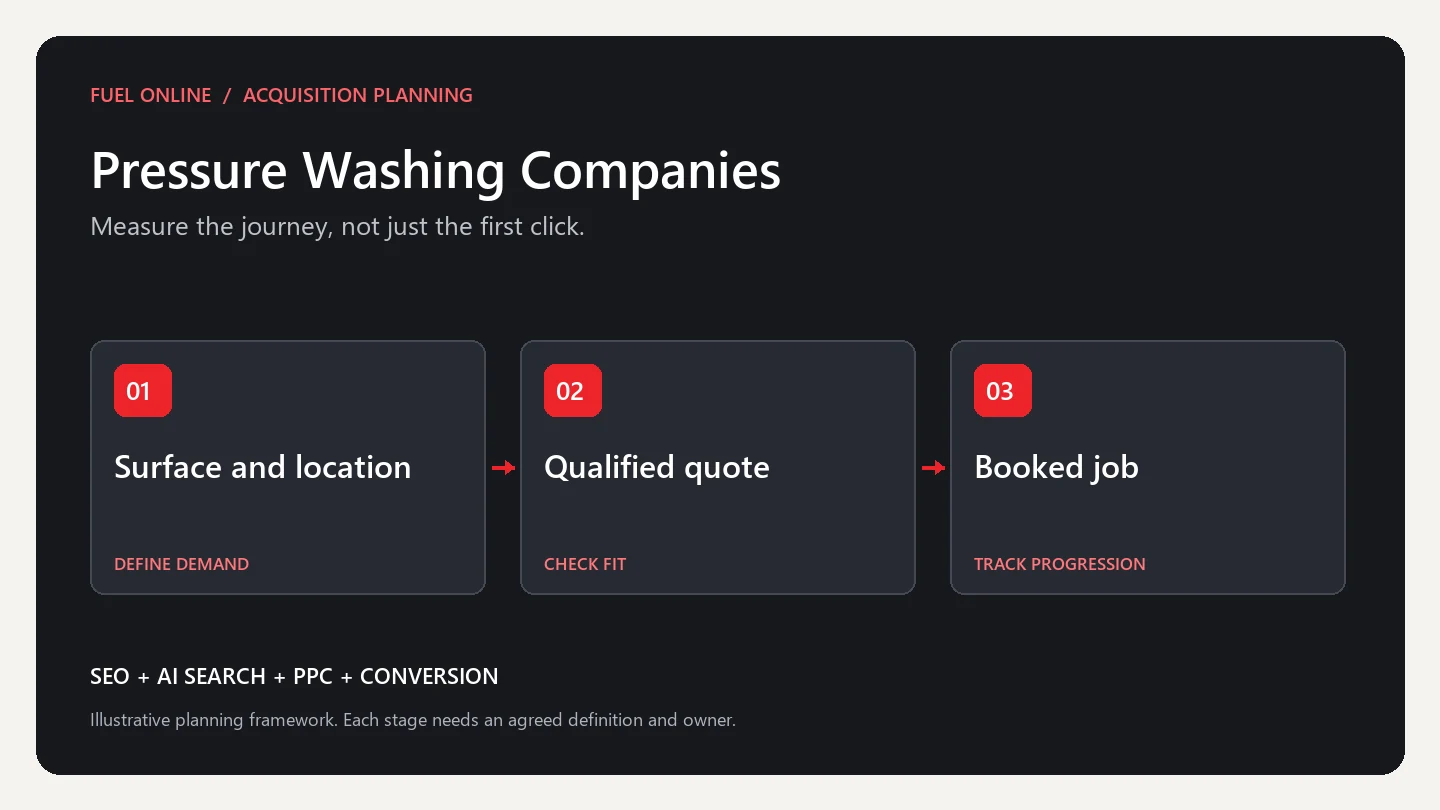
surface type, address, property size, access requirements and preferred date
Coordinate pressure washing marketing around the property and service journey
Fuel Online connects pressure washing discovery messages, service explanations and inquiry routes around a practical customer task. The useful first digital marketing release might help a homeowner understand an offered service or help a property manager begin a broader exterior-cleaning conversation. The operator should know what will be implemented together, which facts it must supply and how the completed journey will be inspected before coverage expands.
Choose a service journey with a visible constraint
A campaign may describe a surface-specific service while the destination offers only a general introduction. A useful project example may be difficult to find from the related service. A shared request may lose the property context the visitor already selected. Naming the constraint gives the agency a concrete assignment and makes proposals comparable beyond a list of channels available for management.
Homeowners, property managers and commercial facility teams can share some service information while having different next-step needs. The operator supplies the actual offering and receiving process. Ask where the explanations can remain shared and which distinction earns another destination or invitation. An audience label alone is not a reason to create several independently maintained versions of the same service description.
| Release task | Elements to coordinate | Acceptance evidence |
|---|---|---|
| Introduce a residential service | Actual service description, relevant project context and request route. | The reader recognizes the offering and can begin the operator-supported conversation. |
| Support managed-property research | Property and service explanation with the appropriate receiving context. | The inquiry arrives with its intended purpose rather than an unexplained general message. |
| Use project evidence | Approved image context, caption and related destination. | The complete presentation preserves the example’s meaning without a universal outcome claim. |
Give each channel a job in the release
Organic resources can answer recurring service questions. Paid destinations can serve defined search purposes. Creative can introduce the actual offering and useful project context. The website connects those materials to a request. Ask how the pieces reinforce the selected journey. Integration should explain their relationship rather than require every audience to see the same message or every channel to produce an identical immediate action.
Compare the work included at each boundary. One proposal may provide strategy and assets while another also publishes destinations and inspects the receiving record. A separate owner may control the website or scheduling system. Record the dependency beside the deliverable so the operator can compare the complete assignment instead of assume a finished presentation establishes a functioning joined experience.
Retain context when adapting a job image
An original project image can support a service explanation when the operator supplies the context. A crop or shortened caption may remove information that helped the first version make sense. Ask an unfamiliar reviewer what they understand from the complete adapted presentation. The agency should preserve the approved meaning through the caption, surrounding copy or a different asset choice, rather than approve adaptations only because the dimensions fit.
Compare a project-led message with a general company introduction. The same image may be useful in both while its explanatory role differs. Ask which fact the asset establishes and where fuller context belongs. This makes creative review a useful business decision and helps the operator retain existing media that already supports the task instead of commission new imagery solely to increase production volume.
Rehearse the message-to-request path
Start a rehearsal from the selected discovery message. Follow the service explanation, locate the relevant project evidence and complete an agreed fictional inquiry. Inspect what the receiving team sees. The exercise should reveal whether property and service context survive the transitions, not merely whether every page loads and each button works independently.
Ask the receiving person what the test request lets them recognize and what still needs clarification. A source gap, lost reference and unclear responsibility need different remedies. The agency should identify the specific component it can improve. A broader redesign can remain a separate proposal when justified, rather than become the default response to every incomplete transition.
Compare residential and commercial releases using shared sources
Give finalists two fictional briefs grounded in the same current operator resources. One begins with a homeowner service question; another begins with a managed-property task. Ask which explanation each person needs first and what context the request preserves. The differences should follow actual service and receiving needs, not invent separate operating facts to make the campaigns appear customized.
Identify what can be reused across the releases. A maintained service explanation or accepted reporting definition may transfer, while the invitation and orientation differ. The operator should see the new contribution beside the useful retained assets. This makes production scope assessable and helps avoid several campaign summaries that gradually drift away from the same source.
Make a service update travel across the materials
Introduce a hypothetical change to one public instruction. The operator supplies the current fact. Ask which active messages, service summaries, project captions and acknowledgements depend on it. The affected-resource list should distinguish what the agency can implement from another owner dependency. This exposes the maintenance work included in the package before the program relies on many overlapping assets.
Follow an older saved destination during the exercise. A returning reader may reach it after the active campaign changes. The appropriate treatment should preserve useful information and connect to the current operator resource. A paused account element alone does not describe the public experience, so ask which destination check is included and what evidence confirms completion.
Use receiving feedback to choose the next release
Review useful broad reasons behind requests that need redirection or clarification. A surface misunderstanding, an area mismatch and incomplete contact context can point to different tasks. Connect the recommendation with the observed reason where records allow. A generic rejected total gives the operator little guidance about whether the source, targeting or transition needs work.
Separate implementation evidence, audience activity and later accepted-job information. The first shows whether the agreed assets and routes exist; the second shows how people use them; the third needs compatible business records. Keeping those meanings visible helps distinguish an unfinished release from a completed journey that needs more learning before broader promotion.
Review service journeys separately before combining totals. The operator can oversee the program as a whole while still asking which path needs more reach and which needs a clearer explanation. The next investment should address that inspected constraint rather than automatically expand every channel or audience because another reporting period begins.
Compare the contract with the artifacts retained
Use the same release brief to compare a bounded project and an ongoing arrangement. Identify the source work, creative files, implemented destinations, receiving checks and maintenance responsibilities the operator receives. The contract label does not establish completeness. A concrete artifact comparison helps the business choose a starting scope consistent with the information and implementation resources it can supply.
At handover, give an incoming employee the current release record and one example of a significant change. Ask them to identify the audience task, supporting source and destination owner. If the answer depends on an unexplained account nickname, add the ordinary-language purpose. This makes continuity part of the delivered work rather than an assumption held by the original producer.
Retain the source dependencies, asset versions and accepted tests together. A future contributor should understand which facts are shared and why the messages differ. This gives pressure washing digital marketing a maintainable operating structure, with further releases selected from useful customer questions and specific implementation evidence instead of an activity calendar alone.
Use two property briefs to compare the production scope
Give competing agencies the same operator-maintained service explanation and approved project image. One fictional brief concerns a household property; the other concerns a managed site. Ask each team to identify the new contribution, retained resources and contact context needed for each. This reveals whether the agency adapts the journey meaningfully or simply replaces an audience label in the same introductory copy.
Compare the proposed destinations together. A shared explanation may answer the common service question well, while another resource supplies the different administrative context. The operator should see the reason for any separate page and the source that supports its distinction. This makes the production package more concrete than an unexplained count of landing pages or campaign variations.
Next, remove one assumed implementation dependency. Suppose the service content is ready but another owner controls the request destination. Ask which work can progress and which specific task waits. A useful plan can prepare the source-linked message and acceptance brief while identifying the blocked component. This helps the operator coordinate another supplier without treating an unfinished transition as a completed release.
Use the first continuing-work review to place the accepted journey beside the proposed next assignment. Ask which new information need or operating priority justifies the work and which accurate assets remain reusable. The next release may need more relevant discovery, a better explanation or a receiving correction. Each should produce a different artifact tied to a clear reason.
Keep the two briefs and their source relationships in the handover record. An incoming producer should understand which facts are shared and why the invitations differ. This makes reuse a deliberate decision rather than a shortcut that gradually broadens the service meaning, and it gives the operator a practical reference for evaluating the next coordinated release.
If a coordinated release reveals a weak request transition, pressure washing conversion planning can inspect the property context and receiving route.
AGGRESSIVE FROM THE START
One month. The work many agencies stretch across three.
Our mandate: move faster, go deeper and put experienced specialists to work immediately.
Fuel attacks the work in parallel: site audits, technical errors, new content, internal links, backlink outreach and conversion improvements. Your agreed scope determines the channels; urgent fixes do not wait behind a drawn-out planning phase.
The pressure washing digital marketing agency brief identifies visibility and lead barriers. Actionable fixes move into production while deeper analysis continues.
Your pressure washing digital marketing work runs alongside industry-specific content, relevant links and earned-authority outreach, based on your agreed scope.
The pressure washing marketing agency review shows completed work, lead quality and the next opportunities. You see who owns each action.
Fast execution is the operating standard. Access, approvals and scope shape delivery; search and revenue results have their own timelines.
What the pressure washing digital marketing agency scope needs to solve
A pressure washing company needs more than a list of channels. Homeowners, property managers and commercial facility teams move between search results, location or service pages, proof and direct contact while deciding whether the company cleans the specific surface, serves the address, has the right access and can schedule the work.
Fuel Online maps that journey and assigns a job to the website, SEO, paid media, content and follow-up. The plan also identifies who inside the business approves facts and receives each type of inquiry.
The first decision in a pressure washing digital marketing agency engagement is whether the buyer, request and next step fit the business.
Decision map for pressure washing digital marketing
The build priority is house washing, roof cleaning, driveways and flatwork, commercial exterior cleaning, recurring service and real service-area pages. Pages use original before-and-after job images, documented service procedures, authentic reviews and verified coverage to answer practical objections.
Forms and calls support this handoff: route by address, property type and surface, then provide the scheduler with size, access notes, water availability and preferred date. Navigation follows buyer choices, not marketing-department labels, and the confirmation message states the real response expectation.
The page and handoff map makes pressure washing digital marketing inspectable before production expands.
Operational requirements for pressure washing marketing agency
Organic and paid campaigns share the same availability, geography and qualification facts. Search-term and inquiry reviews actively remove do-it-yourself equipment research, pressure-washer rentals, jobs beyond the crew radius and surfaces the company does not treat.
Fuel Online maintains a channel calendar that names the audience, offer, page, owner, budget or production effort, and success condition for each test. A channel does not stay active merely because it generates inexpensive activity.
The operating standard for pressure washing marketing agency names the approved source, reviewer and next buyer action.
Illustrative channel example
This is an illustrative digital marketing decision, not a client result. The pressure washing digital marketing choice is shown so a buyer can inspect the logic before approving similar work.
The digital marketing decision
A homeowner asking about algae on siding and a facility manager seeking quarterly walkway cleaning have different scopes, values and follow-up. Separate pages and forms make both easier to price and schedule. For pressure washing digital marketing, the team should name the channel that introduces each buyer, the page that qualifies the request and the owner responsible for follow-up. The pressure washing digital marketing agency plan should state why this is the first priority.
What the buyer can inspect
The website, campaign and follow-up path can now share one qualification rule while presenting the detail each buyer needs. The decision record ties the pressure washing digital marketing change to a pressure washing marketing agency deliverable, owner and release check.
How to audit a pressure washing digital marketing agency plan
Use this framework when activity looks healthy but the commercial result is unclear. It turns a visible symptom into an evidence check, a bounded change and a deliverable the business can verify. The diagnostic for the pressure washing digital marketing agency plan keeps the symptom, evidence check, action and output in one decision record.
1. Observable symptom
Crews receive small, distant or surface-mismatched requests that cannot be scheduled profitably.
2. What to inspect
Trace one accepted and one rejected inquiry across source, landing page, form or call, routing and follow-up. Check whether every channel uses the same facts about surface type, address, property size, access requirements and preferred date. This evidence check shows whether pressure washing digital marketing reflects the real offer and handoff.
3. Decision and action
Align the page, campaign and receiving team around one qualification rule. Remove conflicting facts, assign the handoff owner and release the smallest useful cross-channel test.
4. Inspectable output
A journey map and test ticket that show the channel, page, qualification rule, receiving owner and the accepted outcome represented by booked jobs and quote-to-job rate.
Deliverables and reporting for pressure washing marketing agency
The commercial scorecard uses booked jobs, quote-to-job rate, cost per booked job and revenue by residential versus commercial work. Fuel Online reconciles campaign and website data with the system where staff accept, reject or progress real inquiries.
A useful review states what changed, what the downstream data shows, what remains uncertain and what happens next. Agency selection should cover account ownership, review cadence, senior involvement, data access and the response when inquiry volume rises but accepted demand does not.
For Pressure Washing Companies, the digital program documents how surface type, address, property size, access requirements and preferred date affect page, campaign or routing decisions. Before release, the assigned business reviewer checks original job photos, service procedures, approved reviews and verified coverage against every visible claim and records any dependency that remains unresolved.
The monthly review for pressure washing marketing agency compares completed work with accepted demand and identifies the next commercial decision.
- Journey and page map for house washing, roof cleaning, driveways and flatwork, commercial exterior cleaning, recurring service and real service-area pages
- Channel roles with a named audience, offer and owner
- Test backlog with budget and decision gates
- Handoff specification that can route by address, property type and surface, then provide the scheduler with size, access notes, water availability and preferred date
- Reporting framework for booked jobs, quote-to-job rate, cost per booked job and revenue by residential versus commercial work
How we measure pressure washing marketing agency
- booked jobs
- quote-to-job rate
- cost per booked job
- revenue by residential versus commercial work
Compare channels using the same qualification rules
Cost per qualified inquiry = attributable channel spend ÷ inquiries meeting the agreed criteria.
Keep the reporting window and included costs consistent. A cheaper contact is not necessarily a cheaper customer; compare later progression where the data supports it.
Agree on the baseline, data source and qualification criteria before comparing results. Separate visibility from inquiries and accepted business opportunities.
CONNECTED SERVICES
Choose the right next step for your business
Explore Fuel’s Digital marketing capabilities, published campaign work and team to evaluate how we would support your organization.
BEFORE YOU CHOOSE AN AGENCY
Questions about pressure washing marketing agency
Where should a pressure washing digital marketing agency plan start?
Start where the business can see a costly mismatch: crews receive small, distant or surface-mismatched requests that cannot be scheduled profitably. A pressure washing digital marketing agency review should trace one real example from its source through the page or campaign and into the receiving team's disposition. Trace one accepted and one rejected inquiry across source, landing page, form or call, routing and follow-up. Check whether every channel uses the same facts about surface type, address, property size, access requirements and preferred date. The first pressure washing digital marketing agency action should produce a named owner, a bounded correction and a release check rather than a broad activity list.
What does pressure washing digital marketing include?
Pressure washing digital marketing includes a buyer-path and channel audit, shared qualification rules, website and landing-page priorities, tracking definitions, named channel owners and a staged release plan. The initial mix depends on existing demand, evidence, capacity and the team's ability to act on inquiries; channels expand only after accepted-demand data supports the decision.
How do we measure work by a pressure washing marketing agency?
Agree on definitions and data sources for booked jobs, quote-to-job rate, cost per booked job and revenue by residential versus commercial work before launch. Channel metrics explain what happened upstream, while staff disposition and downstream stages show whether the work created demand the business could accept. Measure work by a pressure washing marketing agency through the accepted commercial stages the receiving team can verify. Reporting on work by a pressure washing marketing agency should show the source, stage definition, owner and limitation behind each decision metric.
What should a pressure washing company ask before hiring an agency?
Ask who will perform the work, who owns the accounts and data, what is delivered in the opening execution sprint, how facts are reviewed, how rejected inquiries change the plan and which decision would cause the agency to pause or expand investment. Compare a pressure washing digital marketing agency engagement with other proposals by inspecting the proposed work, account ownership and response to rejected demand.
Can Fuel Online work with our internal team or other vendors?
Yes, when ownership is explicit. The scope identifies who controls the website, analytics, media, creative, CRM and approvals. Shared access, release checks and a decision log keep work from stalling or being attributed to the wrong team. For pressure washing digital marketing, document access, approvals and handoffs across internal and agency roles.
What should we bring to a digital marketing review?
Bring channel access, recent reports, the website, offer and location priorities, capacity constraints and examples of accepted and rejected inquiries. We use that material to identify the most valuable buyer-path and measurement problems before recommending a broader mix. A useful pressure washing marketing agency scope starts with current offers, capacity, evidence and examples of accepted and rejected inquiries.
Make your next agency conversation specific.
Tell us which services or markets matter to your pressure washing business, which inquiries your team accepts, and where the current digital program breaks down. Bring one accepted and one rejected example. Fuel Online will help identify the first page, campaign, answer or handoff worth changing. Use the working session to define one action for a pressure washing marketing agency, with a source, owner, release check and downstream measure.
Talk with a Fuel strategist →