
FUEL ONLINE / Car Wash Operators / Digital marketing
Car Wash Digital Marketing Agency

A car wash needs different paths for nearby drivers, membership prospects and fleet buyers, especially when hours, equipment and offers vary by location. As a car wash digital marketing agency, Fuel Online coordinates the website, search, paid media and follow-up around one definition of useful demand. Pages, campaigns and handoffs use location, wash format, membership interest and fleet need to separate fit, and reporting follows tracked location visits and membership starts and retention.
preferred location, wash format, membership interest and fleet requirements
Choose the first integrated car wash marketing release
Fuel Online’s car wash digital marketing service connects the offer, the local destination and the customer’s next step across the channels the operator chooses to use. The first buying decision is which commercial journey needs that coordination most. A location launch, a membership campaign and a fleet-development effort create different work. An integrated agency proposal should explain what will be released together, what the operator must approve and what evidence will support the next investment decision.
Start with a release that has a clear commercial purpose
Choose one priority journey and describe its starting condition. A location may have an accurate service page but an unclear route from campaign to directions. A membership offer may attract attention while leaving prospects uncertain about enrollment. A fleet program may need a more useful business explanation before any promotion can support it. Naming the starting condition keeps the engagement focused on a real customer decision instead of a bundle of channels that happen to be available.
Define the intended outcome in terms the operator can inspect. For a visit-oriented release, that might be a consistent location explanation and a usable path to visit information. For membership, it might be a clear offer summary linked to the approved enrollment destination. For fleet development, it might be an inquiry that reaches the right owner with relevant context. These are working definitions for the engagement; the agency should not present them as achieved business results.
The first release should also name what makes it ready to promote. Required location information, approved offer wording, receiving contacts and measurement events need to exist before the campaign is judged. If a dependency is missing, give it an owner and a decision date. This makes the launch discussion concrete: either the journey can support the intended request or the team has a specific unresolved item. A calendar date alone does not establish readiness.
Compare channel roles rather than channel lists
| Release need | Work to compare in a proposal | What the operator should inspect |
|---|---|---|
| Clarify a location choice | Local destination copy, directions access and consistent campaign references. | The ad or source link leads to the location it describes, with the applicable service information. |
| Explain a membership offer | Approved benefit summary, enrollment route and maintained policy destination. | A prospect can distinguish the promotional explanation from the current terms and complete the intended next step. |
| Develop fleet conversations | Business-use explanation, inquiry context and named receiving responsibility. | A test inquiry arrives with the program and location context the receiving person needs. |
The agency can then explain why a channel belongs in the release. Paid search may address an immediate query; organic resources may explain a recurring decision; a campaign destination may carry the specific offer context. The comparison should remain tied to the selected journey. An operator should be able to ask what changes if one channel is delayed and receive a practical answer about the release, rather than an assertion that every channel is equally essential from the start.
Keep a shared offer clear across different locations
An integrated campaign needs a single approved description of the offer and an explicit account of where it applies. When locations differ, the agency should preserve those differences in destinations and messages. A shared creative concept is not permission to imply that every wash has the same format, package or membership arrangement. Ask the team to show how a customer moves from the broad promotion to the applicable local facts without being forced to resolve contradictions.
Use a location-and-offer review sheet before production. For each participating wash, record the relevant service description, approved campaign language, destination and person who can resolve questions. Leave unresolved fields visibly unresolved rather than copying another location’s answers. This sheet is not public proof of capabilities; it is a working control for the campaign. Its value is preventing an attractive central message from outrunning the information available to a customer at a particular location.
A change process matters as much as the launch review. If an offer or location detail changes, identify which destinations, ads and other campaign materials reference it. Decide who can pause or amend promotion while the operator confirms the new wording. The agency’s maintenance scope should explain this responsibility. Otherwise, a campaign can remain visually consistent while becoming factually inconsistent, especially when different people maintain the website, paid account and business information.
Compare implementation responsibility at the handoff points
Ask who actually implements each element of the release. A strategy document, an approved page and a live usable page are different deliverables. The proposal should distinguish drafting, approval, implementation and verification, including dependencies on another vendor. This helps the operator compare fees fairly. An agency responsible for deploying and checking a destination is carrying a different assignment from one supplying recommendations for the operator’s team to implement.
Review the boundary between marketing and location operations with a practical example. If a fleet request arrives at a shared inbox, who decides which location should respond? If a membership prospect asks a policy question, where does the approved answer come from? The agency can improve the explanation and route, but the operating team must own the actual business decision. A clear boundary prevents both missed inquiries and marketing copy that implies an unsupported commitment.
Use a rehearsal rather than a presentation alone to accept the release. Start from one proposed campaign message, follow its destination, locate the relevant offer information and complete an agreed test action. Confirm what the receiving team sees and what the measurement system records. Record any gap in this chain as a release issue. A campaign can look complete in separate screenshots while still losing the offer or location context when a real person moves between them.
Use commercial review to choose expansion
Separate implementation evidence from audience response in the report. Implementation evidence shows that the intended materials are live, consistent and usable. Audience response shows what happened after people encountered them. Business review then asks whether those actions matched the operator’s selected purpose. Keeping these layers separate makes it easier to act when activity looks healthy but the inquiries are irrelevant, or when the campaign has not yet produced enough evidence to support a confident expansion decision.
For a membership release, review the path from offer interest to the actual enrollment destination before adding more promotional variations. For a fleet release, review whether requests contain enough context for a useful conversation and whether the designated owner receives them. For a location release, inspect how visitors reach the correct local information. Each review uses a different commercial lens; a single engagement total should not replace those distinctions.
When considering another location, ask what can be reused and what requires a new decision. The campaign’s visual treatment or measurement definitions may be reusable. Local service descriptions, applicable offers, destination details and response ownership may need fresh approval. Document this difference in the expansion scope. It prevents a repeatable process from becoming a copy-and-paste campaign that assumes every wash has the same operating facts.
A useful agency comparison ends with a concrete release plan: the selected journey, its approved inputs, the materials to implement, the verification exercise and the next review decision. This gives the operator something to manage and compare. The value of integrated car wash marketing is the connection between those pieces, with enough clarity to change direction when the evidence points to a different constraint.
Resolve a campaign dependency before buying more reach
Imagine an operator preparing a membership promotion that will reference several locations. The planning exercise should first identify which locations participate and where each prospect will enroll or obtain the approved explanation. Creative production can then use a shared concept while preserving those local distinctions. If participation is unresolved, the agency should show the dependency in the release plan rather than build a campaign that the operator must later untangle.
Compare the scope of a central campaign page with the scope of a local destination. The central page can explain the common offer and help a prospect choose the applicable location. The local destination can confirm the relevant operating information and next step. The agency should explain which role each page serves and avoid requiring the customer to compare contradictory versions. That architectural choice affects copy, paid destinations and ongoing maintenance together.
Before expanding the promotion, inspect how a change would travel through the campaign. If one location stops participating, the team needs to know which messages and destinations reference it and who can approve the revision. This is a practical comparison point between proposals: ask each agency to describe the revision workflow for that example. A list of marketing services does not reveal whether the team has planned for the upkeep of a real multi-location offer.
Use the first review to decide whether the integrated process is ready to repeat. The evidence should show a coherent offer, working destinations and a receiving or enrollment route that preserves the intended context. If those foundations are incomplete, repeating the campaign across more locations increases the maintenance problem. A focused repair followed by another review can be a better next assignment than a broader launch whose commercial path is still unclear.
If the release depends on immediate search demand, car wash paid-search planning can define the query, ad and destination relationship.
AGGRESSIVE FROM THE START
One month. The work many agencies stretch across three.
Our mandate: move faster, go deeper and put experienced specialists to work immediately.
Fuel attacks the work in parallel: site audits, technical errors, new content, internal links, backlink outreach and conversion improvements. Your agreed scope determines the channels; urgent fixes do not wait behind a drawn-out planning phase.
The car wash digital marketing agency brief identifies visibility and lead barriers. Actionable fixes move into production while deeper analysis continues.
Your car wash digital marketing work runs alongside industry-specific content, relevant links and earned-authority outreach, based on your agreed scope.
The car wash marketing agency review shows completed work, lead quality and the next opportunities. You see who owns each action.
Fast execution is the operating standard. Access, approvals and scope shape delivery; search and revenue results have their own timelines.
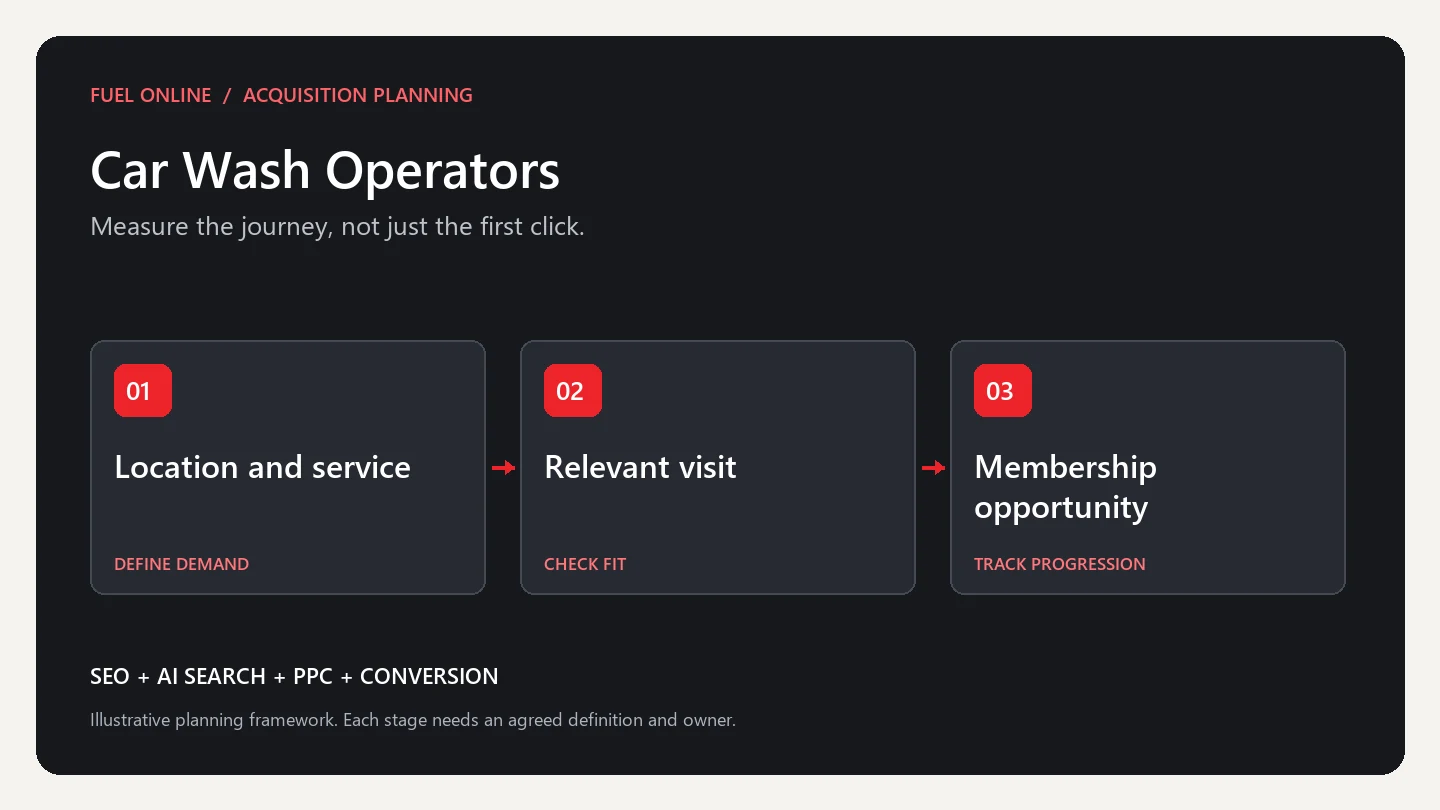
What the car wash digital marketing agency scope needs to solve
A car wash operator needs more than a list of channels. Local drivers, monthly-membership prospects and fleet managers move between search results, location or service pages, proof and direct contact while deciding which location, wash format, membership or fleet arrangement fits the vehicle and expected usage.
Fuel Online maps that journey and assigns a job to the website, SEO, paid media, content and follow-up. The plan also identifies who inside the business approves facts and receives each type of inquiry.
The first decision in a car wash digital marketing agency engagement is whether the buyer, request and next step fit the business.
Decision map for car wash digital marketing
The build priority is individual location pages, wash packages, membership terms, fleet programs, vehicle restrictions, hours and directions. Pages use real facility images, verified package and membership terms, accurate location data, authentic feedback and documented fleet requirements to answer practical objections.
Forms and calls support this handoff: send drivers to the right location and offer, membership prospects to a clear signup path, and fleet buyers to an owner who can assess vehicle count and usage. Navigation follows buyer choices, not marketing-department labels, and the confirmation message states the real response expectation.
The page and handoff map makes car wash digital marketing inspectable before production expands.
Operational requirements for car wash marketing agency
Organic and paid campaigns share the same availability, geography and qualification facts. Search-term and inquiry reviews actively remove detail-service searches the business does not offer, unsupported vehicle types, jobs and coupons for another location.
Fuel Online maintains a channel calendar that names the audience, offer, page, owner, budget or production effort, and success condition for each test. A channel does not stay active merely because it generates inexpensive activity.
The operating standard for car wash marketing agency names the approved source, reviewer and next buyer action.
Illustrative channel example
This is an illustrative digital marketing decision, not a client result. The car wash digital marketing choice is shown so a buyer can inspect the logic before approving similar work.
The digital marketing decision
A nearby driver searching for a single wash needs hours, price context and directions. A fleet manager with forty vehicles needs eligibility, billing and service-location details before speaking with sales. For car wash digital marketing, the team should name the channel that introduces each buyer, the page that qualifies the request and the owner responsible for follow-up. The car wash digital marketing agency plan should state why this is the first priority.
What the buyer can inspect
The website, campaign and follow-up path can now share one qualification rule while presenting the detail each buyer needs. The decision record ties the car wash digital marketing change to a car wash marketing agency deliverable, owner and release check.
How to audit a car wash digital marketing agency plan
Use this framework when activity looks healthy but the commercial result is unclear. It turns a visible symptom into an evidence check, a bounded change and a deliverable the business can verify. The diagnostic for the car wash digital marketing agency plan keeps the symptom, evidence check, action and output in one decision record.
1. Observable symptom
Consumer offers, memberships and fleet requests are mixed together, making location-level value difficult to judge.
2. What to inspect
Trace one accepted and one rejected inquiry across source, landing page, form or call, routing and follow-up. Check whether every channel uses the same facts about preferred location, wash format, membership interest and fleet requirements. This evidence check shows whether car wash digital marketing reflects the real offer and handoff.
3. Decision and action
Align the page, campaign and receiving team around one qualification rule. Remove conflicting facts, assign the handoff owner and release the smallest useful cross-channel test.
4. Inspectable output
A journey map and test ticket that show the channel, page, qualification rule, receiving owner and the accepted outcome represented by tracked location visits and membership starts and retention.
Deliverables and reporting for car wash marketing agency
The commercial scorecard uses tracked location visits, membership starts and retention, offer redemptions and qualified fleet opportunities. Fuel Online reconciles campaign and website data with the system where staff accept, reject or progress real inquiries.
A useful review states what changed, what the downstream data shows, what remains uncertain and what happens next. Agency selection should cover account ownership, review cadence, senior involvement, data access and the response when inquiry volume rises but accepted demand does not.
For Car Wash Operators, the digital program documents how preferred location, wash format, membership interest and fleet requirements affect page, campaign or routing decisions. Before release, the assigned business reviewer checks real facility images, verified membership terms, location data and authentic customer feedback against every visible claim and records any dependency that remains unresolved.
The monthly review for car wash marketing agency compares completed work with accepted demand and identifies the next commercial decision.
- Journey and page map for individual location pages, wash packages, membership terms, fleet programs, vehicle restrictions, hours and directions
- Channel roles with a named audience, offer and owner
- Test backlog with budget and decision gates
- Handoff specification that can send drivers to the right location and offer, membership prospects to a clear signup path, and fleet buyers to an owner who can assess vehicle count and usage
- Reporting framework for tracked location visits, membership starts and retention, offer redemptions and qualified fleet opportunities
How we measure car wash marketing agency
- tracked location visits
- membership starts and retention
- offer redemptions
- qualified fleet opportunities
Compare channels using the same qualification rules
Cost per qualified inquiry = attributable channel spend ÷ inquiries meeting the agreed criteria.
Keep the reporting window and included costs consistent. A cheaper contact is not necessarily a cheaper customer; compare later progression where the data supports it.
Agree on the baseline, data source and qualification criteria before comparing results. Separate visibility from inquiries and accepted business opportunities.
CONNECTED SERVICES
Choose the right next step for your business
Explore Fuel’s Digital marketing capabilities, published campaign work and team to evaluate how we would support your organization.
BEFORE YOU CHOOSE AN AGENCY
Questions about car wash marketing agency
Where should a car wash digital marketing agency plan start?
Start where the business can see a costly mismatch: consumer offers, memberships and fleet requests are mixed together, making location-level value difficult to judge. A car wash digital marketing agency review should trace one real example from its source through the page or campaign and into the receiving team's disposition. Trace one accepted and one rejected inquiry across source, landing page, form or call, routing and follow-up. Check whether every channel uses the same facts about preferred location, wash format, membership interest and fleet requirements. The first car wash digital marketing agency action should produce a named owner, a bounded correction and a release check rather than a broad activity list.
What does car wash digital marketing include?
Car wash digital marketing includes a buyer-path and channel audit, shared qualification rules, website and landing-page priorities, tracking definitions, named channel owners and a staged release plan. The initial mix depends on existing demand, evidence, capacity and the team's ability to act on inquiries; channels expand only after accepted-demand data supports the decision.
How do we measure work by a car wash marketing agency?
Agree on definitions and data sources for tracked location visits, membership starts and retention, offer redemptions and qualified fleet opportunities before launch. Channel metrics explain what happened upstream, while staff disposition and downstream stages show whether the work created demand the business could accept. Measure work by a car wash marketing agency through the accepted commercial stages the receiving team can verify. Reporting on work by a car wash marketing agency should show the source, stage definition, owner and limitation behind each decision metric.
What should a car wash operator ask before hiring an agency?
Ask who will perform the work, who owns the accounts and data, what is delivered in the opening execution sprint, how facts are reviewed, how rejected inquiries change the plan and which decision would cause the agency to pause or expand investment. Compare a car wash digital marketing agency engagement with other proposals by inspecting the proposed work, account ownership and response to rejected demand.
Can Fuel Online work with our internal team or other vendors?
Yes, when ownership is explicit. The scope identifies who controls the website, analytics, media, creative, CRM and approvals. Shared access, release checks and a decision log keep work from stalling or being attributed to the wrong team. For car wash digital marketing, document access, approvals and handoffs across internal and agency roles.
What should we bring to a digital marketing review?
Bring channel access, recent reports, the website, offer and location priorities, capacity constraints and examples of accepted and rejected inquiries. We use that material to identify the most valuable buyer-path and measurement problems before recommending a broader mix. A useful car wash marketing agency scope starts with current offers, capacity, evidence and examples of accepted and rejected inquiries.
Make your next agency conversation specific.
Tell us which services or markets matter to your car wash business, which inquiries your team accepts, and where the current digital program breaks down. Bring one accepted and one rejected example. Fuel Online will help identify the first page, campaign, answer or handoff worth changing. Use the working session to define one action for a car wash marketing agency, with a source, owner, release check and downstream measure.
Talk with a Fuel strategist →