
This CPG UGC case study examines how Fuel Online connected creator content, paid social distribution and branded search. The reported results appear below; the later planning exercise explains how to evaluate a future program using separate evidence for delivery, visits, orders and incremental business.
The Context: The “Empty Follower” Dilemma
Our client, a rapidly growing health supplement brand, had successfully built a large audience on TikTok and Instagram. However, they hit a revenue plateau.
Their internal team was producing highly polished, expensive studio content that garnered “likes” but failed to drive users off the social platform and onto their e-commerce store.
The Diagnosis: The client was treating social media purely as a branding exercise, completely disconnected from their search strategy. In the modern digital ecosystem, social media platforms operate as localized search engines. Furthermore, Google’s algorithm (and emerging AI Answer Engines) actively look to social platforms to measure “Brand Entity Authority.” Because the client’s social content lacked specific conversion triggers and search oriented keywords, it was generating zero downstream organic demand.
The FuelOnline Methodology: The Social to Search Pipeline
FuelOnline completely overhauled their social strategy, moving away from expensive studio shoots and pivoting to a highly structured, data driven UGC framework designed specifically to trigger organic search behavior.
Step 1: Search Intent UGC Seeding
We stopped creating content for “engagement” and started creating content for “curiosity.”
- The Action: FuelOnline sourced and managed a network of 50 micro influencers. Instead of having them read standard product scripts, we engineered their talking points to include highly specific, proprietary phrases (e.g., “the 3 step gut reset method”). We did not include direct swipe up links in these specific top of funnel videos. The goal was to force the user to open Google and actively search for that exact branded phrase.
Step 2: Paid Social Amplification of Winning Assets
Organic social reach is notoriously volatile. We used paid media to pour gasoline on the assets that mathematically proved their ability to drive search.
- The Action: We monitored the organic search volume spikes correlating with specific UGC posts. Once a piece of content proved it could generate active Google searches, we whitelisted that specific creator’s video and amplified it via TikTok Ads and Meta Ads, utilizing broad targeting to maximize the “billboard effect.”
Step 3: Semantic Knowledge Graph Synchronization
To capture the massive influx of new search demand, the brand needed to own the narrative across the entire web.
- The Action: We built dedicated, highly optimized landing pages on the client’s website that perfectly matched the exact phrases the UGC creators were seeding. We wrapped these pages in
ProductandFAQPageschema. This ensured that when a user searched the seeded phrase, they didn’t just find a link; they found a definitive, rich Answer Engine result entirely owned by the client.
Empirical Results and Performance Data
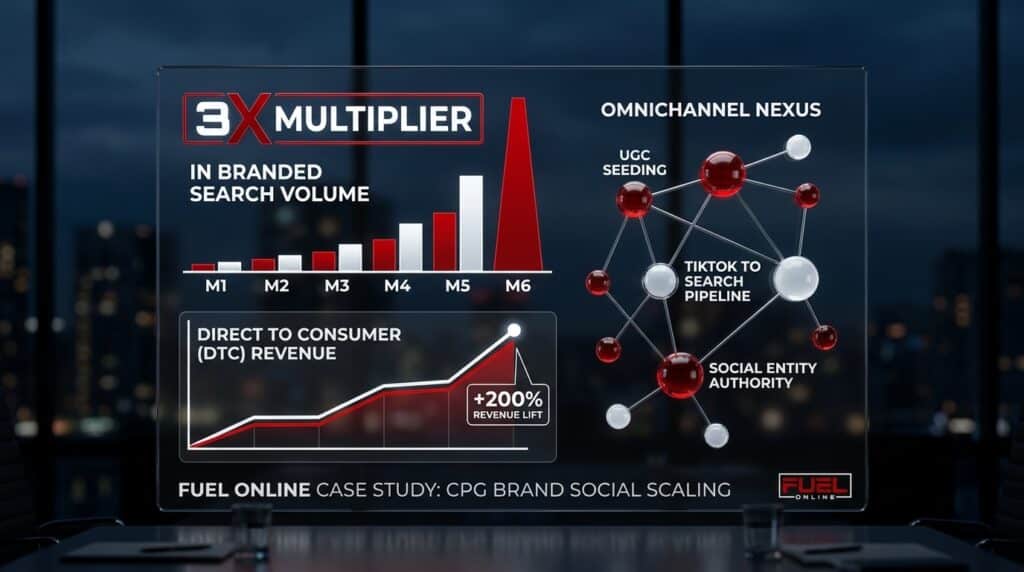
By mathematically linking social awareness directly to search intent, FuelOnline shattered the client’s revenue plateau.
| Performance Metric | Baseline (Pre Campaign) | Month 6 (Post Deployment) | Net Growth |
| Branded Search Volume (Google/Bing) | 12,000 / month | 36,500 / month | 3x Multiplier |
| Cost Per Acquisition (Paid Social) | $42.00 | $29.50 | 30% Reduction |
| Organic Social Traffic to Site | 4,500 / month | 18,200 / month | +304% |
| Direct to Consumer (DTC) Revenue | $150k / month | $450k / month | +200% |
Client Testimonial
“We were spending a fortune on beautiful social media videos that did absolutely nothing for our bottom line. Fuel Online came in and completely flipped the script. They showed us how to use authentic creator content to actually manipulate search behavior. They didn’t just grow our Instagram; they tripled the number of people actively searching for our brand on Google. Our DTC sales have never been higher.”
Founder and CEO, Health and Wellness CPG Brand
Apply this CPG UGC case study to a future creator-to-commerce experiment.
Start with the customer decision the creative should help, the product information supporting it and the evidence needed to evaluate the test. Keep content delivery, observed search behavior, referral visits and commerce outcomes separate. A useful experiment can reveal which part of that chain needs attention without treating every later brand search or order as an effect of the creator asset.
The following is a hypothetical planning exercise for a fictional household-label brand. It does not describe additional work performed for the historical client above or add to the reported results. Its purpose is to help a prospective buyer compare an experiment’s inputs, implementation and interpretation. It introduces no new claim about an advertising platform’s features or a particular product’s benefits.
Give the creator a decision brief, not just a phrase to repeat.
Suppose the fictional brand sells label packs with several size choices. Prospective customers ask which pack suits the items they want to organize. The brief should identify that question and the approved material that answers it. A creator can demonstrate a relevant selection process using the actual product information supplied. The assignment should not depend on inventing a product benefit or suggesting that every viewer has the same need.
Identify what the asset must make understandable. A viewer might need to recognize the product family, compare available choices or understand where to find the relevant explanation. Those tasks are different from completing an order. Define the intended next action before selecting an experiment measure. Otherwise, an asset can be judged against a purchase goal even though its brief only asked it to introduce the brand.
Keep the approved source material with the brief. It should show which product and choice are being depicted, which explanation the creator may use and who resolves an uncertain statement. A previous campaign asset may show an older pack. A current catalog record may describe the offering without explaining the particular demonstration. Have the product owner confirm the connection before the creative is treated as ready for distribution.
Check the destination before increasing distribution.
For the fictional brand, follow the question from the asset to the resource a buyer can actually use. If the asset compares pack sizes, the destination should help establish the available choices rather than present an unrelated general promotion. If a customer searches the brand or product wording instead of following a link, inspect whether the relevant explanation is available through that route as well. This is a proposed customer-path check, not a claim that every viewer will behave that way.
A product page, a comparison resource and a campaign landing page can each serve a useful purpose. Choose the resource that answers the question without creating unnecessary competing explanations. Preserve an existing accurate resource when it already does that job. If a new destination is proposed, explain what it allows the customer to decide that the existing resources cannot.
| Observation | Useful evidence | Interpretation boundary |
|---|---|---|
| The approved creative was distributed. | The asset version, product source, distribution record and stated period. | Delivery does not establish that viewers understood the offer or later searched for it. |
| Brand or product queries changed. | The defined query group, source report and comparable observation windows. | A change can coincide with other activity; it is not automatically incremental demand from this asset. |
| Visitors reached a destination. | The recorded route, destination and available referral or campaign context. | A recorded referral can support a route observation without reconstructing every earlier exposure. |
| Commerce records show orders. | The order definition, period, relevant product choices and treatment of later adjustments. | An order total needs a stated attribution and revenue basis before it can support a campaign comparison. |
Write down the comparison before looking at the outcome.
Choose a test question narrow enough to interpret. The fictional team might ask whether a particular explanation helps customers reach the right pack information. It should record the asset, destination and intended action before distribution. A broader question about whether the entire social program creates additional business needs a broader design and evidence. Do not let a small creative test silently become proof of that larger proposition.
State what the comparison will be and what it cannot control. If the team compares two periods, record their lengths and the relevant business conditions. If it compares audiences or other groups, establish what makes them comparable and what exposure differences can actually be documented. A convenient group is not automatically a useful comparison, and a neat percentage does not repair a weak design.
Maintain a simple record of concurrent changes. A discount, a new retail listing, a change in product availability, another campaign or a revised purchase path can affect the same observations. The experiment owner should identify which changes occurred during the review period. This does not make the test worthless; it narrows what the business can reasonably conclude and can suggest a better next assignment.
Keep the creative comparison about the intended difference.
Suppose the fictional team wants to compare two ways of explaining pack selection. If one asset also shows a different product, a new discount and another destination, the result no longer isolates the explanation it intended to evaluate. Write down the planned difference and the elements expected to stay consistent. If the team cannot keep those elements comparable, describe the exercise as a broader package comparison instead of claiming that the opening phrase alone caused the outcome.
Retain the approved version of each asset with the source brief. A later edit to the demonstration or product wording can change the question the asset answers. The person reviewing performance needs to know which version was distributed during each period. A file name reused for several edits is not enough to establish that relationship. Use the business’s maintained records to keep the creative, product source and destination connected.
Before distribution, ask someone who was not involved in drafting to follow the proposed path. Can that person identify the product choice the creative explains, locate the corresponding information and understand the intended next action? Their review can expose a missing explanation or an unrelated destination before money is spent. It is a readiness check on the assignment, not a consumer study or proof that a wider audience will respond in the same way.
Record the unresolved decision after that check. If the reviewer cannot distinguish the pack choices, fix the explanation before comparing distribution performance. If the explanation is clear but the destination cannot support the intended action, assign the implementation work. If both are ready, the experiment can address the remaining response question. This sequence prevents a test budget from becoming the first method used to discover a known source or purchase-path problem.
Distinguish an attributed route from incremental business.
A recorded visit from a campaign can help establish how that visit arrived. It does not by itself establish what would have happened without the campaign. A returning customer might already know the brand, while another person might encounter the asset and later return through an unrecorded route. Keep those possibilities separate from the specific source information the business actually has.
In this exercise, incremental business means the additional outcome the team is trying to distinguish from what would otherwise have occurred. It is a question requiring a credible comparison, not a label attached to every attributed order. When the design cannot support that distinction, report the observed association, the measured routes and the remaining uncertainty. Avoid renaming a before-and-after difference as incremental revenue simply because it followed the release.
A useful agency review should explain this boundary plainly. Ask which observation supports the creative decision, which supports a destination change and which would be needed for an expansion decision. The same set of records may answer one of those questions well and another poorly. Preserve the useful finding rather than either claiming universal success or discarding the entire exercise.
Keep the arithmetic attached to its records.
Consider a separate fictional illustration. A campaign-period report contains 120 completed orders, while an earlier equal-length period contains 100. The observed difference is 20 orders. That subtraction is correct, but it does not establish that the campaign caused all 20. The team still needs the comparison conditions, the product and availability context, and a way to consider the other changes recorded during the period.
Suppose the campaign’s media expenditure is 600 fictional currency units and its recorded route is associated with 30 of the orders. Dividing 600 by 30 gives 20 media units per associated order under that route definition. Dividing the same expenditure by the 20-order period difference gives 30. These calculations have different denominators. The second is not an incremental acquisition cost unless the evidence supports treating that difference as additional orders caused by the campaign.
The figures are hypothetical, not an agency fee, current advertising benchmark or new Fuel result. They illustrate why a report should name the numerator and denominator beside the calculation. A cost based only on media expenditure also excludes any separately scoped creative, implementation or analysis work. A proposal should state those costs clearly before the business compares it with a broader project measure.
Agree what the commerce measure includes.
Ask the reporting owner what counts as an order in the chosen review. An order placed, a payment recorded and an amount retained after a cancellation or return are different records. A campaign report may use another action definition. Before combining the figures, identify the product population, the period and the adjustment rule. This exercise defines a marketing comparison rather than prescribing an accounting policy.
For the fictional brand, an order containing several packs is not automatically several new customers. A returning customer’s purchase also has a different relationship to acquisition than a first recorded order, where the business can establish that distinction. Retain the available definitions instead of using units, orders, customers and revenue interchangeably. If the source cannot identify a distinction reliably, do not invent it to make the report more detailed.
Use a mixed result to choose a smaller next change.
Suppose the fictional asset attracts visitors to the pack comparison, but the receiving review shows repeated questions about an option the brand no longer sells. Inspect the source and destination before increasing distribution. The useful next change may be to correct an outdated explanation or clarify the available choice. A higher advertising allocation would not itself resolve that inconsistency.
A different result might show that the explanation is accurate but the selected pack is difficult to retain through the purchase path. That condition calls for an implementation investigation, not automatically another creator script. If the purchase path is usable but the experiment lacks a meaningful comparison, improve the design and evidence before making a stronger effectiveness claim. Each result should lead to the task it actually supports.
Define the handover around a repeatable experiment.
Before agreeing to a larger program, ask for the approved brief, product-source references, asset versions, destination checks and observation definitions. Identify who supplies a changed product fact, who updates the asset or resource and who maintains the reporting comparison. The deliverable should make the next decision easier to inspect, not leave the business dependent on a presentation with unexplained headline totals.
End the review by separating completed work from later interpretation. The team can verify that an approved asset and a useful destination were released, that the chosen records were captured and that the review followed its stated definitions. Whether the work produced additional business remains a separate evidence question. That distinction allows a prospective buyer to use this planning exercise without converting it into an additional claim about the historical case above.