
This B2B SaaS GEO case study describes Fuel Online’s reported work for a mid-market HR software company. Review the original engagement and results below, then use the separate source experiment guide to define a future question panel, citation review and buyer-evidence assignment.
The Context: The “High DR, Zero Citation” Trap
In Q1 of this year, a mid-market HR SaaS company approached FuelOnline facing a modern search crisis. They possessed a highly authoritative website (Domain Rating 78) and historically ranked well for broad terms like “what is workforce management software.”
However, their organic lead velocity had dropped by 22% Year-Over-Year.
The Diagnosis: Their high-traffic “Ultimate Guides” were being scraped and summarized by Generative AI engines (Google SGE, Perplexity, Gemini). Because their content lacked strict semantic structure and unique data, the AI models were summarizing the concepts but not citing the client as the source. Furthermore, they were entirely absent when users asked AI engines high-intent comparison questions like, “What is the best HR software for remote mid-market teams?”
The FuelOnline Methodology: Deploying the GEO Nexus™ Framework
To reclaim their market share, FuelOnline executed a 4-month pivot from traditional SEO to Generative Engine Optimization (GEO). We executed this across three distinct technical pillars:
Step 1: Semantic Entity Mapping & Disambiguation
LLMs do not understand “keywords”; they understand “entities” and their relationships.
- The Action: We mapped the client’s core software features to established global entities within Wikidata and Google’s Knowledge Graph. Instead of optimizing a page for the keyword “payroll integration,” we semantically structured the page to define the relationship between the client’s proprietary API and the broader entity of Enterprise Resource Planning (ERP).
Step 2: Information Gain Injection (The Answer Engine Catalyst)
LLMs actively filter out repetitive, consensus-level content. To force a citation, a page must offer Information Gain—unique, proprietary data not found anywhere else on the internet.
- The Action: FuelOnline bypassed standard copywriters. We interviewed the client’s lead product engineers to extract raw, proprietary performance metrics (e.g., “Our API reduces payroll processing latency by 41% compared to legacy CSV uploads”). We formatted these unique data points into high-density Q&A blocks, making the client the sole primary source for this specific metric.
Step 3: Technical Schema Nesting
We overhauled the technical architecture to feed structured data directly to Answer Engine crawlers.
- The Action: We went beyond standard markup by nesting
FAQPageschema directly insideSoftwareApplicationschema. We utilized theSameAsattribute to definitively link their product pages to highly trusted third-party review entities (G2 and Capterra), creating an undeniable semantic trust loop that LLMs rely on for recommendations.
Empirical Results and Performance Data
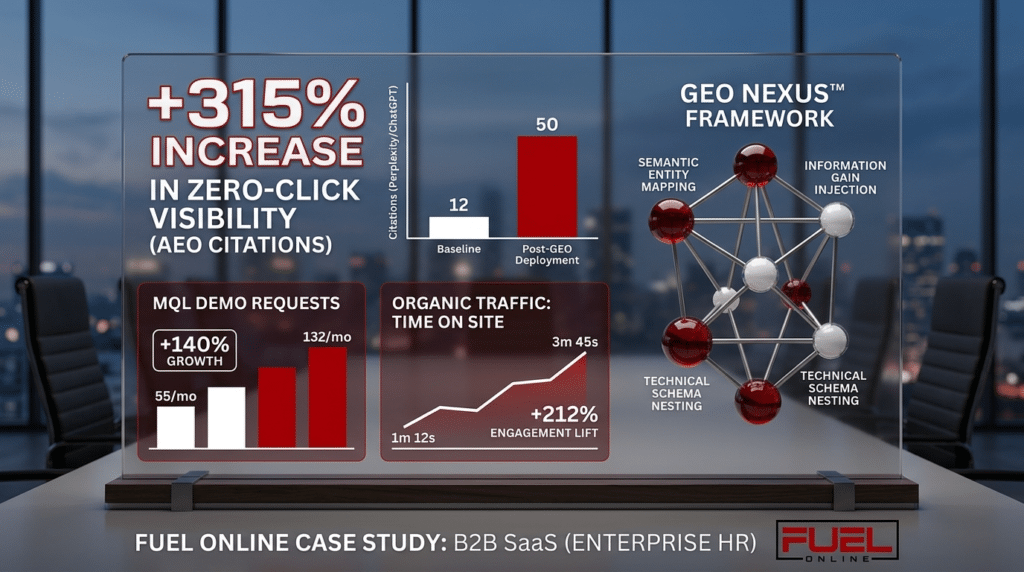
The transition to a GEO-focused architecture yielded highly qualified, bottom-of-funnel growth within 120 days.
| Performance Metric | Baseline (Pre-GEO Audit) | Month 4 (Post-GEO Deployment) | Net Growth |
|---|---|---|---|
| Answer Engine Citations (Perplexity/ChatGPT) | 12 Active Citations | 50 Distinct Queries | +315% |
| Visibility for “vs / alternatives” AI Queries | 0 Top 3 Mentions | 28 Top 3 Mentions | Infinite |
| Organic Traffic Qualification (Time on Site) | 1m 12s | 3m 45s | +212% |
| Qualified Demo Requests (MQLs) | 55 / month | 132 / month | +140% |
Client Testimonial
“FuelOnline fundamentally changed how we view organic search. They didn’t just tweak title tags; they re-engineered our content so that AI engines literally have no choice but to cite our data. Within four months, we stopped losing traffic to AI overviews and started actively capturing our competitors’ market share in ChatGPT and Perplexity prompts.”
— CMO, Mid-Market HR SaaS
The following fictional future exercise is separate from the historical campaign above. Its questions, sources and counts illustrate a research design, not additional client work or outcomes.
Plan a B2B SaaS GEO source experiment
A useful B2B SaaS GEO experiment begins with a buyer question, an approved source and an observation plan. Decide what the published resource should help a reader understand, then compare dated answers against that source. Citation inclusion, factual accuracy and commercial activity are different observations. A proposal should explain which of them the assignment can examine and what evidence the client must supply. This gives a buyer something more inspectable than a promise to make a product appear in answers.
Consider a fictional HR software company preparing a resource about how business teams describe a scheduling workflow during product evaluation. The exercise does not assert that the historical client offers a particular scheduling feature or that a real platform behaves in a specified way. The company's product owner supplies the approved explanation. The experiment asks whether publishing a clear source makes that explanation available to readers and how a selected set of observed answers uses it. It is a planning exercise, not another result from the case above.
Choose one decision the resource can help a buyer make. In this example, the question is what information a business team needs to prepare before discussing its scheduling workflow with a software provider. The resource might distinguish the team's current process description, the questions it wants to resolve and the product statements the provider has approved. It should not prescribe employment policies, legal obligations or technical capabilities that the company has not supplied. The content's value comes from making the evaluation conversation clearer, not from inventing a proprietary statistic.
Define the source's boundaries before drafting. Record who supplied each product statement, when it was confirmed and the circumstances it addresses. Keep examples visibly separate from statements about the actual offering. If the source includes an illustrative workflow, identify it as an example rather than evidence that every customer uses the product that way. A reviewer should be able to trace a consequential statement to an approved input. That traceability helps the company answer a source question even when no external answer cites the page.
Select an initial question panel before looking for favorable results. Include questions about the decision the source actually addresses, plus nearby questions that require different information. The nearby questions can reveal whether the resource is being stretched beyond its scope. Keep the original wording and explain why each question belongs in the panel. Do not keep adding questions until the reported inclusion rate looks attractive. A small predefined panel provides a more interpretable comparison than a collection chosen only after the observations are known.
The panel also needs a clear audience assumption. A business buyer preparing an evaluation is different from an existing user asking for operating instructions. In this exercise, the new resource addresses the former. If an observation concerns a user-support question, record that difference instead of treating the absence of a citation as a failure. The same product can support several information tasks, but a source experiment cannot evaluate all of them simply by using the product's name in every question.
Record what an answer actually does
Save the actual question, observation date, displayed answer and linked destinations when those are available. Record the observed service and any visible context needed to interpret the interaction. Keep unavailable settings unknown rather than filling them in from memory. If a comparison uses different contexts, label that difference. The purpose is to preserve what was observed, not to claim that one saved answer represents every buyer, location, account or later interaction.
Review each observation at several levels. First, does the answer address the intended evaluation question? Second, does it state the approved product explanation accurately? Third, does it link to the company's resource, another source or no visible source? Fourth, does the linked destination actually support the statement for which it is used? These checks can produce different results. An answer can cite the company while misreading the source, or explain the issue accurately while citing another useful resource.
A source destination should be inspected in context rather than credited solely because its domain appears. The linked page may be an older resource, a general product overview or the exact new guide. Record the destination and the relevant statement it supports. If an answer combines several sources, distinguish which statement comes from which page where that relationship is observable. When the relationship is unclear, mark it unresolved. A visible link does not by itself prove that every sentence in the answer came from that destination.
Use an agreed observation sheet so reviewers do not silently change the meaning of success. One column can record whether the resource appears among visible citations. Another can record whether the answer's key explanation agrees with the approved source. A third can record whether the cited passage supports that explanation. Keep a short reason for uncertain judgments. The sheet should let another reviewer understand a decision without accepting a single overall score whose components are hidden.
For a hypothetical arithmetic example, suppose a fixed panel contains eight questions. Before publication, one observed answer links to an existing company resource. In a later observation round, three answers link to the new guide. Report the counts as one of eight and three of eight, or 12.5% and 37.5% for those particular rounds. The difference is two observations and 25 percentage points. It is not evidence that every future answer has a 37.5% chance of citing the company or that the guide caused a particular commercial outcome.
Now suppose only two of the three later cited answers represent the approved explanation accurately, while the third overstates the example's scope. Keep that accuracy finding separate from the three citation inclusions. The useful next task may be to inspect whether the page makes its example boundary sufficiently clear. It would be misleading to call all three equally successful simply because the link is present. Conversely, a clear answer that cites another source can still inform the buyer even though it does not satisfy the company's visibility objective.
Interpret the comparison within its limits
Keep a dated publication and change record alongside the observation sheet. Record when the new resource became available and whether other relevant pages, product descriptions or external sources changed during the comparison. A page being published is not proof that a particular service retrieved it immediately. If the observed answer does not use the guide, the available evidence may not explain why. Do not replace that uncertainty with a story about an engine's internal ranking or a guaranteed recrawl schedule.
A before-and-after difference can be worth investigating without establishing causation. The underlying service may change, competing sources may change and repeated answers may vary. A simultaneous product announcement can alter the surrounding information even if the guide is unchanged. Record these events where known. The experiment can report what happened in its selected observation rounds and whether the source appears to support the resulting statements. A stronger causal claim requires a stronger design than a small uncontrolled comparison.
Use a comparison resource only when it answers a real design question. For example, a company might observe an established information page alongside the new guide to see whether both change in the same period. That can add context, but the resources are not automatically equivalent controls. Their topics, histories and available sources may differ. Explain the reason for including the comparison and its limitations. Do not label any unchanged page a control simply because the label makes the experiment sound more conclusive.
Review question stability as well as source stability. Rephrasing a question can be a useful separate test of how broadly the explanation applies, but it changes the comparison. Keep the original panel intact and label any additional wording as an exploratory set. Likewise, a new product question that the source does not answer should not be added retrospectively to improve or reduce the original score. This separation allows useful exploration while preserving the meaning of the planned observations.
Commercial receiving evidence belongs in another part of the review. A company can report observed evaluation requests using its own definitions, but it should not multiply the panel's citation percentage by inquiries to invent an attributed total. A prospective buyer may research several sources, and the saved question panel does not identify that person's actual journey. Keep available visit information, a person's stated discovery account and aggregate receiving activity distinct. Unknown relationships remain unknown even when the source experiment shows an encouraging pattern.
Decide in advance what finding would change the next publishing decision. Accurate citation of the wrong product context may call for a clearer boundary. Accurate answers without the company's source may justify examining whether the guide contributes useful material beyond existing sources. Inconsistent reviewer judgments may call for a better observation definition. These are narrower and more actionable responses than commissioning another batch of similar articles. The experiment earns its value by helping the business choose the next task, not only by producing a percentage.
Compare the work and evidence included
An experiment proposal should distinguish preparation, publication, observation and interpretation. Preparation organizes approved product inputs and the reader decision. Publication makes the agreed resource available through the company's actual publishing process. Observation preserves dated questions, answers and source destinations. Interpretation explains the findings and their limits. One provider may deliver only some of these components. A buyer should understand that boundary before comparing fees, timelines or claimed outcomes.
The comparison below describes possible future work products, not a required package or a statement about the historical engagement. Ask the provider to identify the client input, its own deliverable and the acceptance evidence for each selected component. A source guide can be complete while publication remains dependent on another team. An observation report can be complete while a product-source question remains unresolved. Separating those statuses makes the assignment easier to manage and prevents a broad completion label from concealing the actual next decision.
| Component | Client input | Provider deliverable | Acceptance evidence |
|---|---|---|---|
| Source preparation | Client supplies the approved HR-software explanation, its owner and the evaluation question. Unknown product statements remain open rather than becoming invented content. | Provider organizes the source boundaries, reader decision and unresolved inputs into a reviewable brief. | Accept when a reviewer can trace each consequential statement to an approved input and distinguish the fictional example from the actual offering. |
| Publication implementation | Client identifies its publishing owner and the approved resource destination. Any dependency outside the assignment remains named. | Provider prepares or implements the agreed resource within its actual authority, retaining the source context and useful navigation. | Accept the public resource against the approved manuscript and source map. Publication alone does not establish retrieval, citation or commercial activity. |
| Observation collection | Client and provider agree on the fixed panel, observation periods and visible context to retain before reviewing outcomes. | Provider saves actual questions, displayed answers and source destinations, with unavailable information marked unknown. | Accept a complete dated record for the agreed observations. A favorable screenshot without the question or destination is not an equivalent evidence package. |
| Interpretation and next task | Client supplies relevant known publication or product changes and separately defined commercial evidence if that question is included. | Provider explains citation, accuracy and source-support findings, limits and a bounded next publishing decision. | Accept an explanation another reviewer can follow without assuming causation. Unknown inquiry attribution and unresolved source relationships remain visible rather than disappearing inside a summary score. |
The client's contribution is substantive. A product owner must confirm the explanation the resource presents. A publishing owner must identify the route for an approved release. A business reviewer must understand which question the resource is intended to answer. If those inputs are unavailable, the agency can organize the unresolved questions but should not invent the answers to keep production moving. A narrower preparation assignment may be more useful at that stage than a promise to deliver a finished experiment on an unsupported schedule.
At handover, request the approved source inputs, the final published resource, the fixed question panel, the dated observation records and the interpretation notes. The company should be able to inspect the same evidence without depending on a presentation's headline. Include unresolved items and the reason they remain unresolved. That package supports a later comparison when the product or available sources change. It does not certify future citations, universal answer accuracy, qualified pipeline or the results of any later campaign.
For a broader discussion of the service behind this type of work, review Fuel's existing SEO service information or its case study library. Use those resources to clarify the intended assignment, while keeping this exercise's evidence definitions intact. The historical case retains its original reported metrics and testimonial. A future HR-software source experiment should be judged through its own approved explanation, useful published resource and dated observations, with commercial results assessed only when the relevant evidence actually exists.