
FUEL ONLINE / Architecture Firms / PPC & Google Ads
PPC for architects: Google Ads

Architecture firms need the right project type and selection team, not more residential, student, or drafting-only inquiries. Fuel separates paid searches such as 'healthcare architecture firm in Boston' from low-fit intent such as 'free house plans', then aligns ads, geography, landing pages, and contact actions with sector, project type, geography, procurement route, delivery model, and schedule. Search-term reviews and business development team feedback move budget toward qualified project conversations, not the cheapest clicks or form fills.
Project type, site location and estimated scale; Design stage and intended timeline; Decision-maker and procurement process; Services required and project-fit criteria
Resolve architecture paid-search ambiguity through sector, project role and selection stage
Compare PPC for architects by following a complete project request from the search message into the firm evidence and business-development conversation it supports. A sector term, a project photograph and a form submission do not establish the same thing. The useful agency decision is whether the stated request fits the actual firm offering and which information remains unresolved. Ask for a worked review of ambiguous requests, permissioned project roles and selection-team records before judging a campaign by its largest conversion total.
Read the request beside the firm offering
Start with the firm supplied offer and project-fit information. Identify the sectors, services, geographic relationships and types of initial conversation it wants to promote. A general architecture term does not establish that every project type is relevant to this firm. The agency should show how its proposed campaign message uses the maintained explanation. Where the firm has not supplied a fact, record the question rather than expanding the offering from a portfolio photograph or a nearby sector label.
Read the complete request before deciding what a phrase means. Someone researching a laboratory project may represent a selection team, seek educational material or ask about employment. A sector word alone does not establish commercial purpose. The agency should connect the available question or inquiry with the promoted service, destination and intended next conversation. If the context is incomplete, a targeted clarification can be more useful than a broad exclusion that also removes relevant project research.
Use an illustrative request asking for plans as a test of that reasoning. It could concern a freely downloadable resource, a drafting-only service or a real project team asking about the firm design scope. The word does not settle the distinction. Ask the firm what it actually accepts and which information would identify the intended conversation. The agency should preserve the uncertainty where necessary rather than assume that every similar term belongs to one universal exclusion category.
| Illustrative request or source | Question to resolve | Useful campaign evidence |
|---|---|---|
| Sector-specific project inquiry | Which firm service and prospective role are actually being discussed? | Full request and maintained offer remain connected. |
| Plans or educational-resource request | Is the purpose a project conversation or another task? | The complete context supports a reversible classification. |
| Permissioned project image | What role and stage does the source establish? | Caption and shortened message retain that scope. |
| Several selection-team participants | Do records describe one project discussion or different opportunities? | Contact counts and project-stage counts use explicit relationships. |
| Existing-project communication | Which supported continuing-contact route applies? | Routing remains useful without inflating new acquisition. |
Keep project evidence and geographic roles clear
Project examples need their own evidence sheet. Record the firm role, sector, scope represented, stage shown and permission for the proposed use. A completed-building photograph, a design illustration and a project announcement can help a reader in different ways. They should remain distinguishable when used on an ad destination. A shortened caption should not turn a specialist contribution into responsibility for the entire project or imply that an unbuilt illustration is a photograph of completed work.
Compare the project example with the service statement it supports. A page may show experience relevant to a sector while the actual offering needs a fuller explanation. Ask which maintained source supplies that relationship. The agency can connect the example with the firm description without inventing credentials, procurement eligibility or additional services. A useful destination explains why the material belongs in this buying journey instead of presenting an attractive gallery as a complete answer to every project question.
Treat project location, office location and current geographic scope separately. An example documents work associated with a place; an office identifies the firm presence; the current offer describes the relationships the firm wants to discuss. The agency should use the actual firm supplied scope. A campaign destination should not create an implied local office or unrestricted project reach simply because a portfolio reference contains a place name that appears in a search.
Ask how the landing page helps a selection-team member continue. That person may need the relevant service explanation, documented firm role, a project resource or the correct business-development contact route. The useful next step depends on the stated question and available material. A general contact invitation can be appropriate without implying that the visitor has issued a formal request or that the firm has accepted a commission. The public wording should preserve the actual stage.
Rehearse a selection-team request
Work through a fictional request from a selection team exploring a laboratory project. The message names the sector and asks whether the firm can discuss a role, but leaves the specific service scope unclear. The reviewer should identify the potential business purpose and the factual input needed from the firm. A laboratory reference in the portfolio can orient the conversation; it does not by itself establish that the proposed role is offered or suitable for the new assignment.
Now suppose a second fictional message references the same sector but asks for material for a student project. The sector is relevant to the portfolio while the immediate purpose differs from the acquisition objective. The agency should classify the request under the firm process rather than count it as another commission prospect. That does not justify excluding every search containing the sector or educational language. Ask what complete evidence supports the narrower decision and which relevant requests could also be affected.
A third message comes from a person associated with an existing project and asks to contact the team. It may need a supported continuing-project route rather than a new-business form. Preserve the actual stated purpose and the appropriate administrative instructions. A return through an advertisement does not automatically create another prospective client. The agency can improve orientation and reporting while leaving the firm project communications and professional decisions within their established process.
Finally, change a documented role in the review materials. Suppose the firm clarifies that one project example represents a specific contribution rather than the broader role suggested by a shortened campaign introduction. Identify the page, caption, project link and active message that depend on that wording. Correct those relationships and retain accurate unrelated material. Another contributor should be able to follow the change record without learning the explanation from a private meeting.
This exercise gives the buyer a way to compare campaign judgment as well as writing. An agency that can name the supported role, identify an ambiguous request and preserve the relevant journey is demonstrating a usable reasoning process. A generic instruction to add more sector phrases does not establish those relationships. Compare the completed worksheet with the source material and ask which specific ambiguity the proposed release removes for a prospective project team.
Preserve the conversation through the inquiry route
The inquiry route should request context that helps business development decide the next conversation. The firm may need the stated project type, place, organizational role and broad stage where those facts are available. Ask why each proposed field belongs in the initial interaction. Some details may need a later discussion. A confident but guessed category can obscure the actual question, so retain a short explanation or supported uncertainty route when the firm process calls for it.
Keep the arrival source distinct from the request. A visitor may enter through a sector example but ask about another project type. Another member of a selection team may return through a different channel. Preserve the original page context and the purpose stated by the person separately where the available configuration supports it. Neither a campaign name nor a later visit should silently overwrite the explanation of what the team is seeking or how the original interaction was recorded.
Several people can participate in one selection conversation. Ask whether reporting counts submissions, contacts, organizations or project opportunities. Two employees discussing one project may be separate contacts within a shared opportunity, while one organization can discuss genuinely different projects. The firm supplies the relationship used for its report. Uncertain matches need visible review rather than a silent merge based only on a shared email domain or a similar project label.
Work through seven fictional messages
Consider an explicitly fictional set of seven messages. Three people identify themselves as participants in one organization project discussion. Another organization sends one potential-project inquiry. The remaining messages are a student resource request, an existing-project contact and a marked delivery test. The set contains seven messages and two candidate new-project discussions under those stated relationships. It is not evidence of seven new commissions, and neither candidate has been accepted merely because the message arrived.
Suppose the firm records a business-development meeting for the first discussion while the second requires clarification. The worksheet can show two candidate discussions, one recorded meeting and one unresolved discussion. The three participant contacts remain attached to the first discussion, while the other purposes retain separate categories. The test is excluded from acquisition reporting. These figures demonstrate a record relationship only; they are not Fuel results, industry benchmarks or forecasts of project conversion.
Ask the agency and the receiving team to reproduce the same result. A report counting people can legitimately differ from a report counting project discussions, but the labels should make that difference clear. A recorded meeting remains different from a proposal opportunity or accepted commission defined by the firm. If later-stage information is unavailable, preserve the observed stage and identify the missing source. A complete-looking return calculation should not be built from invented project values or assumed outcomes.
Compare costs and accept the delivery path
Compare cost figures with an explicit numerator, denominator and period. Advertising spend per received message answers a different question from spend per firm-reviewed project discussion. If agency fees or landing-resource production are included, state that scope separately. Use a consistent review rule for unresolved requests and later dispositions. The buyer should be able to understand why a reported cost changed before assuming that the difference reflects a better or worse campaign.
Rehearse the actual public route with clearly marked fictional details agreed by the firm. Begin at the selected project or service destination, follow the supported invitation and inspect the confirmation and receiving record. Ask the receiver to state the project question and next administrative action. Repeat with a second selection-team participant or a corrected detail. This checks whether the delivered system preserves the intended meaning rather than merely producing an event in an advertising dashboard.
If a test fails, isolate the artifact responsible. An unclear project role needs an evidence or caption revision. A relevant message sent to the wrong destination needs a receiving repair. A student request counted as a project opportunity needs classification work. Those problems do not require the same campaign intervention. Name the implementer and acceptance evidence, especially where a website supplier or receiving-system owner controls a separate part of the path.
Retain the complete request examples, permissioned project evidence, source relationships and reasons for campaign decisions at handover. An unfamiliar contributor should be able to apply a changed role or contact destination without altering unrelated accurate material. A useful architecture PPC engagement makes those decisions reproducible. Future discovery and commercial outcomes can then be evaluated from actual records, while the completed message, destination and receiving work remains independently inspectable.
For the related firm-wide scope, explore architecture firm marketing.
AGGRESSIVE FROM THE START
One month. The work many agencies stretch across three.
Our mandate: move faster, go deeper and put experienced specialists to work immediately.
Fuel attacks the work in parallel: site audits, technical errors, new content, internal links, backlink outreach and conversion improvements. Your agreed scope determines the channels; urgent fixes do not wait behind a drawn-out planning phase.
The PPC for architects brief identifies visibility and lead barriers. Actionable fixes move into production while deeper analysis continues.
Your architecture firm Google Ads work runs alongside industry-specific content, relevant links and earned-authority outreach, based on your agreed scope.
The PPC management for architects review shows completed work, lead quality and the next opportunities. You see who owns each action.
Fast execution is the operating standard. Access, approvals and scope shape delivery; search and revenue results have their own timelines.
What PPC for architects changes for architecture demand
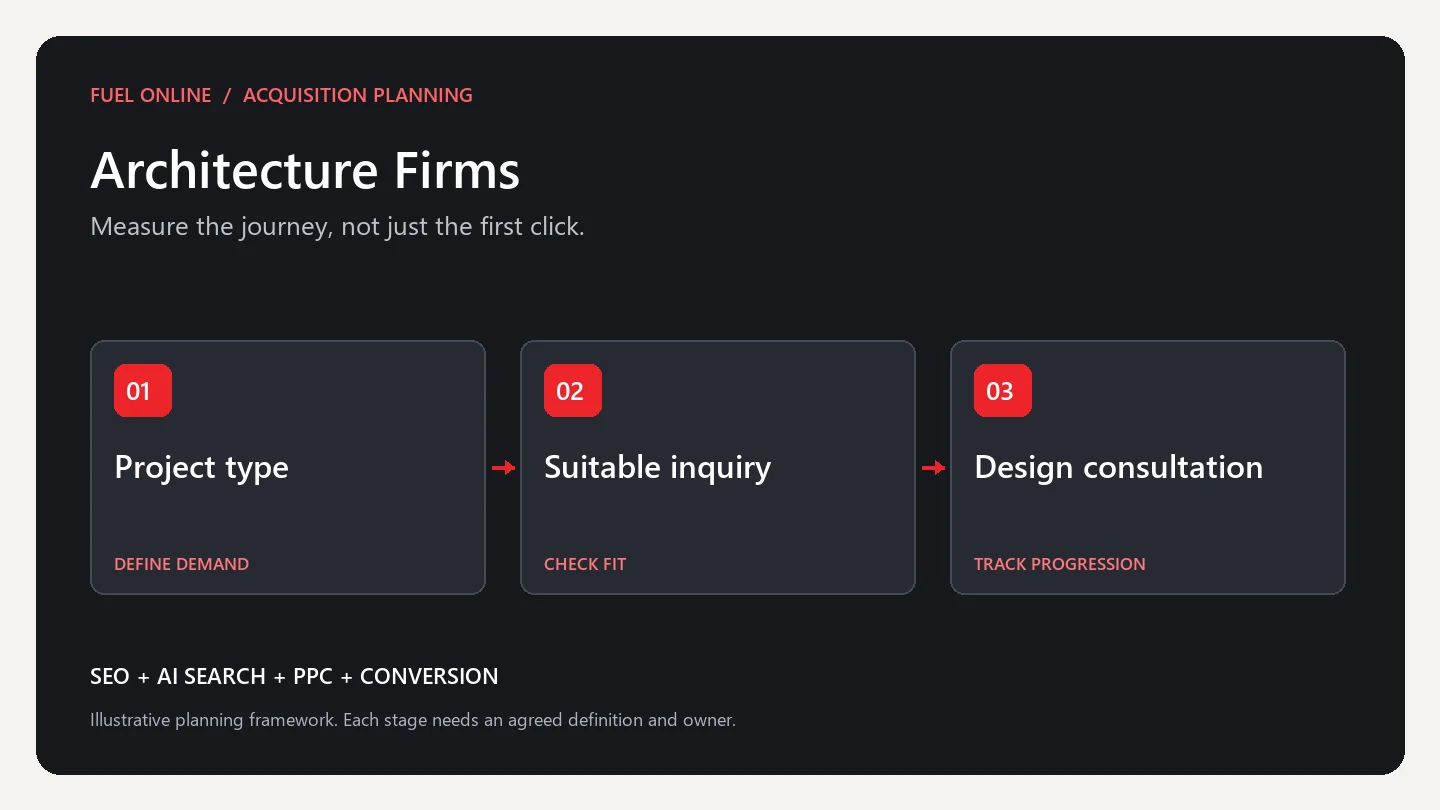
Paid acquisition becomes useful when the account mirrors the business. Fuel separates campaigns when geography, service, economics, qualification, or next step differs. The distinction between 'healthcare architecture firm in Boston' and 'free house plans' becomes visible in queries, exclusions, ads, pages, and reporting.
Each ad group has a defined buyer, promise, evidence need, destination, and contact action. The landing page uses permissioned project photography, accurate project roles, named team expertise, and current credential statements and gives the sales team project type, location, decision role, procurement route, budget context, and schedule.
A practical architecture firm PPC diagnostic
Use this diagnostic when paid conversion volume improves but the receiving team does not see a comparable change in qualified project conversations. The diagnostic for PPC for architects starts with the observable symptom, checks the page, source, campaign, or handoff responsible for it, and ends with one reviewed action, owner, and validation method.
Observable symptom
Reported conversions increase, but search terms and landing pages still send 'free house plans' demand instead of opportunities closer to 'healthcare architecture firm in Boston'.
What to inspect in architecture firm Google Ads
Review actual search terms, geography, ad promise, landing-page fit, contact action, and the sales, intake, or scheduling decision.
Decision criteria for PPC management for architects
Add or remove a reviewed exclusion, separate the campaign, revise the landing page, or hold budget until the handoff works.
Inspectable output
A search-term and landing-page decision log showing what changed, why budget moved, and whether qualified project conversations improved.
PPC management for architects deliverables you can inspect
The team receives a campaign and budget matrix, reviewed query decisions, exclusions, landing-page message map, conversion tracking, and a weekly budget log.
- Campaign, geography, and budget matrix, used to define the PPC for architects scope.
- Reviewed query and exclusion set, used to govern the architecture firm Google Ads release.
- Ad and landing-page message map, used to evaluate the PPC management for architects decision.
- Conversion and offline-disposition tracking
- Weekly search-term and budget decision log
Illustrative architecture example
Illustrative example, not a client result: Fuel would separate paid-search demand from a selection team evaluating an architect for a laboratory, civic, or higher-education project and job seekers, plan downloads, and residential drafting requests in the account, then review the actual query, geography, promise, landing page, contact action, and final disposition before changing budget.
The architecture firm Google Ads decision log would show the exclusion, campaign split, landing-page revision, or budget hold and its owner. Spend expands only after reviewed evidence shows a stronger path to qualified project conversations.
Within PPC management for architects, the buyer team can inspect the artifact, approval, and next investment decision.
How commercial progress is judged
Fuel connects page, query, campaign, or source context with acceptance, rejection reasons, response, capacity, and qualified project inquiries, consultations held, proposal opportunities, and project-type fit. Diagnostic measures explain where the journey breaks; they do not replace the business outcome.
The decision record for PPC for architects states what changed, why it changed, who approved it, and whether the next action is to expand, revise, consolidate, or stop.
Reporting for PPC management for architects must connect the service-specific diagnostic to qualified project conversations, explain data limits, and name the next decision rather than treating activity as proof of value.
Questions to ask an architecture agency
Ask for a search-term decision log, landing-page map, conversion definition, and budget-change record. Confirm who approves exclusions, creative, tracking, and offline disposition imports.
When reviewing PPC for architects, require a named practitioner, implementation owner, approval path, and sample artifact. Reject unsupported promises of rankings, citations, lead volume, cost, or revenue.
How we measure architecture firm Google Ads
- qualified project inquiries
- consultations held
- proposal opportunities
- project-type fit
Use a cost metric that reflects qualified demand
Cost per qualified inquiry = campaign spend ÷ inquiries meeting the agreed criteria.
Define the included spend, reporting window and qualification rules before comparing campaigns. Track raw leads separately so cheaper but unsuitable inquiries do not make performance look better.
Agree on the baseline, data source and qualification criteria before comparing results. Separate visibility from inquiries and accepted business opportunities.
CONNECTED SERVICES
Choose the right next step for your business
Explore Fuel’s PPC & Google Ads capabilities, published campaign work and team to evaluate how we would support your organization.
BEFORE YOU CHOOSE AN AGENCY
Questions about architecture firm Google Ads
What happens before Fuel increases paid spend?
During the first month, the PPC for architects scope produces a search-term review, campaign and geography matrix, conversion definition, and the first budget decision. Fuel also records the client inputs and approval needed for the first release.
What does Fuel need from our architecture team?
Effective architecture firm Google Ads work requires ad-account, analytics, landing-page, call, and disposition access plus budget constraints, approved claims, and timely query review. Fuel identifies missing access or ownership before work is scheduled around it.
How will we know the work is commercially useful?
Under PPC management for architects, commercial usefulness depends on whether the diagnostic connects to qualified project conversations, the data limits are stated, and the evidence supports a clear keep, revise, or stop decision.
Should paid campaigns launch before landing-page changes?
Start with the query, geography, ad promise, landing page, contact action, and receiving path closest to qualified project conversations. The PPC for architects plan should hold expansion when a landing-page or handoff defect would turn more spend into unusable conversions.
What does a credible architecture firm Google Ads scope include?
A credible architecture firm Google Ads scope includes query and exclusion review, geography and budget rules, landing-page alignment, conversion definitions, disposition feedback, and documented budget decisions. It also names the client dependencies, practitioner, deliverable, and approval path.
How should PPC management for architects report commercial progress?
Reporting under PPC management for architects should connect the service-specific diagnostic to qualified project conversations, show what changed and why, state data limits, and name the next decision.
Make your next agency conversation specific.
Bring recent search terms, landing pages, and accepted or rejected contacts so we can identify the first paid-media decision. The first working session on architecture firm Google Ads will identify the priority artifact, evidence, owner, and approval decision for qualified project conversations.
Talk with a Fuel strategist →