
FUEL ONLINE / Architecture Firms / AI SEO, AEO & GEO
AI SEO for architects: AEO and GEO

Architecture firms need the right project type and selection team, not more residential, student, or drafting-only inquiries. For AI SEO for architects, Fuel organizes approved service facts, tests the category, fit, process, and comparison questions people ask, and repairs conflicting pages or profiles. You receive a fact sheet, prompt log, correction backlog, and named reviewers. Progress is judged by clearer sources and journeys that result in qualified project conversations, without promises of citations or answer control.
Project type, site location and estimated scale; Design stage and intended timeline; Decision-maker and procurement process; Services required and project-fit criteria
Compare architecture AI discovery through service roles, project credits and client questions
Fuel Online helps architecture firms connect public questions with their actual services, project experience, professional roles and project-inquiry process. When comparing AI SEO for architects, inspect the source relationships the agency can make clearer. An owner researching a design partner, a selection team inspecting relevant work and a student looking for project material may use similar terms while needing different answers. A useful assignment identifies the maintained passage and completed information improvement, making delivered editorial work inspectable separately from an outside answer observation.
Distinguish a firm service from a named project role
Begin with a service explanation and a project resource selected by the firm. Ask finalists which question each answers. The service page describes the scope the firm supplies for publication. The project resource presents work in its named context and credits. A project appearing on the site does not establish every possible service role. The agency should show which source supports each relationship instead of turning a recognizable building into a general claim about everything the firm can deliver.
Project credits deserve explicit treatment in a concise answer. Ask which role is attributed to the firm, which belongs to another project participant and which statement needs confirmation. The firm's supplied material governs those relationships. A shorter summary should preserve the credit context, not strengthen the role because a broader phrase seems easier to understand. This gives a prospective agency buyer a concrete source-annotation exercise without asking marketing to decide technical project responsibilities from an image or portfolio title.
A client-selection question has a different purpose from a general architecture-topic question. Ask how the source map helps an owner or selection team find the information the firm actually publishes about its approach, relevant project context and inquiry process. A student or vendor may need a different destination. The agency should retain uncertainty when a short question does not establish the reader's role. Shared design terminology alone is not a sufficient basis for every answer to end in the same project invitation.
| Question | Source role | Acceptance artifact |
|---|---|---|
| Firm service | Actual published scope versus a named project role. | Annotated statement and supporting service passage. |
| Project credit | Firm role versus other participants. | Short summary compared with complete credits. |
| Client selection | Relevant context versus student/vendor information. | Reader finds the appropriate inquiry path. |
| Outside answer | Displayed association versus source implementation. | Separate dated observation and completed revision. |
Read project imagery together with its context
A photograph can illustrate a named project while the credits and surrounding explanation establish the published relationship. Ask what the complete presentation communicates before adapting a crop or short caption. Appearance alone should not establish a commission, role, location capability or project result. An existing image can remain useful when its context is retained. The agency's task is to clarify the actual relationship rather than make the image stand in for information that belongs in maintained text.
For a selection exercise, create a fictional answer combining a firm service, named project and another participant's role from different resources. Ask the agency to annotate which relationships the sources support. Individually accurate phrases can form an unsupported combined claim. The useful response names the particular ambiguity and proportionate repair. A new general design article may not resolve a project-credit problem, even if it repeats the same familiar building or sector terms.
Include a project-type question the public resources do not answer. Ask what firm input is missing and which explanation could usefully address it. The firm may choose to clarify its scope, publish relevant contextual material or keep a project-specific discussion within its business process. The agency should not invent experience to complete an answer sheet. A precise unresolved source need can be a useful deliverable when its owner and proposed next artifact are clear.
Separate source improvement from outside answer behavior
Record the question, date, experience, visible statement and available sources for an observation. A firm mention, project citation and correct role attribution are different findings. Keep the completed editorial revision in a separate record with its firm-supplied basis. This lets the buyer accept useful source work while external answers vary. The commercial scope should not turn a source edit into a promise that a particular answer experience will recommend the firm or describe a project relationship correctly next time.
Compare an incorrect statement with a correct statement presented without its necessary context. One may need a factual revision; the other may need a better connection to credits or fuller project information. Ask the agency to explain the difference using the actual source passages. This makes the proposed work more useful than a universal recommendation to rewrite every portfolio page after an unfavorable observation or expand production without identifying what the reader needs to understand.
A recurring question set should include genuinely different client decisions. Another wording of the same firm-identity question may need observation only. A question exposing an unclear project role may justify another source brief. Ask what the new assignment contributes and which maintained resource it will inspect. The engagement should leave a reason for the next task rather than simply add more near-identical prompts because another reporting period has begun.
Test the source register with a future project update
Change a firm-supplied project credit or professional association in the review materials. Ask which service introductions, biographies, captions and project summaries depend on it. Another contributor should locate the affected statements without private project knowledge. Some passages may need revised wording while unrelated accurate resources remain useful. The register should identify those differences instead of marking every page containing a project name equally affected by a narrow update.
An unfamiliar reviewer can test two paths: an owner comparing relevant work and a reader checking a named project credit. They should identify the principal source, explain the published role and find the relevant next destination. Record where they must infer a connection. A clearer project introduction or descriptive link may solve the gap more directly than another long overview. The agency should explain the actual reader contribution behind the chosen remedy.
Compare source investigation, writing, publishing and recurring observation as separate commercial components. Another supplier may control the site or the firm may need to confirm a project relationship. Ask which resource the agency changes and what remains usable after its contribution. Similar AI discovery labels can hide different amounts of implementation. A clear dependency and completed check give a fairer comparison than a count of sampled answers whose relationship with delivered source work is unclear.
For a final-format test, ask another contributor to prepare a short firm introduction using the accepted annotations. It should preserve the distinction between a service statement and project-specific experience. Compare the result with the maintained sources and credits. If the reason for a phrase depends on an analyst's private explanation, clarify the working record. The accepted example then guides future formats instead of becoming another report that cannot support the next editorial decision.
At handover, retain a source disagreement, its accepted revision and the project-update exercise. Ask a new editor to explain which fact is maintained where and what remains an external observation. They should be able to distinguish the firm's statement from a third-party role without reconstructing the decision from disconnected pages. This turns the source register into a practical tool for future portfolio maintenance and helps preserve useful accurate project context through later redesigns or supplier changes.
The next investment can address a particular unanswered relationship or client task. The firm may need clearer sector orientation, a better connection to project credits or no further edit for a variable outside answer. Ask the agency to name the distinction and proposed artifact. Architecture AI discovery then has an understandable buying basis grounded in maintained firm information, useful client paths and transparent observations, while project-selection and professional decisions remain within the firm's own process.
Use a project-credit comparison as a proposal acceptance test
Give each finalist a fictional project sheet containing the firm's own role description and the supplied credits for another participant. Ask for two short introductions: one helping a selection team understand relevant experience and one orienting a reader to the named project. The introductions may differ while preserving the same attribution. Compare every role statement with the sheet. The useful response explains which source establishes the firm's contribution and which context must remain available when the summary appears in a shorter format.
Next, provide a third-party project description that uses a broader label than the firm's maintained source. Ask what the agency would confirm before incorporating it. The exercise should not assume either version is automatically wrong. The agency should identify the exact disagreement, fact owner and proposed next source task. This exposes whether its research process can retain uncertainty without silently selecting the strongest role claim because it would make an answer or portfolio introduction more persuasive.
Use the accepted annotations to test a sector-comparison question from an owner. Ask which published work is relevant and what the source establishes about that relevance. A project may illustrate context without proving every service relationship in the sector. The agency should explain the specific connection it can support and any information the firm would need to add. This creates a useful buying exercise without inventing credentials or asking marketing to interpret technical project responsibilities from a familiar building type.
Add a student or vendor question as a contrast. Ask which resource helps that reader and why the same project-inquiry invitation may not serve the task. The firm supplies the actual routes it supports. The agency should preserve the different purpose rather than make every portfolio visit part of one client-acquisition narrative. This is useful when comparing proposals because a larger answer or traffic total can hide whether the intended owner and selection-team information became easier to understand.
Retain the paired introductions, source disagreement and sector example with the register. Give a new contributor a proposed caption and ask what it communicates before showing the accepted wording. They should identify the attribution and relevant source. If their interpretation broadens the role, clarify the caption at that specific point. The exercise leaves the architecture firm with a reusable editorial standard for future portfolio formats instead of another collection of summaries whose claims need to be rechecked from scratch.
When project-role questions expose unclear portfolio and service page relationships, architecture resource planning can organize the maintained firm information.
AGGRESSIVE FROM THE START
One month. The work many agencies stretch across three.
Our mandate: move faster, go deeper and put experienced specialists to work immediately.
Fuel attacks the work in parallel: site audits, technical errors, new content, internal links, backlink outreach and conversion improvements. Your agreed scope determines the channels; urgent fixes do not wait behind a drawn-out planning phase.
The AI SEO for architects brief identifies visibility and lead barriers. Actionable fixes move into production while deeper analysis continues.
Your architecture firm AI SEO work runs alongside industry-specific content, relevant links and earned-authority outreach, based on your agreed scope.
The architecture firm AEO and GEO review shows completed work, lead quality and the next opportunities. You see who owns each action.
Fast execution is the operating standard. Access, approvals and scope shape delivery; search and revenue results have their own timelines.
What AI SEO for architects changes for architecture demand
AI SEO, AEO, and GEO overlap, so the work matters more than the label. Fuel improves the public source layer used to explain sector, project type, geography, procurement route, delivery model, budget context, schedule, and team capacity. That means fixing the facts and pages first, then observing answer behavior with a repeatable prompt set.
Fuel inventories sector, project-type, portfolio, process, team, and geographic pages and records permissioned project photography, accurate project roles, named team expertise, and current credential statements in an approved fact sheet. Prompt observations become source corrections, content decisions, or profile updates, not unsupported claims about influencing a model.
A practical architecture firm AI diagnostic
Use this diagnostic when answer visibility improves but the receiving team does not see a comparable change in qualified project conversations. The diagnostic for AI SEO for architects starts with the observable symptom, checks the page, source, campaign, or handoff responsible for it, and ends with one reviewed action, owner, and validation method.
Observable symptom
Answer systems blur architecture firm services, fit, or geography because public pages and profiles provide incomplete or conflicting explanations.
What to inspect in architecture firm AI SEO
Compare the approved fact sheet, service pages, profiles, prompt observations, and the named owner of every changing fact.
Decision criteria for architecture firm AEO and GEO
Correct the authoritative source, record its reviewer, and rerun the same buyer questions after publication.
Inspectable output
A dated source correction, approval owner, prompt retest, and observation record tied to qualified architecture firm journeys.
Architecture firm AEO and GEO deliverables you can inspect
The team receives an approved fact sheet, buyer-question prompt library, source correction backlog, governance owners, and dated retest record.
- Approved entity and service fact sheet, used to define the AI SEO for architects scope.
- Buyer-question prompt library, used to govern the architecture firm AI SEO release.
- Dated answer and source observation log, used to evaluate the architecture firm AEO and GEO decision.
- Source correction and content backlog
- Governance owners and retest record
Illustrative architecture example
Illustrative example, not a client result: Project pages and profiles disagree about the firm’s role, project type, location, or delivery scope. Fuel would identify the approved fact owner, correct the authoritative page or profile, record the source change, and rerun the same buyer questions.
The architecture firm AI SEO retest would record what changed and what remained variable. A different answer is an observation, while the commercial check is whether corrected sources support qualified journeys toward qualified project conversations.
Within architecture firm AEO and GEO, the buyer team can inspect the artifact, approval, and next investment decision.
How commercial progress is judged
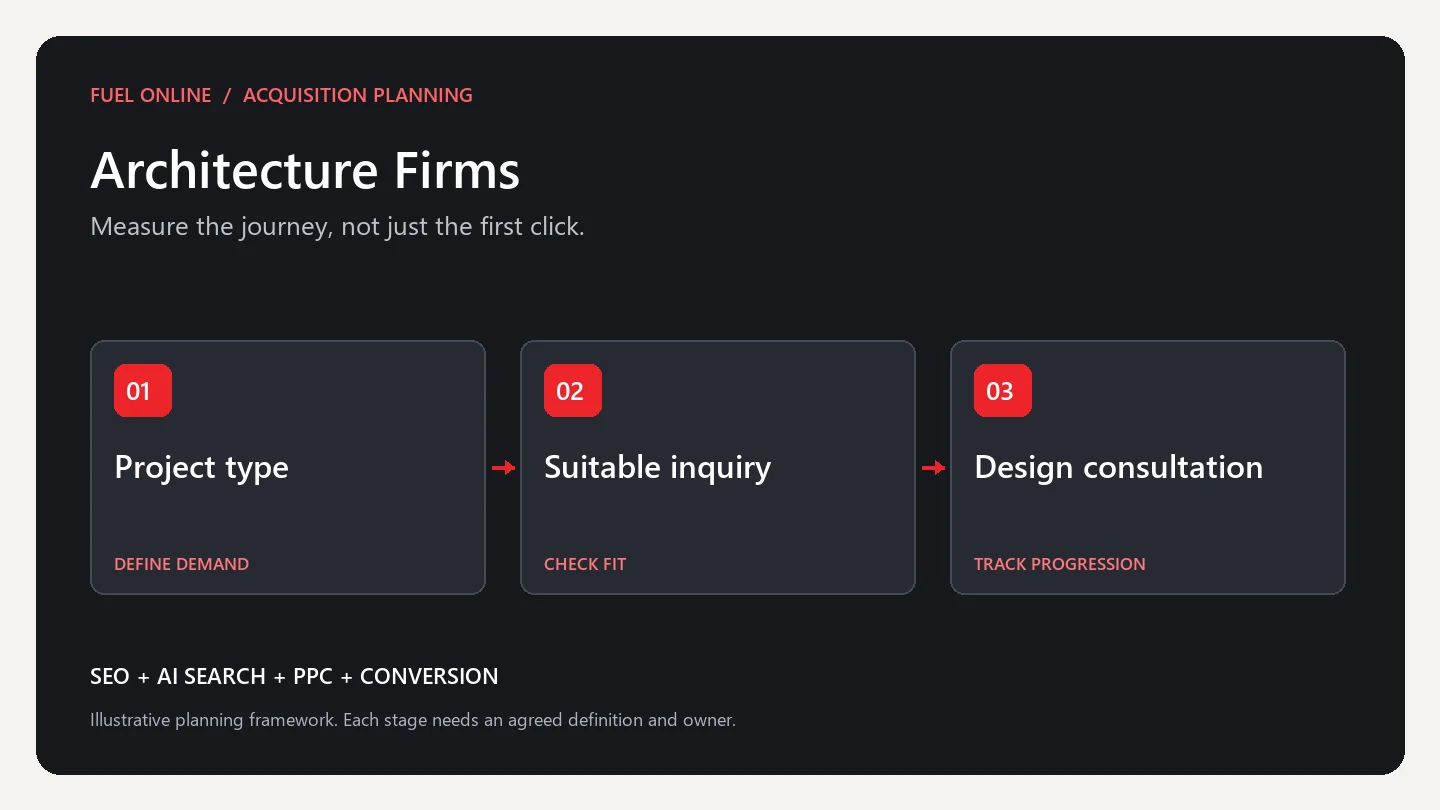
Fuel connects page, query, campaign, or source context with acceptance, rejection reasons, response, capacity, and accurate brand and service descriptions, relevant citations, qualified visits from AI systems, qualified project inquiries, consultations held, proposal opportunities, and project-type fit. Diagnostic measures explain where the journey breaks; they do not replace the business outcome.
The decision record for AI SEO for architects states what changed, why it changed, who approved it, and whether the next action is to expand, revise, consolidate, or stop.
Reporting for architecture firm AEO and GEO must connect the service-specific diagnostic to qualified project conversations, explain data limits, and name the next decision rather than treating activity as proof of value.
Questions to ask an architecture agency
Ask for a sample fact sheet, prompt protocol, source-correction record, and governance matrix. Confirm how observations are dated, retested, and separated from claims of model control.
When reviewing AI SEO for architects, require a named practitioner, implementation owner, approval path, and sample artifact. Reject unsupported promises of rankings, citations, lead volume, cost, or revenue.
How we measure architecture firm AI SEO
- accurate brand and service descriptions
- relevant citations
- qualified visits from AI systems
- qualified project inquiries
- consultations held
- proposal opportunities
- project-type fit
Keep AI citation observations measurable
Observed citation rate = sampled answers citing your site ÷ sampled answers checked.
Illustrative arithmetic: 5 citations in 20 recorded answers is 25% of that sample. It is not a platform-wide visibility share, a guaranteed repeat result or proof that the citations generated revenue. Record the prompts, platform and dates.
Agree on the baseline, data source and qualification criteria before comparing results. Separate visibility from inquiries and accepted business opportunities.
CONNECTED SERVICES
Choose the right next step for your business
Explore Fuel’s AI SEO, AEO & GEO capabilities, published campaign work and team to evaluate how we would support your organization.
BEFORE YOU CHOOSE AN AGENCY
Questions about architecture firm AI SEO
What does the first AI search month produce?
During the first month, the AI SEO for architects scope produces an approved fact sheet, buyer-question prompt set, source inventory, and the first correction record. Fuel also records the client inputs and approval needed for the first release.
What does Fuel need from our architecture team?
Effective architecture firm AI SEO work requires approved service facts, named fact owners, source and profile access, subject-matter review, and permission to correct conflicting public information. Fuel identifies missing access or ownership before work is scheduled around it.
How will we know the work is commercially useful?
Under architecture firm AEO and GEO, commercial usefulness depends on whether the diagnostic connects to qualified project conversations, the data limits are stated, and the evidence supports a clear keep, revise, or stop decision.
Does AI search optimization replace conventional SEO?
No. AI SEO for architects depends on accurate, accessible source pages and sound conventional SEO. AEO and GEO add approved fact governance, buyer-question testing, source correction, and repeatable observation; they do not replace crawlability, page quality, or authority.
What does a credible architecture firm AI SEO scope include?
A credible architecture firm AI SEO scope includes fact governance, a stable prompt protocol, source corrections, named reviewers, dated retests, and clear limits on answer-system control. It also names the client dependencies, practitioner, deliverable, and approval path.
How should architecture firm AEO and GEO report commercial progress?
Reporting under architecture firm AEO and GEO should connect the service-specific diagnostic to qualified project conversations, show what changed and why, state data limits, and name the next decision.
Make your next agency conversation specific.
Bring the architecture firm questions answer systems get wrong or leave incomplete and the sources your team can approve. The first working session on architecture firm AI SEO will identify the priority artifact, evidence, owner, and approval decision for qualified project conversations.
Talk with a Fuel strategist →