
FUEL ONLINE / Architecture Firms / Digital marketing
Marketing agency for architects: Digital Strategy

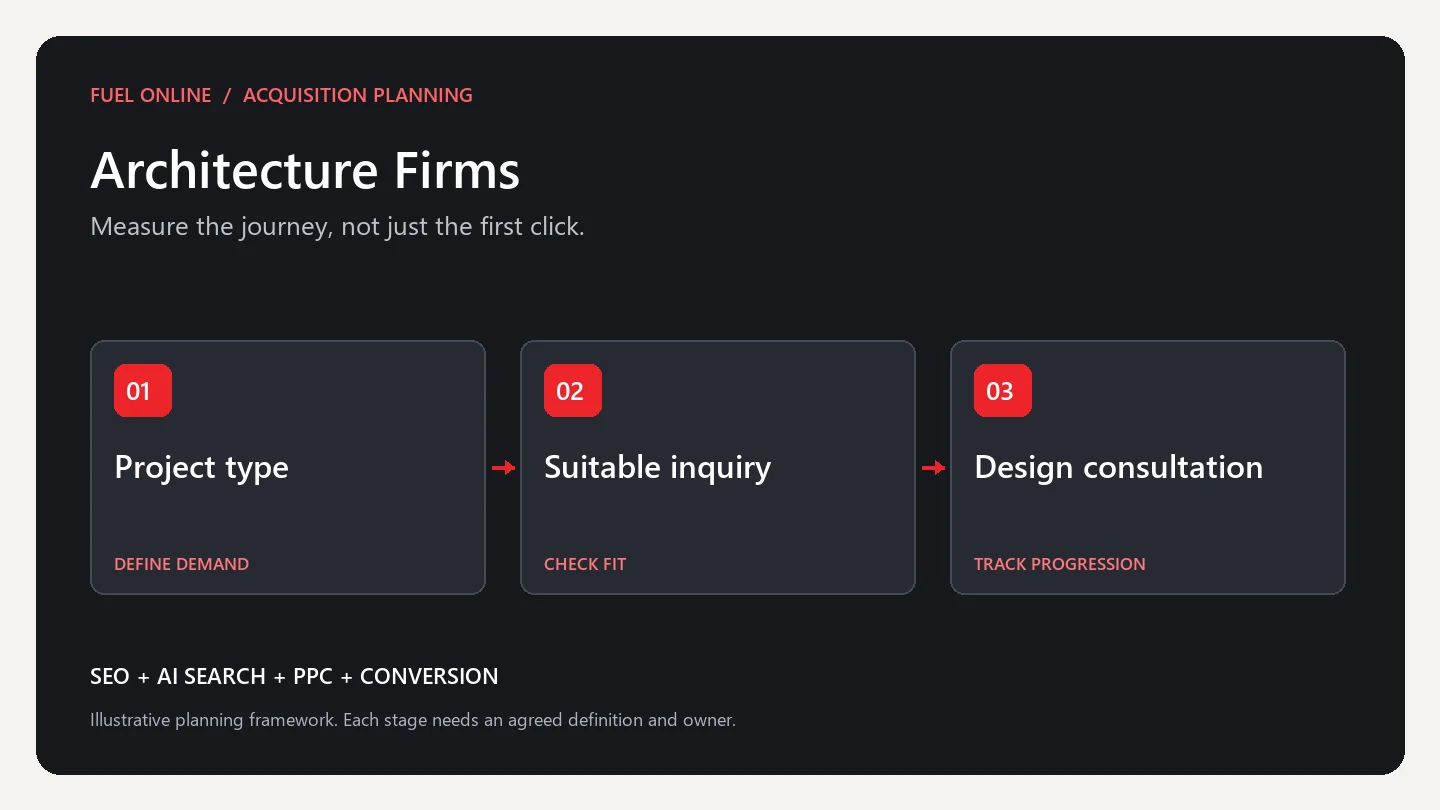
Architecture firms need the right project type and selection team, not more residential, student, or drafting-only inquiries. As your marketing agency for architects, Fuel Online gives search, paid media, decision content, landing pages, and follow-up one commercial job. We build around sector, project type, geography, procurement route, delivery model, and schedule, exclude low-fit demand, and connect channel decisions to business development team feedback. You receive a 30/60/90 plan aimed at qualified project conversations, not a generic package of activity.
Project type, site location and estimated scale; Design stage and intended timeline; Decision-maker and procurement process; Services required and project-fit criteria
Choose architecture marketing around a defined project-research journey
Choose a marketing agency for architects by comparing one complete prospective-client research journey across its proposed channels. A practice introduction, portfolio example, professional biography and project inquiry route can share language while establishing different things. A useful release connects those roles without merging their meanings. The buyer should inspect what the reader learns and what the firm receives afterward, rather than assuming a package of search, advertising, content and reporting automatically creates a coherent path to a project conversation.
Choose the project-research conversation
Begin with the task the architecture firm selects. A prospective client identifying the practice may need different orientation from someone exploring a particular project example or finding a known professional. Ask which journey leads the first release and why. The firm supplies its actual offering and administrative process. The agency should not invent a project model, service association or commission promise simply to make the campaign brief more specific or persuasive.
Map the journey using the message, supporting source, destination, public action and receiving role. Record what each step establishes. A portfolio visit, project conversation request and later firm decision require different evidence. The agency should preserve those meanings while showing how channels contribute. This makes implementation comparable across suppliers whose similar service labels may include different amounts of actual publishing, contact configuration and receiving checks.
The practice resource should describe the offering the firm supplies for publication. A portfolio resource illustrates authorized context about a particular project. Ask how a reader moves between them and what the link promises. A familiar building image does not establish every service relationship the firm offers. The agency can improve orientation without expanding the source or interpreting visual appearance as proof of a technical capability or future project outcome.
| Release component | Artifact to compare | Useful result |
|---|---|---|
| Practice explanation | The actual firm supplied offering connects with relevant professional and project context. | A portfolio image does not silently establish every service association or future outcome. |
| Visual adaptation | Authorized labels preserve rendering, project-stage and completed-work distinctions. | Short formats do not imply a stage or relationship the source does not establish. |
| Project inquiry | The invitation, confirmation and received record retain the same administrative meaning. | A request does not become an accepted commission, quotation or project schedule. |
| Source change | Specific dependent introductions and saved destinations are identified when a fact is revised. | Accurate unrelated material remains intact rather than being treated as equally affected. |
Professional biographies need a maintained relationship with the practice information. Ask which source establishes the published role and which introductions depend on it. A name appearing near a project type does not establish every service association or credential. The firm confirms what it wishes to publish. The release map should identify specific dependencies so another contributor can maintain the information after the original producer leaves.
Connect practice, portfolio and professional sources
Portfolio context should remain within the scope the firm authorizes. A conceptual rendering, project-stage image and documented completed work can have different roles. Ask which label and surrounding explanation establish that context. A shortened format should not imply a stage or result the source does not establish. The agency may retain a useful asset and improve its caption or connection rather than require a new image for every channel adaptation.
A project example can answer a distinct prospective-client question without becoming the entire practice description. Ask what the reader learns beyond appearance and which source facts support it. The firm supplies the project relationship and any publishable context. The agency should not invent client details, design decisions or outcomes to make a narrative feel complete. A missing contribution should become a precise firm input rather than a story assembled from the image alone.
Different client conversations may share sources while needing different invitations. Someone researching an early idea and another person preparing a defined project brief can have different administrative needs where the firm makes those distinctions. Ask how the message and destination reflect the actual process. The agency should preserve what the sender states instead of inferring project readiness, authority or suitability from a short query or a selected label.
Geographic information also needs a clear relationship. An office, stated practice area and location within a project example establish different facts. Ask which firm source supports the chosen message and how the destination preserves it. A place name should not create another office or imply acceptance of a project in that area. The useful path helps the reader locate current practice context without filling gaps from nearby addresses or broad regional language.
The project inquiry invitation should describe the actual administrative action. A request for a conversation does not establish a commission, quotation or schedule. Ask the agency to compare the invitation, confirmation and received record. The meaning should remain consistent. The firm supplies its next-step wording; marketing can make the explanation clearer without adding fees, turnaround promises or project requirements to make the destination appear more comprehensive.
Rehearse the public-to-receiving path
For a worked comparison, give finalists the same practice explanation, portfolio resource and current inquiry route. Ask which message and page changes they would deliver and what the receiver should recognize. Identify components another supplier controls. A ready draft differs from a published destination and checked record. The release plan should name the dependency and completion evidence so the firm can coordinate implementation without mistaking approved creative for a complete public journey.
Rehearse the selected path using agreed fictional administrative details. Begin at the message, follow the source, complete the supported action and inspect the received record. Ask the receiver to describe the request in ordinary language. Compare that interpretation with the public invitation. This checks whether the intended project and stated brief context survive, not merely whether a button functions or a technical event appears in a tool.
Source context should stay separate from the sender's own purpose. Someone may arrive from one portfolio resource while asking about a different type of project. The association can help where supported, but it should not override the person's message. Ask how both meanings appear to the receiving role. This prevents a campaign label or page title from assigning a final project category that the initial action does not establish.
Continuing clients and other supported contacts need recognizable orientation. A person may reach an acquisition destination while returning to an existing conversation. Ask how they identify the firm's maintained instructions. The agency can improve labels and navigation without creating another project-management operation. Reporting should preserve that purpose where records allow rather than automatically classify every campaign-page interaction as newly acquired commission demand.
Reporting should distinguish observed interactions, identifiable project inquiries and later firm stages where records support them. Ask for a sample behind each metric and the rule for repeated contacts. A source label can explain arrival without establishing project suitability or a future commission. Keep those meanings separate. The receiving team can compare reports with its conversations and identify whether differences concern definitions, continuity or unavailable later information.
Maintain the release through actual source changes
Introduce a firm-supplied practice or professional-role change in the review materials. Ask which active messages, saved destinations and recurring introductions depend on it. The agency should identify particular edits and distinguish its responsibility from another owner's task. Pausing distribution does not explain what someone sees on an older saved page. The maintained public path should stay coherent after campaign emphasis or underlying firm information changes.
Use a revised portfolio-context label as a second maintenance exercise. Ask which captions and project introductions depend on it and which practice material remains accurate. A narrow correction does not require a sitewide rewrite. Retain the source decision with completed work so a future contributor can shorten or adapt the presentation without removing the distinction that made the original example understandable.
Compare strategy, source editing, creative adaptation, destination implementation, receiving checks and recurring review separately. Ask what remains usable after each component and which work belongs elsewhere. A bounded release and continuing service can both contribute when their responsibilities are clear. The firm should compare actual artifacts rather than assuming similar monthly service labels include the same implementation or require an invented forecast of future commissions to justify the engagement.
At handover, give another colleague the journey brief, source map and completed tests. They should identify the reader task, current destination and received event without decoding an agency-only campaign name. If private project knowledge carries the meaning, clarify the materials at that point. The accepted examples then help future contributors reuse accurate resources while improving a specific observed gap instead of reconstructing every decision after a supplier change.
Choose further work from a named information or receiving problem. A weak portfolio connection needs orientation, a lost brief value needs implementation and unavailable later status needs a definition discussion. Preserve useful resources while making the specific repair. This gives architecture marketing an inspectable release standard grounded in actual firm information, with professional decisions, commission acceptance and project outcomes remaining within the practice's own process.
For the related firm-wide scope, explore architecture firm marketing.
AGGRESSIVE FROM THE START
One month. The work many agencies stretch across three.
Our mandate: move faster, go deeper and put experienced specialists to work immediately.
Fuel attacks the work in parallel: site audits, technical errors, new content, internal links, backlink outreach and conversion improvements. Your agreed scope determines the channels; urgent fixes do not wait behind a drawn-out planning phase.
The marketing agency for architects brief identifies visibility and lead barriers. Actionable fixes move into production while deeper analysis continues.
Your architecture firm digital marketing work runs alongside industry-specific content, relevant links and earned-authority outreach, based on your agreed scope.
The digital marketing for architects review shows completed work, lead quality and the next opportunities. You see who owns each action.
Fast execution is the operating standard. Access, approvals and scope shape delivery; search and revenue results have their own timelines.
What marketing agency for architects changes for architecture demand
The problem is rarely a missing channel. It is a broken link between audience, promise, evidence, page, and follow-up. Fuel gives each channel a job in winning qualified conversations with owners and selection teams and uses sector, project type, geography, procurement route, delivery model, budget context, schedule, and team capacity to keep the message consistent.
Organic search handles durable discovery, paid media tests controllable demand, and decision content supports evaluation. Every path uses permissioned project photography, accurate project roles, named team expertise, and current credential statements and carries project type, location, decision role, procurement route, budget context, and schedule into the receiving workflow.
A practical architecture firm digital diagnostic
Use this diagnostic when digital activity improves but the receiving team does not see a comparable change in qualified project conversations. The diagnostic for marketing agency for architects starts with the observable symptom, checks the page, source, campaign, or handoff responsible for it, and ends with one reviewed action, owner, and validation method.
Observable symptom
Channel reports improve while qualified project conversations stay flat and requests closer to 'free house plans' keep consuming follow-up time.
What to inspect in architecture firm digital marketing
Compare the channel promise with the landing page, form or call path, follow-up owner, and final business outcome.
Decision criteria for digital marketing for architects
Reassign the channel, revise the page, repair the route, or stop the activity based on the broken stage.
Inspectable output
A channel decision with a named page or handoff change, owner, release date, and measure tied to qualified project conversations.
Digital marketing for architects deliverables you can inspect
The team receives a journey map, page and campaign backlog, measurement specification, release log, and ownership record for every digital change.
- Channel role and budget map, used to define the marketing agency for architects scope.
- Priority plan for sector, project-type, portfolio, process, team, and geographic pages, used to govern the architecture firm digital marketing release.
- Campaign exclusions and landing-page requirements, used to evaluate the digital marketing for architects decision.
- Conversion, routing, and tracking specification
- Weekly operating and monthly commercial review
Illustrative architecture example
Illustrative example, not a client result: A facilities director sees relevant portfolio work but cannot connect project type, role, location, procurement route, and schedule to the inquiry. Fuel would trace the entry page, proof viewed, next action, fields, routing, and final disposition, then repair the first break rather than redesigning the whole site without evidence.
The architecture firm digital marketing release would include the revised page or path, measurement event, receiving owner, and validation record. The test stays only if it improves the journey toward qualified project conversations.
Within digital marketing for architects, the buyer team can inspect the artifact, approval, and next investment decision.
How commercial progress is judged
Fuel connects page, query, campaign, or source context with acceptance, rejection reasons, response, capacity, and qualified project inquiries, consultations held, proposal opportunities, and project-type fit. Diagnostic measures explain where the journey breaks; they do not replace the business outcome.
The decision record for marketing agency for architects states what changed, why it changed, who approved it, and whether the next action is to expand, revise, consolidate, or stop.
Reporting for digital marketing for architects must connect the service-specific diagnostic to qualified project conversations, explain data limits, and name the next decision rather than treating activity as proof of value.
Questions to ask an architecture agency
Ask to see a journey map, release ticket, and measurement specification. Confirm who changes the site, campaigns, analytics, forms, CRM connection, and quality feedback loop.
When reviewing marketing agency for architects, require a named practitioner, implementation owner, approval path, and sample artifact. Reject unsupported promises of rankings, citations, lead volume, cost, or revenue.
How we measure architecture firm digital marketing
- qualified project inquiries
- consultations held
- proposal opportunities
- project-type fit
Compare channels using the same qualification rules
Cost per qualified inquiry = attributable channel spend ÷ inquiries meeting the agreed criteria.
Keep the reporting window and included costs consistent. A cheaper contact is not necessarily a cheaper customer; compare later progression where the data supports it.
Agree on the baseline, data source and qualification criteria before comparing results. Separate visibility from inquiries and accepted business opportunities.
CONNECTED SERVICES
Choose the right next step for your business
Explore Fuel’s Digital marketing capabilities, published campaign work and team to evaluate how we would support your organization.
BEFORE YOU CHOOSE AN AGENCY
Questions about architecture firm digital marketing
What changes first in a digital marketing engagement?
During the first month, the marketing agency for architects scope produces a journey map, page and campaign backlog, measurement specification, and the first release ticket. Fuel also records the client inputs and approval needed for the first release.
What does Fuel need from our architecture team?
Effective architecture firm digital marketing work requires site, campaign, analytics, form, and CRM access plus reviewers, approved proof, capacity limits, and accepted or rejected inquiry feedback. Fuel identifies missing access or ownership before work is scheduled around it.
How will we know the work is commercially useful?
Under digital marketing for architects, commercial usefulness depends on whether the diagnostic connects to qualified project conversations, the data limits are stated, and the evidence supports a clear keep, revise, or stop decision.
Do we need every digital channel at once?
Start with the break closest to qualified project conversations, not a predetermined channel. The diagnostic for marketing agency for architects may prioritize the page promise, proof, form, measurement, route, or response owner before recommending more acquisition.
What does a credible architecture firm digital marketing scope include?
A credible architecture firm digital marketing scope includes journey mapping, page and campaign priorities, measurement, implementation ownership, release validation, and inquiry-quality feedback. It also names the client dependencies, practitioner, deliverable, and approval path.
How should digital marketing for architects report commercial progress?
Reporting under digital marketing for architects should connect the service-specific diagnostic to qualified project conversations, show what changed and why, state data limits, and name the next decision.
Make your next agency conversation specific.
Bring the channel, page, or follow-up problem preventing more qualified project conversations. The first working session on architecture firm digital marketing will identify the priority artifact, evidence, owner, and approval decision for qualified project conversations.
Talk with a Fuel strategist →