
SEO by Platform / Shopify SEO / Shopify AI Search and Agentic Commerce Optimization
SHOPIFY SEARCH + AI COMMERCE ENGINEERING
Fuel Online is a specialist Shopify AI search and agentic commerce, answer engine optimization and AI commerce agency. Our veteran digital marketing engineers combine advanced diagnostics, commercial analysis, AI-assisted research and production-level implementation for Shopify and Shopify Plus stores. Shopify AI search optimization makes products understandable and eligible across open-web retrieval and supported agentic storefronts. Fuel aligns public product answers, Shopify Catalog data, grouping, policies, crawler choices and measurement without promising placement an AI channel controls.
Built for established Shopify and Shopify Plus teams that need Shopify AI search and agentic commerce tied to accountable implementation and qualified demand.
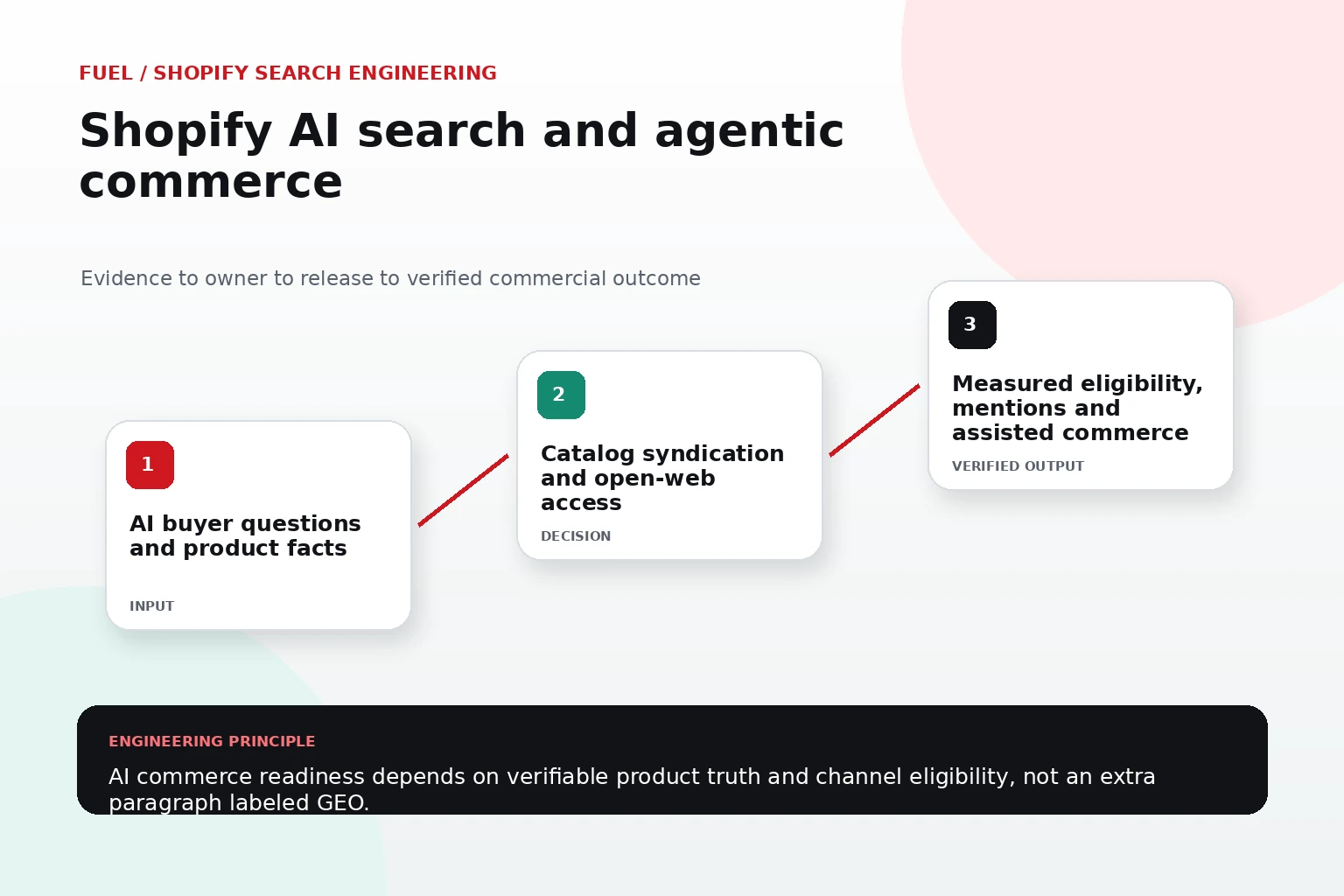
FUEL DIGITAL MARKETING ENGINEERS
Your project goes to strategists and engineers who understand the difference between a Shopify setting, Liquid output, an app injection, catalog data and a headless route. We focus on the Shopify AI search and agentic commerce decisions affecting your storefront, catalog and growth goals.
Ratings checked September 2026. Review the independent profiles.
DIAGNOSE BEFORE YOU SCALE
If your store is underperforming in Shopify AI search and agentic commerce, the visible symptom may come from product data, Shopify configuration, theme output, an app or a release failure. These checks isolate the responsible layer before your team edits the catalog at scale or adds another dependency.
01
02
03
THE ENGAGEMENT, MADE CONCRETE
Your Shopify AI search and agentic commerce engagement should reflect catalog size, storefront architecture and implementation ownership. These work products show your team the evidence behind each recommendation, the required change and an explicit definition of done.
01
Define where Shopify AI search and agentic commerce affects product discovery, buyer confidence, qualified revenue or migration risk.
02
Include ordinary templates, commercially important pages and the edge cases most likely to fail.
03
Record what your storefront actually outputs and whether Shopify, the theme, an app, product data or another integration controls it.
04
Rank confirmed issues by affected commercial cohort, confidence, effort and release dependency.
05
Recheck the same fixtures after deployment and retain exceptions or rollback decisions.
06
Monitor the affected store pages while separating completed implementation, search visibility and commercial impact.
WHAT AI COMMERCE READINESS MEANS FOR A SHOPIFY STORE
AI visibility is not created by adding slogans about AI. Fuel strengthens the product facts, entity relationships, policies and accessible buying guidance that supported systems can retrieve, then tests a fixed set of commercially relevant questions and records what actually happens.
| What you may be seeing | Why it matters | What Fuel engineers | How your team verifies it |
|---|---|---|---|
| Product facts are split across tabs, scripts or inaccessible interfaces | Answer systems may miss compatibility, dimensions, use cases or policy details shoppers need | Expose important verified facts in accessible product and supporting content | Answer accuracy and cited store destinations improve across a retained prompt panel |
| Variants, identifiers, prices or availability conflict | A product can be confused, omitted or represented with the wrong offer | Reconcile visible content, structured entities and eligible catalog data | Consistent product identity and current offer facts on sampled items |
| The store cannot explain why its product fits a buyer need | Generic descriptions provide little evidence for comparison or recommendation | Add specific decision support, constraints, compatibility and first-party expertise | Priority buyer questions are answered accurately on retrievable store pages |
| AI visibility is reported without business attribution | Executives cannot distinguish a mention from a qualified visit or sale | Track prompts, cited URLs, referrals and revenue as separate evidence classes | Transparent reporting that avoids unsupported market-share claims |
DECISION MODEL
Illustrative scenario: Consider a store where one high-revenue collection, a standard product and a special product state behave differently. A useful Shopify AI search and agentic commerce investigation records the exact URLs and the Shopify layer responsible for each difference. The team then applies a bounded rule to the confirmed cohort, tests the exception and verifies production. A sitewide toggle chosen from one crawler screenshot would not provide the same control.
| Condition | Evidence needed | Engineering decision | Acceptance |
|---|---|---|---|
| Purpose | What buyer or search task should this Shopify AI search and agentic commerce decision serve? | Document one intended outcome before selecting a control. | The destination and output support that task. |
| Source | Which Shopify layer produces the observed state? | Trace platform, theme, app, data and integration ownership. | The implementation ticket names the accountable source. |
| Exceptions | Which products, markets or templates need different behavior? | Write exception criteria before scaling the rule. | Representative edge cases pass staging. |
| Verification | How will the team prove the release works? | Use direct production checks plus cohort monitoring. | Live output matches intent and business reporting is annotated. |
FUEL FIELD NOTE
Fuel field note for Shopify AI search and agentic commerce: AI commerce readiness depends on verifiable product truth and channel eligibility, not an extra paragraph labeled GEO. Fuel’s first review of your store spans Shopify configuration, theme or storefront, apps and data integrations so one clean URL is never mistaken for the whole system. We compare what your store produces with its customer purpose and the team or system accountable for the change. This is where generic Shopify advice becomes a store-specific engineering decision.
What would change our recommendation? A different buyer task, materially different product state, market-specific output, headless route, app-generated markup or release constraint can produce a different answer. We retain those exceptions instead of forcing every Shopify URL into one rule.
PLATFORM OWNERSHIP
| Store layer | What it controls |
|---|---|
| Shopify configuration | Native product, collection, market, status, sitemap and channel behavior. |
| Theme or storefront | Liquid or headless rendering, metadata, links, media and interactive behavior. |
| Apps and data integrations | Filtering, reviews, feeds, schema, search, personalization and automation. |
| Commercial owner | Product truth, merchandising policy, market fit and success measurement. |
A useful Shopify AI search and agentic commerce ticket names the responsible layer, representative URLs, affected scope, exceptions, release dependency and expected output. This prevents a content decision from becoming an app uninstall and prevents a template defect from becoming thousands of manual catalog edits.
ORIGINAL FUEL DECISION MAP
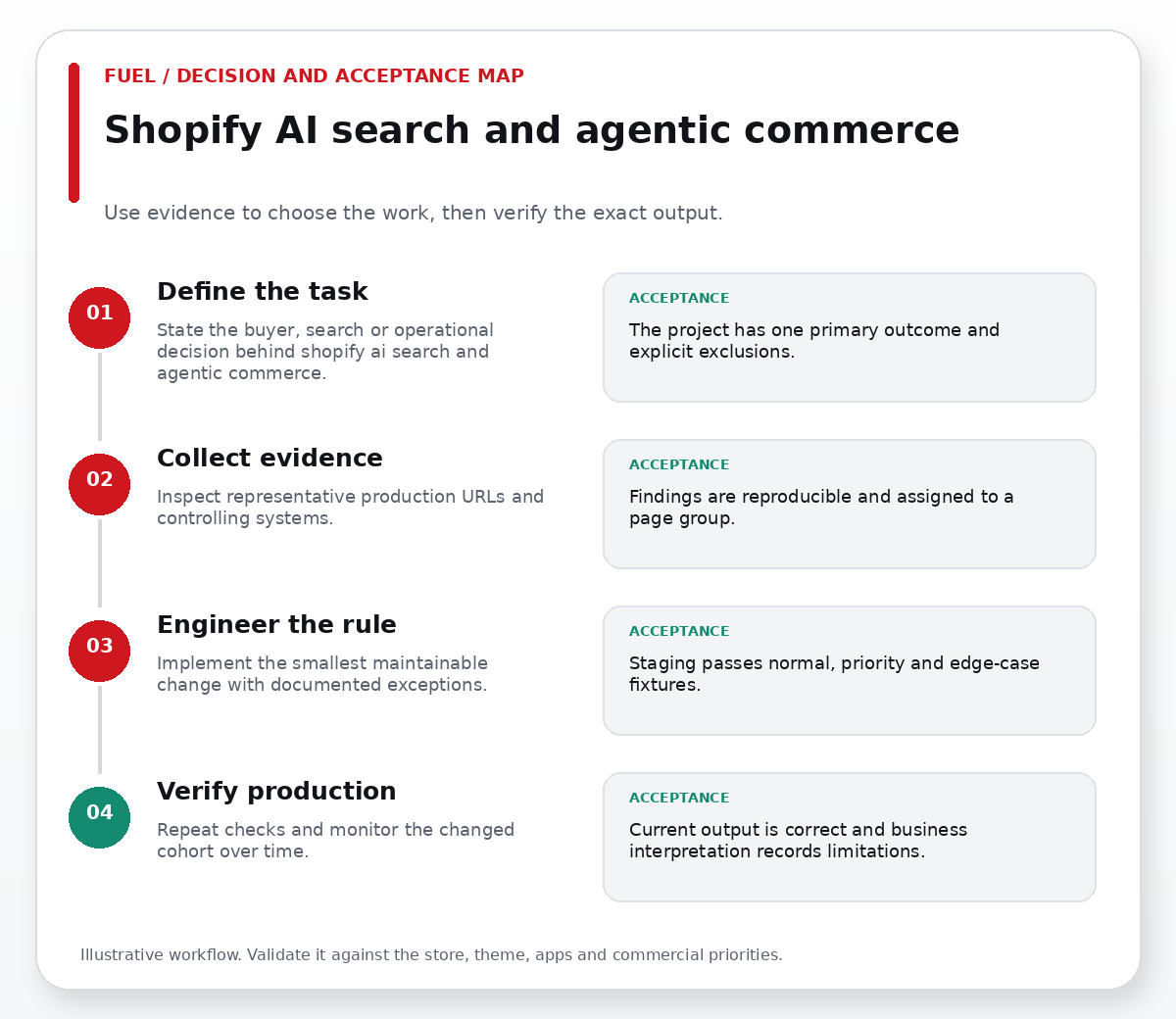
Apply this sequence to a representative Shopify AI search and agentic commerce sample. Report technical acceptance separately from commercial impact because Shopify output, search processing, demand and buyer behavior do not change on the same clock.
AI SEARCH + AGENTIC COMMERCE
Direct answer: It affects whether systems can retrieve, identify and trust the relevant product or collection information. Improve accessible facts, coherent entity relationships and current offers first. Then verify Shopify Catalog or open-web behavior where applicable. No technical change can guarantee an AI recommendation or citation.
To measure how AI systems understand your store in relation to Shopify AI search and agentic commerce, Fuel uses a fixed panel of commercially relevant questions. We record the system, date, exact question, mentioned brands, cited URLs and answer accuracy. This shows what happened in that controlled panel while keeping AI observations separate from qualified referrals and revenue.
WHAT WE VERIFY
ENGINEERING PROCESS
01
State the buyer, search or operational decision behind Shopify AI search and agentic commerce.
Acceptance: The project has one primary outcome and explicit exclusions.
02
Inspect representative production URLs and controlling systems.
Acceptance: Findings are reproducible and assigned to a page group.
03
Implement the smallest maintainable change with documented exceptions.
Acceptance: Staging passes normal, priority and edge-case fixtures.
04
Repeat checks and monitor the changed cohort over time.
Acceptance: Current output is correct and business interpretation records limitations.
INFORMATION GAIN + MEASUREMENT
For a Shopify owner, useful Shopify AI search and agentic commerce evidence is not a longer copy of platform documentation. It connects an affected URL, the responsible Shopify layer, the commercial decision, the implemented change and the production result. Fuel retains that chain so a reader, developer or executive can see why the recommendation changed.
Fuel does not merge technical completion, Google processing, AI visibility and revenue into one Shopify AI search and agentic commerce success claim. A production output can be verified immediately, while indexing, ranking and AI answers follow different clocks. Revenue can also move because of promotions, inventory and paid campaigns. Reporting these clocks separately produces a more defensible decision.
Before recommending a sitewide Shopify AI search and agentic commerce change, Fuel records the sample logic: which templates, product states, collections, markets and edge cases were inspected, plus what was deliberately excluded. That prevents one clean URL from being generalized across a catalog it does not represent. The same sample is retained for post-release comparison.
| Evidence class | What to retain | How it is interpreted |
|---|---|---|
| Live technical fact | The current response, rendered output, link or entity relevant to Shopify AI search and agentic commerce. | Recheck the exact production URL after release. |
| Platform setting | The Shopify control that appears to influence Shopify AI search and agentic commerce, including plan, market or product-state context. | Confirm the setting changes the public output before scaling it. |
| Commercial decision | The buyer task, catalog group, market or revenue priority the Shopify AI search and agentic commerce work should support. | Keep this separate from a technical pass or fail. |
| AI observation | The engine, exact prompt, date, cited page and answer accuracy when Shopify AI search and agentic commerce is tested. | This keeps your report from treating one chatbot response as market-wide visibility or commercial impact. |
| Business outcome | Landing-page revenue, assisted conversion, qualified inquiry or another agreed commercial measure. | Annotate promotions, inventory changes and concurrent releases. |
SHOPIFY SEARCH ENGINEERING LIBRARY
Shopify and search controls change. These primary sources were reviewed for this Shopify AI search and agentic commerce page in September 2026. Fuel labels the platform documentation separately from our implementation judgment.
QUESTIONS SERIOUS BUYERS ASK
The platform's native behavior, Liquid themes, apps, product data, Markets and headless options distribute ownership across several systems. The recommendation must fit the actual implementation.
An app can manage part of the output. It cannot determine buyer intent, product truth, commercial priority or every conflict with the theme and other integrations.
Only when evidence supports one rule and the exceptions are known. Test a representative cohort before scaling.
Inspect the same production URLs, expected output and user task used to define the issue. Monitor the affected group rather than only the sitewide total.
Fuel can provide direct implementation or work with the store's development team, depending on access and release ownership.
Qualified
organic traffic
Peel Appliance Repair, SEO and PPC engagement. Approximately two months. Client-reported on Clutch in February 2026. Baseline indexed to 100. This is not a forecast or a Shopify-specific result.
Read the client reviewPUT FUEL ENGINEERING TO WORK
SHOPIFY AI SEARCH AND AGENTIC COMMERCE / ENGINEERING + EXECUTION
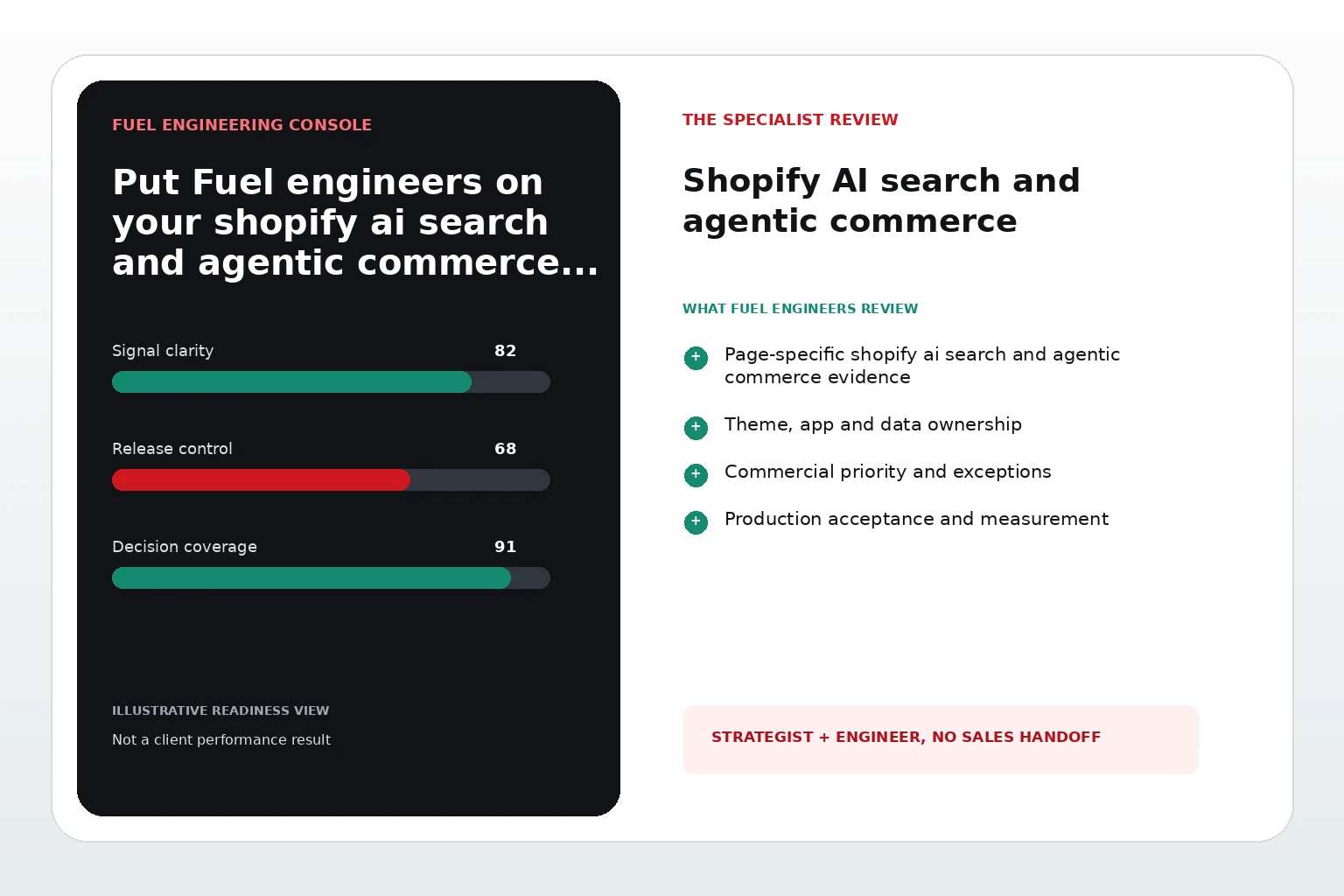
Work directly with digital marketing engineers who specialize in this Shopify challenge. Bring us the store, the affected page groups and the outcome you need. We will discuss the evidence, constraints and work required to move forward.
No sales team. Real strategists and engineers.
Share your URL, priorities and timing in the form below.
Prefer a conversation? 1-888-475-2552