
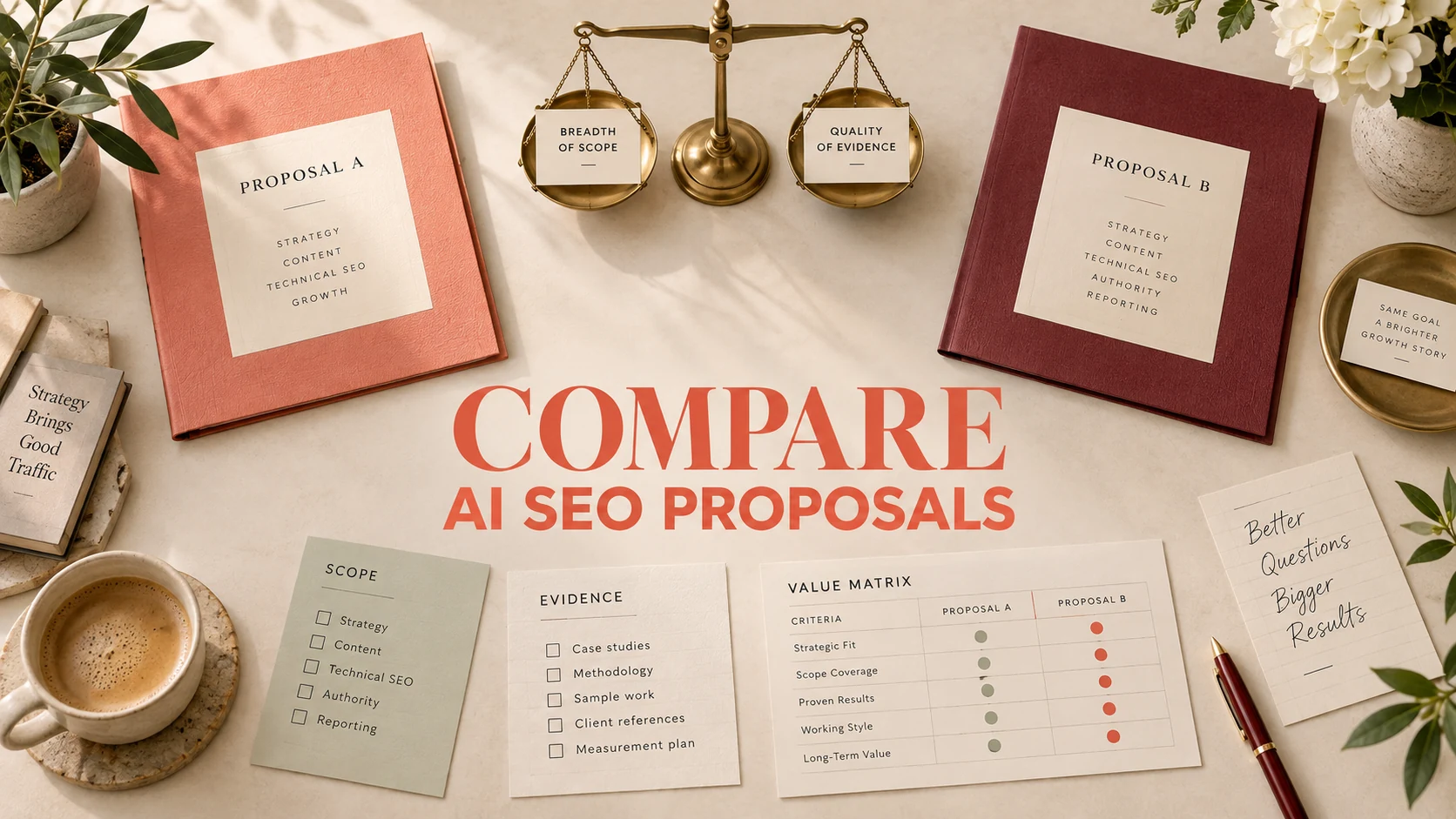
AI SEO pricing is difficult to compare because agencies often place very different work inside the same label. One proposal may cover technical SEO, editorial production, digital PR, prompt tracking, entity cleanup, and conversion reporting. Another may provide a dashboard and several AI-written articles. The monthly totals can look similar while the labor, evidence, risk, and business value are not.
This guide is a companion to Fuel Online’s broader AI SEO pricing and cost guide. It does not repeat market package prices. It gives buyers a method for testing proposals, normalizing deliverables, and deciding what the business is actually purchasing.
Compare scope before price
Ask every bidder to translate its offer into the same work categories: discovery, technical remediation, content, entity and knowledge work, digital PR or third-party coverage, local data, structured data, prompt monitoring, analytics, conversion support, account management, and client training. Mark each category as included, optional, client-owned, or excluded.
Then identify the unit. “Content optimization” might mean ten briefs, ten rewrites, or ten automated scores. “AI visibility tracking” might mean a fixed prompt set tested weekly in three engines, or an estimated share-of-voice number from a vendor database. “Technical implementation” may mean recommendations only or actual changes with QA and rollback.
Proposal normalization worksheet
| Workstream | Agency A | Agency B | Evidence to request |
|---|---|---|---|
| Technical | Audit only | Audit plus 20 fixes | Sample issue, owner, acceptance test |
| Content | Eight new articles | Four expert-led page improvements | Brief, source standard, reviewer time |
| AI monitoring | Dashboard score | 120 prompts across three engines | Prompt list, frequency, raw observations |
| Authority | Five placements | Research and outreach hours | Publisher criteria, disclosure, ownership |
| Measurement | Monthly report | Referral and lead integration | Metric definitions, systems, data access |
This table is hypothetical. It shows why line-item quantity alone is not enough. Four carefully sourced improvements to valuable pages may require more expertise and produce more durable utility than eight generic posts, but the proposal must show the work.
Use outside pricing data carefully
Clutch’s SEO pricing guide, updated September 20, 2026, draws on its database of 65,550 SEO companies and client project reviews. It reports that projects reviewed on Clutch typically cost less than $10,000 and that many listed agencies charge $100 to $149 per hour. Those figures describe Clutch’s broad SEO marketplace. They do not establish a fair price for a particular AI SEO program, region, team, or scope.
Use market figures as a reasonableness check after normalizing scope. A specialized technical audit for a large ecommerce site, multilingual content governance, or original research may sit outside a broad marketplace midpoint. A low price may reflect automation, narrow scope, offshore delivery, limited senior review, or an intentional entry offer. A high price may reflect depth, or it may simply reflect positioning. The proposal has to reveal which.
Separate setup work from ongoing work
Initial work often includes analytics configuration, prompt-set design, crawl and index audits, entity mapping, content inventory, competitor research, governance, and a prioritized roadmap. Ongoing work may include implementation, content briefs, expert interviews, publication, outreach, prompt reruns, reporting, and iteration.
A proposal that charges the same amount each month should still explain how activity changes after setup. Otherwise, the buyer may continue paying for a discovery intensity that no longer exists. Conversely, a low setup fee can hide the fact that foundational work will be spread slowly across the retainer.
Evaluate the deliverable, not the task name
Every significant line should end in a reviewable object. Keyword or question research produces a prioritized map. Technical analysis produces URL-level issues with evidence and acceptance tests. Content strategy produces briefs and page decisions. Entity work produces a conflict register. Prompt monitoring produces raw runs and defined metrics. Reporting produces decisions, not a slide full of unqualified percentages.
Ask who owns the files, dashboards, accounts, source interviews, research data, and creative work when the engagement ends. Require export formats and access levels. A less expensive proprietary dashboard can become costly if the company cannot retain its history or reproduce the score.
Price the human review explicitly
AI-assisted production can reduce drafting time, but it does not remove the need for subject expertise, source validation, editorial judgment, legal or compliance review, design, development, and QA. Ask which steps use automation, which model or vendor processes data, what humans review, and who signs off on claims.
Semrush’s 2026 survey and ranking analysis covered 42,000 blog pages and reported that 87% of responding SEO teams used either fully human or heavily human-led workflows. The same study found only 19% said AI improved content quality, while speed was the more common benefit. Survey opinions and classification methods have limits, but the result supports asking what quality control the price includes.
Test the measurement model
A proposal should distinguish classic search impressions, rankings, clicks, AI mentions, citations, owned citations, referral visits, assisted conversions, qualified leads, and revenue. It should define the prompt sample, engines, markets, devices, repetition, and observation storage. If a proprietary visibility score combines several signals, ask for the formula or at least the inputs and limitations.
Semrush’s June 2026 study found that 61.7% of 3,981 sampled domain appearances were citations without brand mentions. That does not create an industry benchmark. It shows why “citations increased” and “the brand was recommended more often” are different statements. A proposal priced around reporting should preserve that distinction.
Value ladder for measurement
- Work completed and technically verified.
- Pages discovered, retrieved, mentioned, or cited.
- Qualified visitors and assisted journeys.
- Leads, bookings, trials, or purchases with acceptable data quality.
- Gross profit, lifetime value, or another approved business measure.
Not every business can reach the final rung immediately. The agency should say what is measurable now, what integration is required, and where attribution remains uncertain.
Assess content economics
For each proposed page, estimate the buyer decision it supports, existing demand signals, business value, evidence burden, expert time, production cost, maintenance frequency, and conversion path. Avoid evaluating content solely by word count. A short technical reference with original data may require more work and carry more value than a long overview.
Ask whether the plan improves existing pages before creating new ones. It may be cheaper and more effective to consolidate overlapping articles, add current evidence, correct weak answers, and build internal links. If the proposal contains a large monthly publishing quota, require a page-ownership map and an overlap check.
When original expert content is central to the plan, inspect the agency’s content creation process. The relevant questions are who interviews experts, how claims are sourced, how revisions are handled, and what triggers updates.
Understand authority and outreach costs
“Digital PR,” “brand mentions,” and “authority building” can describe research campaigns, journalist outreach, partnership development, paid placements, directory work, or link acquisition. Require a clear method. Ask whether placement fees are included, how sponsorship is disclosed, which publishers are acceptable, and what happens if no coverage is earned.
Ahrefs’ December 2025 analysis of 75,000 brands reported correlations between branded web and video mentions and AI visibility, while content volume had a weak relationship. Ahrefs warned that correlation does not establish causation. A proposal should not turn this finding into a guaranteed mention package. It can justify investing in genuinely useful research and distribution whose value does not depend on one answer engine.
Calculate a risk-adjusted comparison
Create a scorecard with weighted criteria: strategic fit, technical depth, evidence quality, implementation capacity, senior involvement, reporting transparency, data ownership, compliance, speed, and price. Score only what the proposal or reference call supports. Add a risk adjustment for dependencies the business must supply.
For example, an agency may propose expert-led pages but assume the client will provide ten interviews each month. If the client can provide two, the quoted output is not achievable. Another may include technical fixes but require developer access the procurement team will not grant. Pricing without dependency capacity is misleading.
Hypothetical value calculation
Suppose a twelve-month proposal costs $120,000. The team identifies three main value paths: lower paid acquisition dependence, more qualified organic leads, and reusable market research. Do not simply assign optimistic revenue to all three. Build low, expected, and high cases using current conversion rates, margin, sales capacity, and attribution confidence. Then list benefits that are real but not cleanly monetized, such as corrected technical debt, stronger evidence, and reusable content.
The numbers in this example are illustrative. A responsible business case exposes assumptions and sensitivity rather than manufacturing a return percentage.
Run a paid diagnostic when uncertainty is high
If proposals differ because no bidder has enough information, commission a bounded discovery phase before a long retainer. Ask for a technical sample, buyer-question map, prompt baseline, content inventory, measurement design, and twelve-month options. The work should be usable even if another agency implements it.
A diagnostic reduces the contingency each bidder must add for unknowns. It also tests communication, evidence quality, and the client’s ability to supply access and reviewers. Define the pages, markets, systems, and questions included so the discovery project does not become an open-ended audit.
Model internal cost and opportunity cost
The agency invoice is only one part of the investment. Estimate executive interviews, subject-matter review, legal approval, developer time, analytics work, design, publication, procurement, and sales feedback. A plan with heavy client dependencies may cost more internally than a higher-priced managed option.
Also consider the work displaced. If experts spend ten hours each month reviewing broad informational articles, they may not have time to produce a decisive benchmark or improve product documentation. Price the portfolio of opportunities, not just the selected proposal. A smaller program focused on high-value evidence can be the better purchase when organizational attention is scarce.
Contract terms that affect the real price
- Minimum term and exit rights
- Setup, platform, media, placement, translation, and development fees
- Included revision rounds and approval deadlines
- Unused hours or deliverables
- Data, account, and intellectual-property ownership
- Subcontractors and geographic delivery model
- Security and confidential-data handling
- Service levels for errors or urgent changes
- Post-engagement exports and transition support
- Claims, guarantees, and remedy language
A retainer that excludes implementation, media, tooling, and data integration may have a much higher total cost than its headline. Build a twelve-month total with internal labor and third-party expenses.
Questions for the proposal meeting
- Which business decisions and customer journeys does this scope support?
- What will exist after the first 30, 60, and 90 days?
- Which deliverables are recommendations, and which are implemented?
- How are automated outputs reviewed and sourced?
- Which tools and platform fees are included?
- How are AI mentions, citations, referrals, and conversions separated?
- What client inputs can delay or reduce output?
- Who performs the work and how much senior review is included?
- What can we export if the relationship ends?
- Which outcome claims are explicitly outside your control?
Use the answers to compare Fuel Online’s AI SEO packages or any competing offer on the same basis. The goal is a fair comparison, not a checklist designed to favor one delivery model.
Frequently asked questions
Why do AI SEO proposals vary so much?
The label can include different combinations of technical SEO, content, research, PR, local optimization, prompt monitoring, analytics, and implementation. Team seniority, tools, markets, languages, compliance, and site complexity also change the cost.
Is the lowest proposal usually risky?
Not necessarily. It may be narrow, efficient, or intentionally scoped. The risk appears when important work, review, tools, or dependencies are missing or unclear. Compare total scope and ownership before judging the price.
Should pricing be based on deliverables or hours?
Either can work. Deliverables need quality and acceptance definitions. Hours need roles, rates, priorities, and reporting. A hybrid often fits work where outputs are defined but implementation complexity varies.
Can an agency guarantee a return?
No agency controls demand, answer engines, sales follow-up, or attribution. It can commit to work, quality standards, timelines, and measurement. Forecasts should show assumptions and ranges rather than guarantees.
What should be retained after the engagement?
The business should retain approved content, briefs, source files, technical records, prompt definitions, raw observations where permitted, analytics configuration, dashboards or exports, change logs, and account access covered by the contract.
The best comparison makes hidden work visible
A useful AI SEO pricing decision does not ask which agency sells the most activity for the lowest monthly fee. It asks which proposal solves the right constraints, produces reviewable assets, protects the business, supports reliable measurement, and leaves durable value. Once every offer is translated into those terms, the price becomes much easier to judge.