
An AI visibility audit for mass tort law firms measures how often, and how favorably, AI assistants name your firm when claimants research whether they qualify for a litigation. It is a diagnostic: we quantify your citation share, your mention rate, and where you sit against competitors across ChatGPT, Gemini, and Perplexity, tort by tort, so you know exactly what to fix before the next wave of claimants starts searching.
An AI visibility audit is a measurement of how AI assistants represent your mass tort law firm when claimants research a litigation. When someone types “am I eligible for the talc lawsuit” or “which firm handles Roundup claims” into ChatGPT, Gemini, or Perplexity, those tools return a written answer and often name specific firms. The audit counts whether you are named, how often, in what context, and how you compare to the firms that show up instead of you. It turns a vague worry, “are we even in these answers when a litigation breaks,” into a set of numbers you can act on.
This is a diagnostic, not the fix. The audit tells you where you stand and where the gaps are; it does not, by itself, change what the models say. That distinction matters, so we will keep it clear throughout this page: an audit is measurement, benchmarking, and source analysis. The work of actually improving how AI tools cite and recommend you is a separate program, and we will point you to it at the end.
The audit sits inside the broader mass tort marketing program we run, alongside our wider law firm marketing work. It is usually the first step, because mass tort is a national race for attention where demand arrives in bursts, a signed and retained claimant can be worth far more than a single lead, and claimants increasingly screen their own eligibility inside AI tools. Knowing how those tools already treat your firm across the torts you run is the fastest way to decide what is worth doing before the next wave arrives.
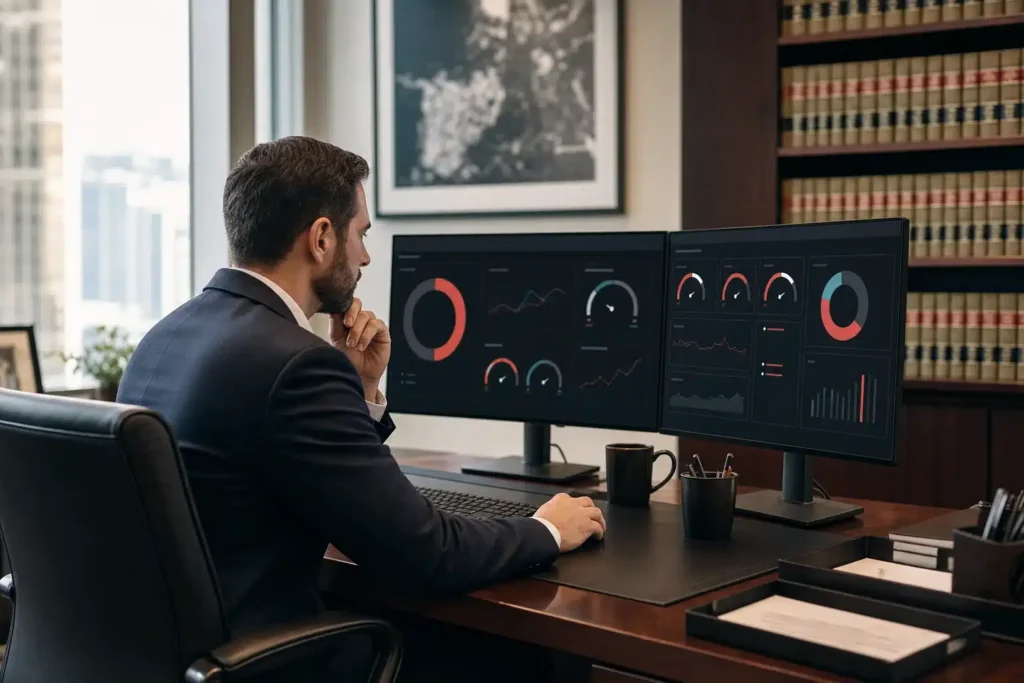
Mass tort is one of the most heavily researched and fastest-moving legal categories, and that research has moved into AI. A litigation opens, media coverage hits, and searches for a specific drug, device, product, or exposure spike overnight, from every state at once. Claimants no longer run a single search and call. They ask AI assistants to explain whether a litigation exists, to check whether their situation might qualify, to lay out filing deadlines and registry cutoffs, and, more and more, to name firms worth contacting for a case review. Every one of those exchanges is a chance for your firm to be mentioned or ignored, and none of it shows up in a traditional rankings report.
Because demand appears in waves and fades when a litigation resolves, timing is everything, and a single early mention in an AI answer can put your firm on a claimant’s shortlist days before they call. That is exactly why measurement has to come first. Guessing which prompts you appear in, or assuming your presence in an established tort carries over to a newly opened one, leads to wasted effort. A mass tort audit measures the questions real claimants ask, tort by tort and generically phrased, so nothing overstates that a given product caused a given injury, across the tools they actually use. The picture reflects the litigations you run and the national market you compete in, not a generic keyword list.
The audit follows a fixed methodology so the results are repeatable and comparable over time and across torts. Each step produces a specific, documented output rather than an impression.
We start by building a prompt set from real claimant queries, not invented ones. We draw on the eligibility questions people ask during intake, the searches that already drive demand for each active litigation, and the phrasing people naturally use with a chatbot, which tends to be longer and more conversational than a Google search. The set spans the full journey: urgent early prompts asking whether a litigation exists and whether a deadline is near, mid-funnel prompts comparing firms and asking how eligibility screening works, and decision-ready prompts that ask for a recommendation on which firm to trust. We build a distinct prompt set for each tort you run, because visibility for one litigation tells you almost nothing about another. A representative prompt set is the foundation of the whole audit, since you can only measure visibility against the questions you test.
We run the prompt set across the assistants your claimants actually use to research a litigation: ChatGPT, Google’s Gemini and AI Overviews, Claude, and Perplexity. Each engine draws on different sources and phrases its answers differently, so a firm can be well represented in one and invisible in another. Measuring them separately is the only way to see those gaps. We record the full answer each engine returns for each prompt, including which firms are named and which sources are cited, so nothing rests on a single snapshot. Because AI answers about active litigations shift as coverage develops, we timestamp every capture.
This is where the audit becomes numbers. Mention rate is the share of prompts in which your firm is named at all, engine by engine and tort by tort. Citation share goes further: of all the firms named across the prompt set, what proportion of those mentions are yours. If ten competitors are named across a hundred eligibility prompts and you appear in eight of them, your citation share is small even if your name technically comes up. We also grade the sentiment and context of each mention, because being named as a firm actively handling a litigation is very different from being mentioned in passing. These metrics give you a baseline you can re-measure later to see whether visibility is moving as a tort develops.

Your numbers only mean something in context, so we benchmark them against the firms that keep appearing in each litigation’s answers. Mass tort is dominated by a handful of high-volume national practices, and the benchmark shows who the AI tools currently treat as the default authority for a given tort, how far ahead of you they sit, and which eligibility prompts they win that you do not. For a category where claimants build a shortlist from these answers the moment a wave breaks, knowing who is already on that shortlist, and by how much, is often the single most useful part of the audit.
Finally, we look at where the engines are pulling their answers from. AI assistants lean on a recurring set of sources: litigation trackers and settlement news, legal directories, review platforms, editorial articles, bar association listings, and the firms’ own sites. The source-gap analysis maps which of those sources feed the answers for each tort in your market and where your firm is absent from them. It is diagnostic, not prescriptive here: the audit identifies the gaps and quantifies them, and the program that closes them is a separate engagement. The point of this step is to turn “we are not showing up for this litigation” into a specific, prioritized list of where the visibility is being decided.
The deliverable is a clear report, not a data dump. For each engine and each active tort you receive the raw metrics, the benchmark, and a plain-English read of what they mean. Here is the kind of information each section gives you and the decision it informs.

An audit is only worth running if it leads to a decision. The report ends with a prioritized read of where the visibility is being lost, by tort and by engine, and which gaps are worth closing first, but closing them is a distinct body of work, and we keep it separate on purpose. Improving how AI assistants answer and cite is the job of answer engine optimization for mass tort firms, and earning durable presence and recommendation inside generative tools is the job of generative engine optimization. The audit hands those programs a measured starting point and a benchmark to improve against, rather than a guess. If you want the full picture of the search and AI stack those programs sit within, our AI SEO and GEO services lay it out.
Running the audit first also protects your budget in a category where spend scales with the number of litigations you run. Because you know your baseline mention rate, citation share, and benchmark before any optimization begins, you can re-measure later and see whether the work actually moved the numbers as a tort matured. Measurement before and after is what separates a visibility program you can hold accountable from one you simply hope is working. If you want to see how that spend maps to the rest of a program, our mass tort SEO pricing page breaks down what moves the number, and our national SEO and content strategy pages show how the visibility is built at scale.
The audit is only as good as the research behind it, and that is where we are built differently. Fuel Online runs the only in-house AI SEO research department in the space, a team dedicated to studying how AI assistants select, cite, and recommend the firms they name. That research feeds our proprietary Fuel AI Index, which measures the information-gain advantage of content against the answers these engines already give. For your audit, that means the prompt set, the citation-share math, and the source-gap analysis are grounded in continuous measurement of how these models behave, not a one-off spreadsheet. You get a diagnostic built by people whose full-time job is understanding this exact problem across a fast-moving national category.
It also means the audit is honest about its limits. AI answers shift as models update and as a litigation develops, so we treat the audit as a baseline you re-measure, not a permanent scorecard. We report what we can measure and we do not dress up a snapshot as a guarantee. We never promise a ranking, an AI citation, a claimant volume, or a case outcome, and every deliverable is written to respect the state bar advertising rules your firm answers to, including accurate, non-overstated descriptions of a litigation rather than any assertion that a specific product caused a specific injury. That is the only responsible way to advise a firm making a serious investment in how claimants find it.
We have grown businesses through search since 1998, earned more than 100 industry awards, and been named a top agency by Forbes, Yahoo, and Clutch. We have generated 4.25 million marketing leads for clients, driven hundreds of millions in client revenue, and delivered 143% average traffic growth for enterprise brands. Our team is 100% U.S.-based with no outsourcing, and our AI work is backed by the only in-house AI SEO research department in the industry and the proprietary Fuel AI Index. For a mass tort firm, that combination means an audit run by a partner that understands both the bar rules the work has to respect and the national, deadline-driven economics of a litigation-led practice. You can review our client case studies to see how we measure and report growth.
Find out how ChatGPT, Gemini, and Perplexity answer when claimants research whether they qualify for the litigations you handle. We will measure your mention rate, citation share, and competitor benchmark for each active tort, then walk you through what the numbers mean. Fill out the form below to book your audit and get a custom scope.
Prefer a direct line? Visit our contact page or call 1-888-475-2552.